
Deputy Governor Taj Yasin Supports Optimising Religious Tourism Potential in Central Java
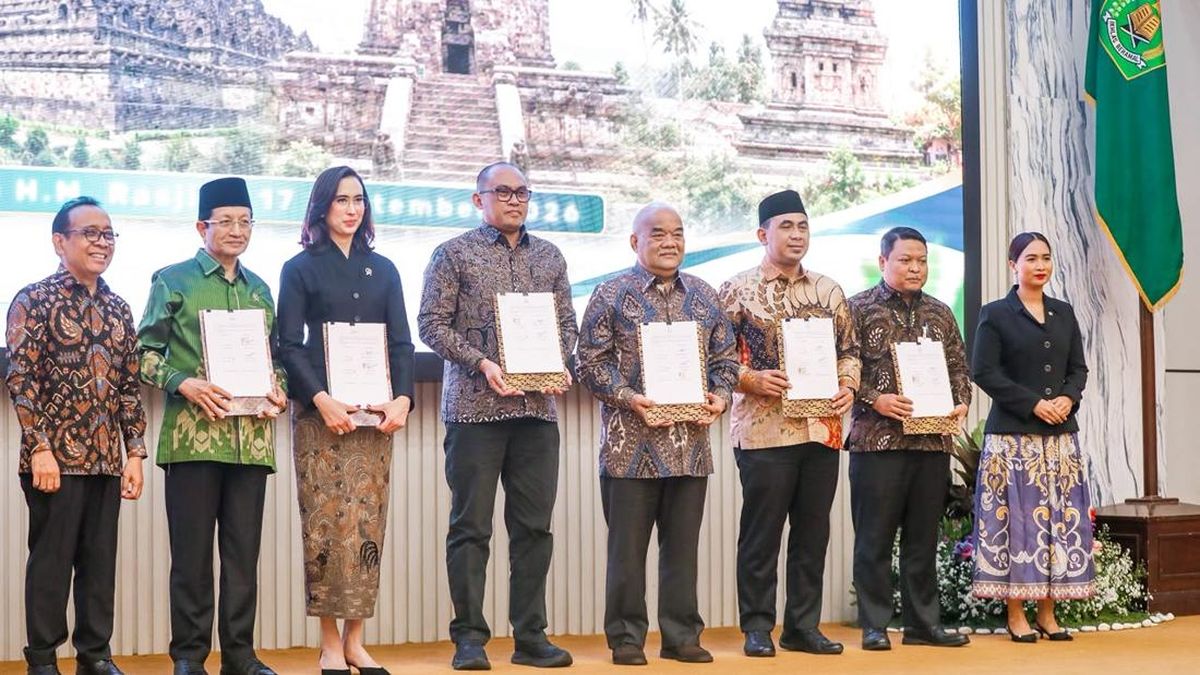
The Central Java Provincial Government fully supports the utilisation of Prambanan, Borobudur, Mendut, and Pawon temples as places of worship for Hindu and Buddhist followers. This support was formalised through the signing of a memorandum of understanding between the central government, the Central Java Provincial Government, and the Special Region of Yogyakarta (DIY) Provincial Government at the HM Rasjidi Auditorium, Ministry of Religious Affairs, Jakarta, on Thursday (17/9).
Representing Governor Ahmad Luthfi, Central Java Deputy Governor Taj Yasin Maimoen (Gus Yasin) welcomed the agreement. He stated that strengthening the religious functions of these four temples is not only important for devotees but can also enhance the appeal of religious tourism.
Gus Yasin noted that reinforcing the religious role of the temples could create different visitation patterns. Beyond being historical destinations, the temples would serve as sites for religious activities, similar to the significance of Mecca and the Vatican.
He expressed optimism that the influx of tourists and worshippers would revitalise the tourism sector and the local economy, ranging from the hotel industry to MSMEs surrounding the temple areas. Furthermore, religious activities can act as a magnet, encouraging devotees to return and spend more time in the region.
“The economy is not just about hotels, but also about the economy within MSMEs, because worship acts as its own magnet,” said Gus Yasin. Strengthening the religious function of the temples aligns with Central Java’s vision for developing sustainable tourism. Gus Yasin reminded that a key indicator of tourism success is the desire of visitors to return and stay longer.
On the same occasion, Minister of Religious Affairs Nasaruddin Umar stated that temples are more than just relics of the past; they contain spiritual, historical, and cultural values, as well as messages of civilisation that must be preserved. He explained that using the temples for religious purposes is a continuation of cooperation that began in 2022.
Under this cooperation, Prambanan Temple is designated as a place of worship for Hindus, while Borobudur, Mendut, and Pawon temples continue to be developed as worship spaces for Buddhists.
Participation in religious activities at these temple sites has shown significant growth. In 2024, the Tawur Agung Kesanga ceremony at Prambanan Temple was attended by approximately 10,000 people. Meanwhile, at Borobudur, Mendut, and Pawon temples, 24,894 participants were recorded in various Buddhist religious activities in the same year. These numbers increased in 2025, with Buddhist religious activities involving 33,556 participants, including international devotees.
Nasaruddin hopes that these four temples will not only be visitable destinations but will evolve into global spiritual centres that continue to benefit the community. He emphasised that strengthening the use of temples as religious spaces must go hand-in-hand with site preservation, order, and sustainability.