
Deputy Food Coordinator States Forestry is the Backbone of Food Security
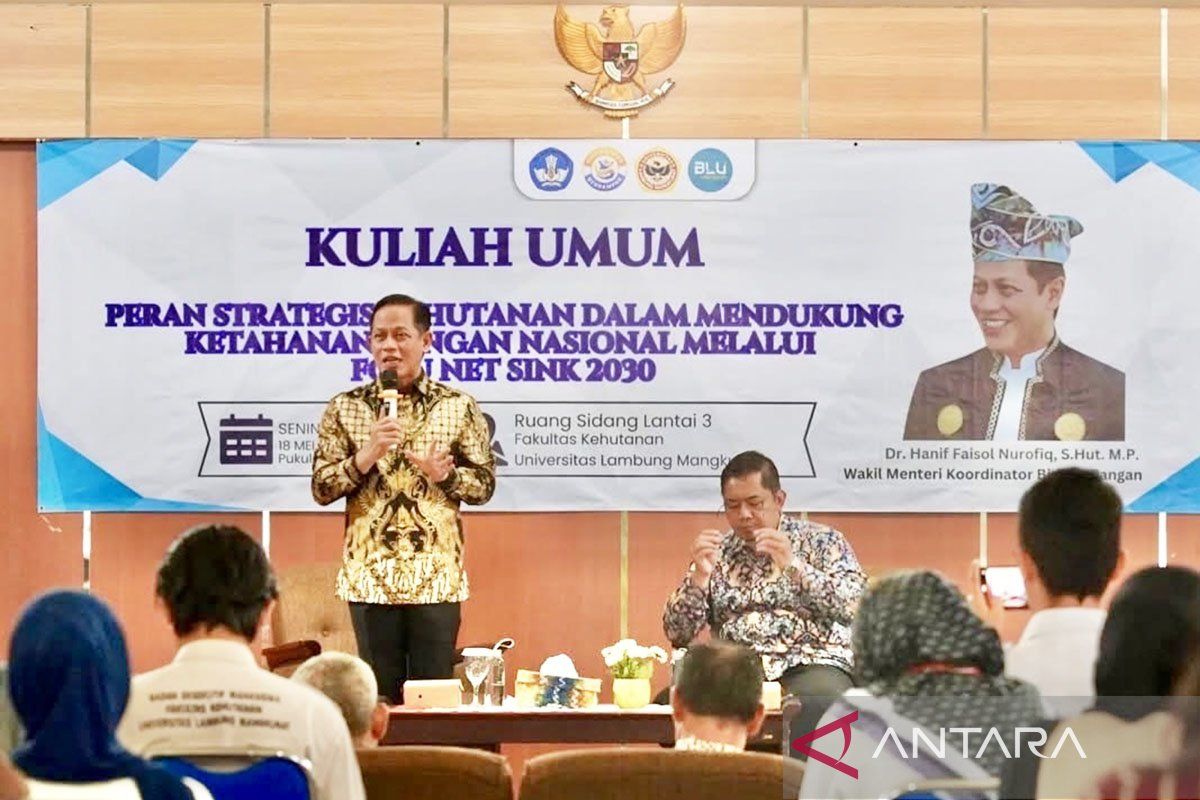
Banjarbaru (ANTARA) - The Deputy Coordinating Minister for Food, Hanif Faisol Nurofiq, stated that the forestry sector serves as a pillar of national food security, as it determines water cycle stability, soil fertility, and climate balance amidst the threats of global environmental change.
“Currently, the government is positioning the FOLU Net Sink 2030 programme not merely as a carbon emission control agenda, but also as a strategy to strengthen national food security and sovereignty through sustainable and productive forest management,” he said during a public lecture at the Faculty of Forestry, Lambung Mangkurat University (ULM) in Banjarbaru, South Kalimantan, on Monday.
He explained that forests should not be viewed merely as collections of vegetation, but rather as ecological infrastructure that maintains water cycles, protects biodiversity, preserves land fertility, and supports climate stability, all of which directly impact the sustainability of the national food system.
“The triple planetary crisis—comprising climate change, environmental degradation, and loss of biodiversity—poses a serious challenge to the food sector, as forest degradation can increase the risks of flooding, droughts, and declining agricultural productivity across various regions in Indonesia,” he added.
Hanif emphasised that the government continues to strengthen the implementation of FOLU Net Sink 2030 through forest and land rehabilitation, peatland and mangrove restoration, the development of social forestry, and food-based multi-use forestry that involves local communities near forest areas as part of the national green economy development.
He also encouraged the younger generation in forestry to strengthen innovation and research in sustainable forest management to address climate change challenges while supporting food security and the sustainability of natural resources in the future.
The Rector of ULM, Prof. Ahmad Alim Bachri, stated that food security and forestry sustainability are strategic challenges requiring collaboration between the government, universities, and the community through the strengthening of education, research, and human resource development.
According to him, the ULM Faculty of Forestry plays a crucial role in preparing human resources that are adaptive to climate change and sustainable natural resource management to meet the development challenges of the forestry and food sectors in the future.
Meanwhile, the Head of the South Kalimantan Forestry Service, Fathimatuzzahra, noted that the material presented by the Deputy Food Minister during the public lecture aligns with the implementation of the FOLU Net Sink 2030 programme carried out by the local provincial government through various forest management activities across several Forest Management Units in South Kalimantan.
“The programme includes forest and land rehabilitation, planting and maintenance of trees, facilitation for Forest Farmer Groups, as well as monitoring and evaluating FOLU activities to maintain the ecological functions of the area while simultaneously strengthening food security and the sustainable welfare of communities living around the forests,” she said.
Source: jawawa.id (https://jawawa.id/newsitem/deputy-food-coordinator-states-forestry-is-the-backbone-of-food-security-1780901129)
Originally published by Antara (Indonesian) (https://www.antaranews.com/berita/5572048/wamenko-pangan-sebut-kehutanan-penopang-ketahanan-pangan), translated from Indonesian