
Deputy Finance Minister Outlines 2027 State Budget Strategy, Maintaining Deficit at 2.4%
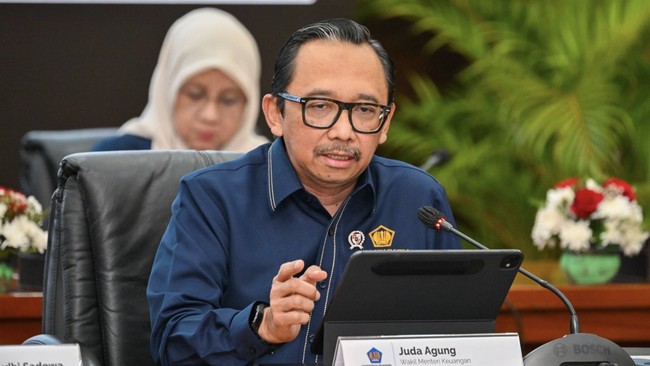
Jakarta, CNBC Indonesia - Deputy Finance Minister Juda Agung has presented the policy direction for the 2027 State Budget (APBN), which is designed to remain expansive yet measured to support higher economic growth targets.
During the 2026 Ministry of Finance Media Gathering in Bogor on Thursday (1/10/2026), Juda stated that the 2027 APBN carries the theme ‘Grow Higher, Prosper Faster’ with three primary functions: driving economic growth, protecting the community, and accelerating economic transformation.
“The 2027 APBN carries the theme ‘Grow Higher, Prosper Faster’. This will be driven by the APBN as a source of growth, with the aim that the budget can grow, protect the disadvantaged, and transform the economy, certainly within a prudent fiscal corridor,” said Juda.
According to him, the ‘to grow’ function means the APBN must be able to stimulate economic activity and investment, as well as support various government priority development agendas. Meanwhile, the ‘to protect’ function is directed towards maintaining public purchasing power, strengthening social protection, and supporting the economic empowerment of vulnerable groups.
As for the ‘to transform’ function, it will be realised through strengthening the foundations of long-term growth, including investment, downstreaming, and industrialisation.
“To transform means the APBN must be able to strengthen the foundations of long-term growth through investment and the development of downstreaming and industrialisation,” he added.
Taxation to SIMBARA as Key Pillars
To support state expenditure needs, the government is preparing various strategies for sustainable increases in state revenue.
In the taxation sector, the government will expand the tax base through the use of data and technology, optimisation of the Coretax system, strengthening the Compliance Risk Management Integrated Risk Engine, increasing supervision of strategic and high-risk taxpayers, and tax law enforcement.
From the customs and excise perspective, the government will strengthen the eradication of illegal excisable goods, optimise excise rates for tobacco products and import duties on certain commodities, expand the export duty revenue base, and strengthen the facilitation of exports and industrial downstreaming.
For Non-Tax State Revenue (PNBP), the government relies on optimising natural resource (SDA) revenue through improved governance and the strengthening of the Inter-Ministerial/Agency Mineral and Coal Information System (SIMBARA).
“We will also improve the quality of PNBP services through standardisation, innovation, digitalisation, and service simplification, as well as ensuring increased compliance through strengthened supervision and law enforcement,” said Juda.
Deficit Maintained at 2.4% of GDP
Regarding financing, the government and Parliament have agreed on a 2027 APBN deficit of 2.4% of Gross Domestic Product (GDP).
Juda emphasised that the financing strategy will rely more heavily on domestic sources to reduce vulnerability to global market fluctuations.
“The main strategy is to remain predominantly focused on domestic financing, which is relatively less vulnerable to global volatility,” he said.
He cited as an example that the proportion of foreign ownership in State Securities (SBN) is now only around 13%-14%, significantly lower than approximately 40% a decade ago.
According to Juda, this condition makes the Indonesian financial market more resilient to external pressures, including exchange rate volatility and capital flows.
In addition to relying on the domestic market, the government will also optimise the roles of Danantara, Special Mission Vehicles (SMV), Public Service Agencies (BLU), and the Sovereign Wealth Fund to support development financing.
Furthermore, the government will utilise the Excess Budget Balance (SAL) as a fiscal buffer to face ongoing high global uncertainty.
Juda emphasised that disciplined fiscal management remains the primary foundation of the 2027 APBN. He noted that the experience of various countries shows that excessively high deficits and debt have the potential to increase borrowing costs and disrupt economic growth sustainability.
“We have learned a lot from countries with high debt and high deficits. Their growth is not sustainable, their yields are higher, and their debt costs are more expensive. Therefore, discipline is crucial in fiscal management, and trust is heavily influenced by our discipline,” he asserted.
Source: jawawa.id (https://jawawa.id/newsitem/deputy-finance-minister-outlines-2027-state-budget-strategy-maintaining-deficit-at-2-4-1790866354)
Originally published by CNBC Indonesia (https://www.cnbcindonesia.com/news/20261001183047-4-772652/wamenkeu-juda-beberkan-jurus-apbn-2027-defisit-dijaga-24), translated from Indonesian