
Deputy Finance Minister Juda Outlines Indonesia’s Economic Journey Before Nobel Laureate
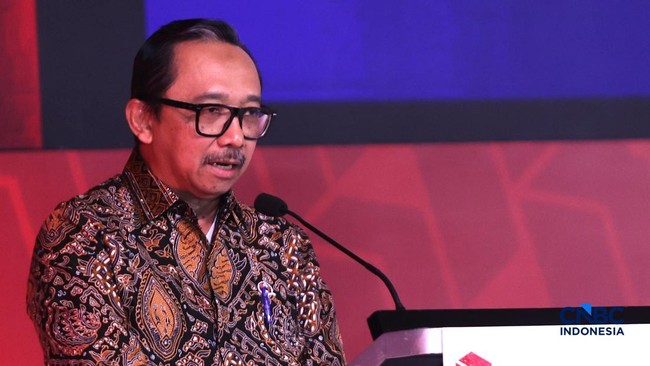
Jakarta, CNBC Indonesia — Deputy Finance Minister Juda Agung has recounted Indonesia’s experience of successive economic crises over nearly three decades, from the 1997–98 Asian financial crisis and the 2008 global financial crisis to the market turmoil caused by the 2013 taper tantrum, the Covid-19 pandemic and current geopolitical uncertainty.
Juda spoke before 2024 Nobel Prize in Economic Sciences laureate James A. Robinson. He said the crises Indonesia had weathered offered important lessons about the role of institutions in sustaining resilience and promoting economic progress.
Juda cited Robinson’s central message that institutions are decisive in determining a nation’s prosperity. Natural-resource wealth alone cannot make a country prosperous without strong institutions, good governance and sufficient opportunities for people to pursue businesses and innovate.
“Looking at our journey in recent years since the Asian crisis, the foundations that were laid have made Indonesia more resilient in facing various shocks, from the 2008 global financial crisis and the 2013 taper tantrum to the 2019 pandemic and the various geopolitical uncertainties we face today,” Juda said in his presentation.
According to Juda, the 1997–98 crisis was a turning point that prompted Indonesia to strengthen its economic institutions and improve governance. Since the reform era, the country has introduced a range of changes, including strengthening democracy and decentralisation, improving transparency and discipline in public financial management, and clarifying the relationship between fiscal and monetary policy.
Indonesia has also reinforced the central bank’s independence, adopted fiscal rules on the budget deficit and government debt ratio, and established the Financial Services Authority (OJK) and the Deposit Insurance Corporation (LPS) to strengthen financial-sector supervision and safety nets.
These reforms have laid the foundations for Indonesia to withstand economic pressures. Juda cautioned, however, that the country still had work to do.
“Our journey is certainly not over,” Juda said.
He stressed that Indonesia’s current challenge is not simply to build strong institutions, but to turn those institutional foundations into an engine of faster, more productive and inclusive growth.
Juda said Indonesia’s economy grew by 5.45% in the first half of 2026, while investment rose by around 7%. Although these figures demonstrate resilience, he said, they are not enough to make Indonesia a high-income country.
In his view, Indonesia needs stronger economic growth, greater investment, enhanced industrial capabilities and the creation of quality jobs.
Demographic challenge
One urgent challenge is to capitalise on the demographic dividend, which is expected to remain available for the next 10–15 years. A large working-age population will be an advantage only if supported by education, skills, healthcare and adequate employment. Juda warned that the opportunity could be missed if job creation fails to keep pace with growth in the labour force and productivity gains remain slow. After 2040, the dependency ratio is expected to rise, increasing the burden on the working-age population.
Indonesia also needs to move beyond a growth model that remains reliant on natural resources, domestic consumption and low-value-added economic activity. Juda said more complex industries, innovative companies and modern services are key to improving the economy’s competitiveness.
He cited Indonesia’s economic complexity ranking of 69th out of 140 countries, behind Malaysia, Thailand and India.
Indonesia therefore needs to shift from simply exporting natural resources towards mastering processing technologies, producing higher-value-added goods and becoming more deeply integrated into global value chains.
Juda emphasised that this transformation requires collaboration between the government and the private sector. The government’s role is to provide the foundations through education, healthcare, infrastructure, food, energy and social protection, while the private sector is expected to drive investment, innovation and efficiency.
Fiscal discipline remains important for maintaining economic credibility and the government’s capacity to respond to shocks. Juda said the state budget cannot finance all development needs, so fiscal policy must prioritise productive spending while creating room for private investment.
Source: jawawa.id (https://jawawa.id/newsitem/deputy-finance-minister-juda-outlines-indonesias-economic-journey-before-nobel-laureate-1791877862)
Originally published by CNBC Indonesia (https://www.cnbcindonesia.com/news/20261013115624-4-775690/di-depan-peraih-nobel-wamenkeu-juda-bongkar-perjalanan-ekonomi-ri), translated from Indonesian