
Deputy Finance Minister Attends G20 Forum, Highlighting Global Uncertainty and AI
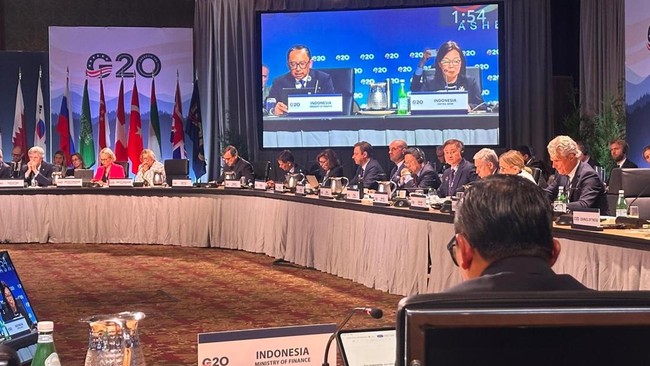
Indonesian Deputy Finance Minister Juda Agung, representing the Minister of Finance, led the Indonesian delegation at the second G20 Finance Ministers and Central Bank Governors Meeting (FMCBG) held in Asheville, North Carolina, USA, from 31 August to 1 September 2026.
During the forum, Indonesia advocated for a pro-growth reform agenda in response to increasing global economic uncertainty, which remains shadowed by geopolitical conflicts, trade tensions, supply chain disruptions, and high levels of global debt. Under the US Presidency, this year’s G20 meeting focused on strengthening economic growth through structural reforms, increased productivity, and the utilisation of new technologies, including Artificial Intelligence (AI).
While G20 members assessed the global economy as remaining relatively resilient against various shocks, future growth prospects still face significant challenges. In this context, Juda asserted that structural reform is key to maintaining economic growth momentum.
“Pro-growth reforms need to be directed towards reducing barriers to business activities and investment, strengthening international cooperation, and encouraging innovation and the use of technology as new sources of growth,” Juda stated during the meeting.
In the forum, Juda also outlined several reform measures implemented by Indonesia to strengthen national economic resilience. He noted that the government continues to simplify regulations to create a more conducive investment climate. Furthermore, the strengthening of the financial sector is being pursued through the implementation of the Law on the Development and Strengthening of the Financial Sector (UU P2SK).
The government also continues to drive economic transformation through natural resource downstreaming programmes and the development of high-value-added industries. Additionally, the State-Owned Enterprises (SOE) sector is a focus of improvement through enhanced governance, institutional restructuring, and increased efficiency and competitiveness.
Juda assessed that the use of AI and new technologies has the potential to become a new engine for economic growth. However, its utilisation must be accompanied by the strengthening of infrastructure, human resource quality, and an adequate digital ecosystem.
Notably, for the first time in the history of the FMCBG forum, the G20 held direct dialogues with business players from the healthcare, manufacturing, and financial services sectors. These dialogues were organised to gather input regarding various investment barriers, productivity, and the challenges of utilising AI in the business world.
According to Juda, private sector involvement is crucial to ensure that the economic reform agenda does not stop at the policy level but is translated into investment, job creation, and improved public welfare.
Beyond growth issues, the G20 forum also discussed global economic imbalances, which are considered potential hindrances to sustainable global economic growth. In these discussions, Indonesia emphasised the importance of international institutions in monitoring global imbalances and providing policy recommendations that consider the specific conditions of each nation.
Juda noted that responses to global imbalances cannot be uniform, as every country possesses different economic structures and characteristics.
In the digital finance sector, Indonesia also highlighted the increasing threat of digital fraud, scams, and various forms of increasingly complex cross-border financial crimes. Juda remarked that while digitalisation expands public access to financial services, it simultaneously increases the risks of fraud and cybercrime.
Consequently, Indonesia is pushing for the strengthening of financial literacy alongside consumer protection. Juda explained that Indonesia has established cross-institutional coordination to improve financial literacy and formed an Anti-Scam Centre to strengthen the handling of fraud cases in the financial sector.
“The development of digitalisation needs to be balanced with the strengthening of literacy and consumer protection. Given that fraud and scams are becoming more complex and cross-border in nature, stronger international cooperation, information exchange, and coordination between countries are required,” he emphasised.
Juda stated that global synergy must also be strengthened through collaboration between the G20 and the Financial Action Task Force (FATF) to maintain the integrity of the global financial system and increase the effectiveness of preventing financial crimes.
Through the G20 forum, Indonesia reaffirmed its commitment to driving an agenda of inclusive economic growth, structural reform, technological innovation, and financial system stability, ensuring that the benefits of economic transformation are widely felt by the community.
Source: jawawa.id (https://jawawa.id/newsitem/deputy-finance-minister-attends-g20-forum-highlighting-global-uncertainty-and-ai-1788332414)
Originally published by CNBC Indonesia (https://www.cnbcindonesia.com/news/20260902130113-4-764336/wamenkeu-hadiri-forum-g20-soroti-ketidakpastian-global-hingga-ai), translated from Indonesian