
Deputy Coordinating Minister for Economic Affairs Sets Out Four Conditions for Indonesia to Achieve 6% Growth in 2027
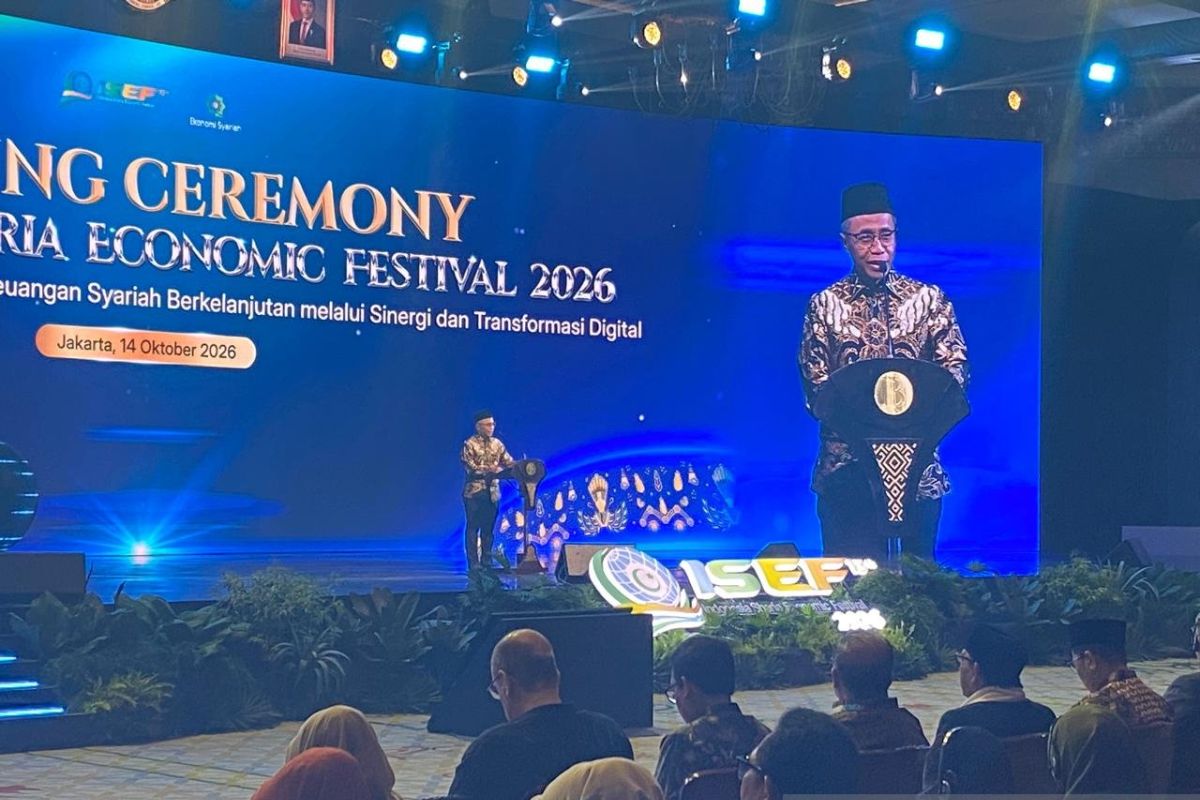
“The economy cannot be driven by the government alone or the private sector alone. The government and private sector have to work together.”
Jakarta (ANTARA) – Deputy Coordinating Minister for Economic Affairs Dradjad Hari Wibowo has outlined four conditions for achieving a 6% economic growth target in 2027 and moving towards 8% over the medium term.
The conditions are investment growth that outpaces gross domestic product (GDP), higher productivity, increased exports of value-added goods supported by more efficient logistics, and the development of the sharia economy as part of efforts to strengthen national competitiveness.
Speaking at the opening of the 2026 Indonesia Sharia Economic Festival (ISEF) in Jakarta on Wednesday, Dradjad said investment needed to grow faster than GDP and be channelled into high-value-added projects. Achieving this would require collaboration between the government and the private sector.
“On several occasions, speaking on behalf of the Coordinating Minister for Economic Affairs, I have said that the economy cannot be driven by the government alone or the private sector alone. The government and private sector have to work together,” he said.
Dradjad added that the government would intensify efforts to remove bottlenecks through deregulation and debureaucratisation so that the private sector could operate more quickly.
The development of the sharia economy, meanwhile, was seen as a key means of driving growth and strengthening national competitiveness. The sector has significant potential, with global Muslim consumer spending projected to reach nearly US$3.6 trillion by 2029 and global sharia financial assets estimated at US$9.72 trillion.
The government is pursuing five strategic directions to develop the sharia economy: strengthening the halal industry and halal micro, small and medium-sized enterprises (MSMEs); increasing exports and international cooperation; reinforcing the halal ecosystem; developing sharia finance; and strengthening sharia social funds.
On the halal industry and MSMEs, Dradjad highlighted the potential of ultra-micro businesses, which should be supported to grow within the halal ecosystem. He also said international cooperation was important if Indonesia was to compete in global markets.
The government is seeking to widen market access for halal products through the Indonesia-European Union Comprehensive Economic Partnership Agreement (IEU-CEPA) and the Indonesia-United Arab Emirates Comprehensive Economic Partnership Agreement (IUAE-CEPA), both of which have taken effect, as well as negotiations with the Gulf Cooperation Council (GCC), Türkiye, Pakistan, Bangladesh and Tunisia.
Strengthening the halal ecosystem is needed across all levels of industry, alongside the development of sharia finance with support from stakeholders including Bank Indonesia (BI) and the Financial Services Authority (OJK).
Dradjad said the halal industry had become one of the drivers of the national economy. The halal value chain contributed nearly 25% of GDP, or around Rp1,524 trillion, in the fourth quarter of 2025. Exports of halal products rose 23% over 2025 to US$63.4 billion.
The national halal ecosystem is also expanding. Indonesia has issued 4.4 million halal certificates covering 14.6 million products, he said.
A total of 39 partner countries recognise Indonesian halal certification through mutual recognition agreements (MRAs), while Indonesia has four halal industrial estates and special economic zones (KEKs).
Globally, Indonesia ranked second in Muslim-friendly tourism in the 2026 Global Muslim Travel Index (GMTI) and first in the Muslim fashion sector.
The government nevertheless acknowledged that improving sharia financial literacy and inclusion remained a challenge. The 2026 National Survey of Financial Literacy and Inclusion (SNLIK) put sharia financial literacy at 43.07%, while inclusion stood at just 13.24%.
“We still have work to do, colleagues at OJK and BI, because sharia financial inclusion and literacy remain challenges,” Dradjad said.
Overall, Dradjad said the sharia economy should not be viewed solely through the lens of religious values, but also as embodying the universal principle of fair trade.
By ensuring supply chains adhere to the principles of halalan thayyiban—what is permissible and wholesome—the sharia economy is expected to promote fair trade for all parties.
Source: jawawa.id (https://jawawa.id/newsitem/deputy-coordinating-minister-for-economic-affairs-sets-out-four-conditions-for-indonesia-to-achieve-6-growth-1791964295)
Originally published by Antara (Indonesian) (https://www.antaranews.com/berita/5785365/wamenko-ekonomi-ungkap-4-syarat-ekonomi-ri-2027-bisa-tumbuh-6-persen), translated from Indonesian