
Deputy Agriculture Minister Calls for Stronger Food Exports to Improve Farmers’ Welfare
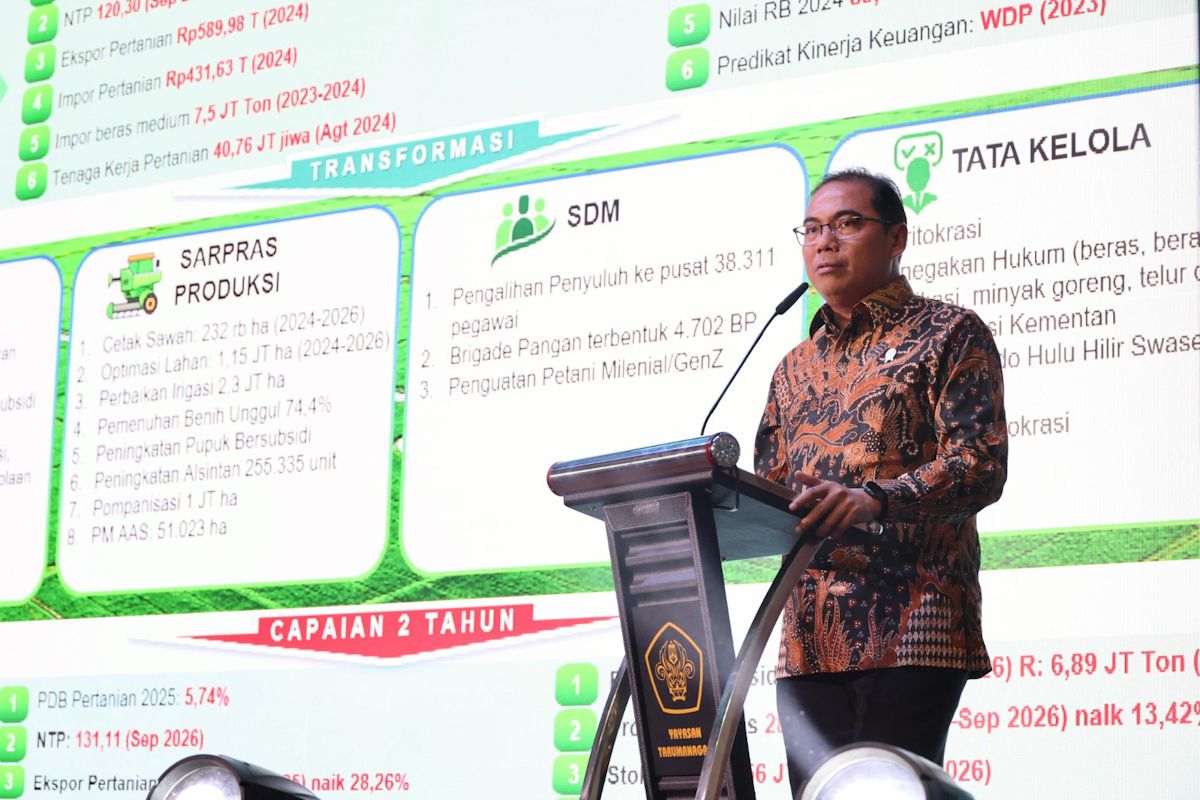
Jakarta (ANTARA) – Deputy Agriculture Minister Alim Setiawan Slamet has called for stronger food exports through improved quality, downstream processing and fair trading practices, so farmers can gain added value and lasting welfare.
He said stronger food exports should not only increase national trade but also deliver tangible benefits to farmers.
“Export growth must be accompanied by stronger production quality, support for farmers and trading practices that ensure farmers receive added value from their work,” Alim said in Jakarta on Thursday.
He made the remarks at the Special Event marking two years of the Prabowo-Gibran administration, entitled A Report for the People, in Jakarta.
Alim said increased exports were one of the agricultural sector’s positive achievements and should be sustained. However, that success must be accompanied by efforts to ensure that the sector’s principal participants, particularly farmers, also benefit from access to wider markets.
“Exports must have a tangible impact on farmers’ incomes. Farmers therefore need support to improve product quality and meet the standards required by export markets,” he said.
He said the expansion of export markets must go hand in hand with stronger production from upstream to downstream. Higher-quality agricultural produce, reliable supply, compliance with quality standards and product processing are all important to ensuring that Indonesian commodities can compete internationally.
“Farmers should receive a commensurate share of the benefits of the Government’s efforts to increase export volumes. Production must therefore be strengthened alongside downstream processing, so agricultural commodities gain added value and can compete in global markets,” he added.
Downstream processing is also needed to increase the value of commodities. By developing processed products and improving the quality of production, farmers could gain greater economic benefits than by selling raw products alone.
Alim said the Government would continue to support farmers in improving production quality and meeting market requirements.
These efforts are expected to open up wider marketing opportunities while strengthening farmers’ position in agricultural supply chains.
At the same time, Alim said, higher production and exports must be supported by sound trading practices.
He highlighted price anomalies in several commodities, where abundant supplies coincide with falling prices for farmers, while consumers may still face rising prices.
“An anomaly occurs when farmers produce a plentiful harvest but prices at the farm gate fall, while consumer prices remain high. This points to problems in trading practices that we must address together,” Alim said.
The situation shows that increasing production alone is not enough to guarantee farmers’ welfare.
Distribution and trade oversight must be strengthened to make supply chains more efficient, narrow price gaps and ensure that economic benefits are not concentrated among certain links in the trading chain.
The Government is continuing to address irregularities in food trading practices in coordination with relevant parties, including law-enforcement agencies, he said. Such oversight is important to maintain fair trade and protect the interests of both farmers and consumers.
Alongside expanding export markets, the Government must also ensure that domestic food needs are met.
Balancing domestic demand with the development of international markets is essential to sustaining production and strengthening Indonesia’s position in food trade.
“Hard work in the agricultural sector must deliver the best possible results. With commitment, collaboration and the right policies, we hope to strengthen production, grow exports and continue improving farmers’ welfare,” Alim said.