
Deputy Agriculture Minister Alim accelerates downstream processing to boost plantation competitiveness
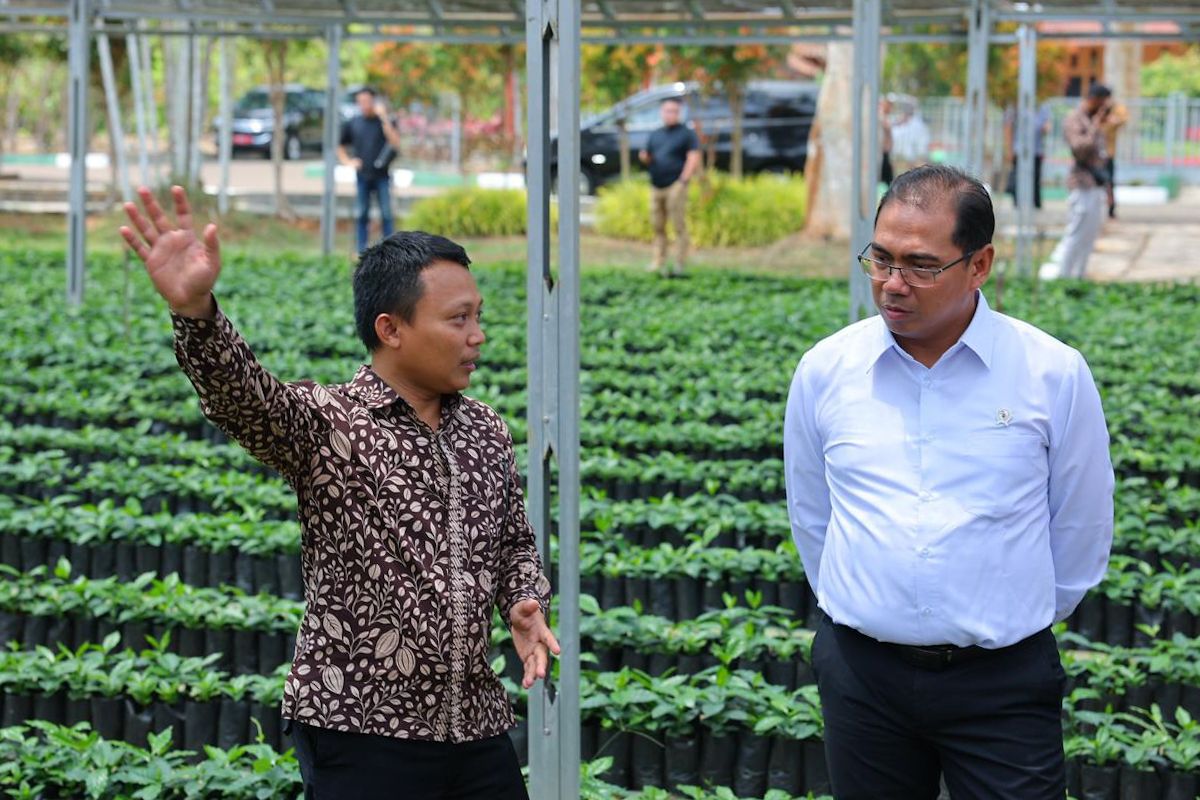
To achieve this, the Ministry of Agriculture is strengthening collaboration among research centres, universities and industry, including in the development of coffee and cocoa commodities.
Jakarta (ANTARA) - Deputy Agriculture Minister Alim Setiawan Slamet is stepping up downstream processing in the plantation sector to improve its competitiveness by using research and innovation to create value-added products capable of competing in global markets.
“The Ministry of Agriculture is strengthening collaboration among research centres, universities and industry, including in the development of coffee and cocoa commodities,” Alim said in Jakarta on Friday.
Alim made a working visit to the Industrial and Refreshment Crops Research and Testing Centre (BRMP TRI) in Sukabumi, West Java.
He said the visit was intended to assess first-hand the potential of the centre’s facilities, land and innovations that could be developed to support national strategic programmes, particularly the expansion of downstream processing for agricultural products.
He said he had been tasked with accelerating development by making use of research and crop-breeding results so they could more quickly produce innovations ready for application.
In his view, speeding up this process requires closer collaboration with universities and other relevant institutions, enabling innovations to be adopted promptly as advanced technologies that support downstream processing in the plantation sector and improve competitiveness.
“We need to encourage closer collaboration, particularly with universities and relevant institutions, so that the innovations produced can be adopted more quickly as advanced technologies,” Alim said.
He said innovations developed by BRMP TRI needed to be linked to industry requirements so their benefits could reach a wider audience.
“Collaboration is key to accelerating the adoption of technology while increasing the value added of plantation commodities,” he said.
He said commodities such as coffee and cocoa had considerable potential for development through technological innovation and stronger partnerships. Existing research therefore needed to be connected with technical requirements and business opportunities.
“The potential is enormous. The task now is to connect these innovations with technical needs and the right partners,” he said.
Alim added that the facilities and land belonging to BRMP TRI also needed to be used to their full potential. These state assets could be put to more productive use through partnerships, including for technology development, education, training and human-resource capacity building.
“We need to invite more partners to use the facilities and land available. We will map the needs, identify partners, and I am ready to help bring them together so that this collaboration can proceed,” he said.
He also urged the centre to replicate successful partnership models at other centres under the Ministry of Agriculture. This would enable innovations across a range of commodities to be developed in a more focused and integrated way.
The ministry has several centres working on strategic commodities, from industrial and refreshment crops, oil palm and sugar cane to spices and medicinal plants, food crops and horticulture. Their potential could be optimised through consortia and collaboration across institutions.
“If this collaboration model succeeds, I think we can develop it in parallel at other centres. We already have a consortium involving several universities and partners, and we will continue it,” Alim said.
The visit also discussed the potential for developing bioenergy technologies alongside downstream processing of commodities.
He said the development of feedstocks such as coconut, coffee and cassava needed to be followed by improvements in quality and technological efficiency.
Other potential feedstocks could also be studied, taking into account technological feasibility and availability.
He stressed that bioenergy development must be carried out carefully so that it does not disrupt food supplies. The choice of feedstocks and technologies must therefore take account of efficiency, sustainability and the balance of competing needs.
Through stronger downstream processing, Alim hopes research and innovation in the plantation sector can be taken up more quickly by businesses, generate value-added products and improve the competitiveness of Indonesian commodities.
Co-operation among research centres, universities, local governments and industry will be fundamental to making agricultural innovation a driver of productivity and economic growth in the plantation sector.
Source: jawawa.id (https://jawawa.id/newsitem/deputy-agriculture-minister-alim-accelerates-downstream-processing-to-boost-plantation-competitiveness-1792763483)
Originally published by Antara (Indonesian) (https://www.antaranews.com/berita/5808039/wamentan-alim-pacu-hilirisasi-dongkrak-daya-saing-perkebunan), translated from Indonesian