
Depok Government Normalises Pesanggrahan River to Tackle Flooding
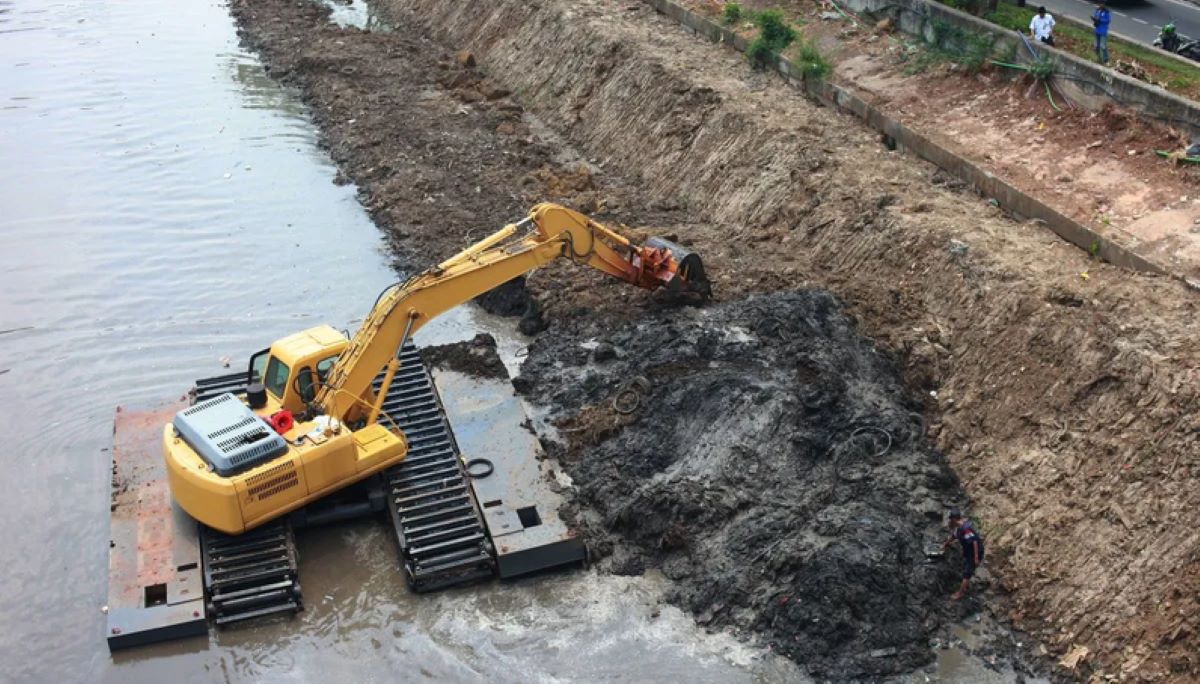
The Depok City Government, through its Public Works and Spatial Planning Agency (Dinas PUPR), has moved swiftly to widen and normalise the Pesanggrahan River. This strategic measure is a primary effort to control flooding that frequently affects several areas in Depok.
“The PUPR Agency is widening the river starting from Jalan Benda Barat, Kampung Benda Barat, Cipayung Village, up to the connecting bridge between Bulak Barat and Pasir Putih Village in Sawangan District,” said Bahtiar Ardiansyah, Head of the Water Resources Development and Rehabilitation Section at the Depok PUPR Agency, on Tuesday (21/7).
Bahtiar explained that the Pesanggrahan River widening and normalisation programme involves 154 Water Task Force personnel. “In addition to involving the Water Task Force, the PUPR Agency is using a PC 200 Long Arm Excavator to dredge mud and rubbish,” he stated.
He detailed that a landslide from a 30-metre high mountain of waste at the Cipayung Final Disposal Site (TPA) in Depok had drastically narrowed and shallowed the Pesanggrahan River’s flow. “The river’s width beneath the TPA shrank to about 1 metre and became blocked by waste accumulation, triggering severe flooding and inundation in the surrounding areas,” he said.
According to Bahtiar, the impact of this narrowed river flow is heavily felt in the border areas of Cipayung and Sawangan Districts, such as Bulak Barat and Kampung Benda, where overflowing water turns into a lake and residents are affected. “This situation has compelled the PUPR Agency to carry out the widening and normalisation of the Pesanggrahan River,” he stated.
In the coming days, the Water Task Force is confirmed to work at maximum capacity to widen and deepen the bottlenecked section of the Pesanggrahan River. The aim is to increase the water retention capacity, prevent overflow into residential areas during high rainfall, and restore the river’s ecological function.
Flooding in the western part of Depok City is classified as prone to inundation when rain falls. The Pesanggrahan River flow itself passes through several crucial points. These conditions are generally caused by high rainfall and the overflowing of the Pesanggrahan River Basin (DAS). “The western part of Depok City often overflows when receiving water flow from upstream areas like Bogor,” he added.
Bahtiar continued that flooding in western Depok is further exacerbated by massive housing development, which reduces the area of water absorption zones. “Massive development causes rainwater runoff to directly burden drains and rivers, where some housing estates or settlements are built in lowlands or former swamps that are naturally prone to inundation,” concluded Bahtiar.