
DEN estimates economic growth between 5.2-5.4 per cent this year
Jakarta (ANTARA) - The National Economic Council (DEN) estimates that Indonesia’s economic growth this year will range between 5.2 per cent and 5.4 per cent, amidst the pressures of a global economic slowdown and domestic challenges.
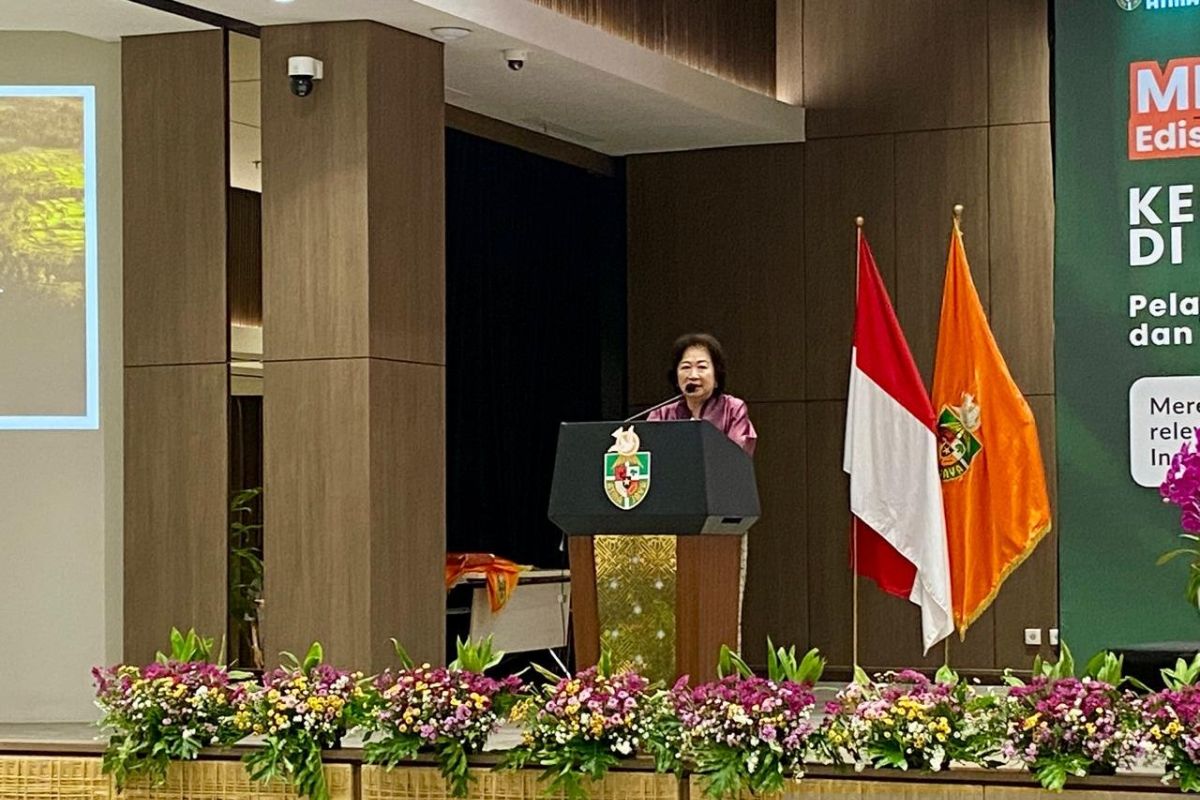
During a Memorial Lecture at Atma Jaya Catholic University in Jakarta on Thursday, DEN Vice Chair Mari Elka Pangestu explained that both the global and Indonesian economies are expected to slow down in the short term. Although economic growth in the first and second quarters remained relatively high, growth in the third and fourth quarters is expected to decline.
“Our average growth, according to IMF estimates, is 5 per cent, but the government’s own prediction is 5.6 per cent. Whether the growth reaches 5.6 per cent, 5 per cent, or somewhere in between will likely be the outlook for this year,” said Mari.
In her speech, she also reflected on the experience and intellectual legacy of Frans Seda, who served as Finance Minister during the difficult period of 1966-1968. During that time, Frans Seda faced crises with political courage, introducing fiscal discipline and creating new fiscal space to drive economic growth.
Mari reminded that the challenges facing Indonesia next year, compounded by the El Niño and La Niña conditions, will become increasingly difficult without appropriate policies, drawing lessons from the fiscal principles applied by Frans Seda.
“Without the right policies—policy space taken based on the principles developed by Mr Frans Seda—next year may become even more difficult, especially as we face El Niño and La Niella,” said Mari.
Furthermore, she explained that Indonesia is currently facing several simultaneous challenges. From an external perspective, global economic uncertainty is influenced by United States tariff policies, US-China tensions, and rising oil prices due to the Hormuz Strait crisis. These conditions have the potential to impact Indonesia’s economy and fiscal position.
Domestically, challenges include increasing competitiveness, regional inequality, and the creation of decent employment. According to Mari, the demographic bonus, which serves as potential economic growth, could become an issue if not accompanied by job creation and adequate income.
Nevertheless, Mari views these challenges as also presenting economic opportunities, particularly through the green energy transition and the development of Artificial Intelligence (AI) technology.
From a fiscal perspective, she noted that rising oil prices and a low tax ratio will increase pressure on the budget, particularly through increased energy subsidies. This condition ultimately narrows the fiscal space available to serve as a buffer against various economic shocks.
Mari reminded the government that it needs to manage fiscal space while maintaining debt sustainability. In this regard, debt remains necessary to finance deficits, but its use must be directed towards supporting recovery and maintaining fiscal sustainability.
Regarding revenue, she assessed that increasing the tax-to-GDP ratio is also vital to expanding fiscal space. She noted that fiscal space cannot expand without increased revenue. Therefore, the government needs to improve tax compliance through the role of the Coretax system and expand the tax base.
On the expenditure side, efficiency and spending priorities must be achieved through spending reviews and government digitalisation. Fuel subsidy reform is also necessary so that subsidies are more targeted, allowing savings to be redirected to other needs such as health, education, and infrastructure.
Regarding monetary policy, with global interest rates rising due to inflationary pressures, she warned that the room for domestic interest rate cuts to encourage growth and investment is also limited. Therefore, Mari emphasised that the impetus for growth must come from structural policy changes.
“Thus, monetary policy will not be able to significantly assist growth and investment. It must come from structural policy changes,” said Mari.