
Demographic Bonus and AI Pose Challenges; Regions Urged to Strengthen Human Resource Development
Indonesia’s large workforce does not automatically translate into a developmental advantage. Amidst the demographic bonus and shifts in the global labour market due to Artificial Intelligence (AI), regional governments are deemed to need a more significant role in ensuring the population possesses the necessary skills, character, and access to quality employment.
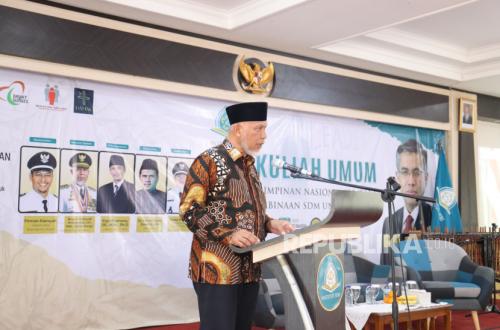
The Governor of West Sumatra, Mahyeldi Ansharullah, stated that development cannot rely solely on economic growth, infrastructure, investment, or technological advancement. The quality of human capital, capable of directing and utilising these instruments, is a crucial factor in determining developmental success.
“The nation’s future is not won by technology alone, but by humans who are capable of providing it with direction,” Mahyeldi said during a public lecture and book launch at the SEBI Institute on Monday (31/8/2026).
According to him, the large number of productive-age residents represents both an opportunity and a challenge. Without relevant education, healthcare services, character building, lifelong learning, and quality job opportunities, the demographic bonus could potentially transform into social and economic issues.
Data from the Central Bureau of Statistics (B/BPS) shows that as of May 2026, Indonesia’s labour force reached 155.41 million people. Of this number, 148.19 million are employed, while the Open Unemployment Rate was recorded at 4.65 per cent.
Mahyeldi believes these figures must be translated into more concrete policies, particularly in enhancing labour skills, aligning education with business needs, strengthening digital and AI literacy, and creating space for the younger generation to participate in solving societal problems.
He noted that regional governments hold a strategic position because they interact directly with the community, schools, universities, the business world, and village-level administrations. This proximity allows regions to bridge various ecosystems for human resource development.
“National leadership is ultimately built from the regions. Regions must be the birthplace of individuals who are competent, characterised, brave enough to take responsibility, and capable of working for the greater good,” he said.
The challenge of human resource development is becoming increasingly complex alongside changing labour market needs due to AI advancements. Referring to the Future of Jobs Report 2025, approximately 39 per cent of core worker skills are expected to change by 2030.
Meanwhile, a study by the International Labour Organization (ILO) shows that about one in four workers globally is in a job with a certain level of exposure to generative AI.
Mahyeldi stated that exposure to AI does not necessarily mean job losses. The more pressing issue is the change in tasks and the competencies required of workers.
Therefore, the community needs to be prepared to continuously learn and upskill. Adaptability becomes essential as labour market requirements evolve alongside technological progress.
To face these changes, Mahyelting proposed a ‘4I’ approach: Faith (Iman), Knowledge (Ilmu), Integrity, and Innovation. He argued that technological development still requires human direction and responsibility.
Knowledge is required so that technology is used based on proper understanding, while integrity is needed to maintain honesty, data protection, accountability, and trust. Innovation is necessary so that advancements in knowledge and technology produce beneficial solutions for society.
Mahyeldi also assessed that human resource development should not stop at training and certification. Development is considered successful if knowledge and skills can be translated into the ability to solve real-world problems.
He proposed a ‘5T’ approach for developing the younger generation: identifying potential and obstacles, forging character and resilience, increasing competence (including digital and AI), fostering networks and creative spaces, and assigning the youth to lead the resolution of real problems.
This approach, according to Mahyeldi, requires the involvement of various parties, ranging from families, schools, and universities to mosques, villages, the business world, the community, and the government.
He also reminded that the success of a leader is not measured solely by the extent of their authority or the number of people under their command. Another measure is the ability to prepare the next generation to take up responsibility.
“The best leader does not make everyone dependent on them; they prepare as many people as possible to lead with integrity,” he said.
Mahyeldi stated that regional development conditions must be read through both data and remaining challenges. The economy of West Sumatra grew by 4.54 per cent year-on-year in the second quarter of 2026, while economic growth for the first half of 2026 reached 4.77 per cent.
However, as of March 2026, the poverty rate in West Sumatra remained at 5.27 per cent, affecting approximately 311,140 people. The rural poverty rate was recorded at 6.88 per cent, higher than the urban rate of 3.82 per cent.
According to Mahyeldi, economic growth achievements are not sufficient as the sole measure of developmental success. Data on poverty, inequality, and community access to economic opportunities must serve as the basis for determining the issues that still need to be addressed.
In this context, the role of regional heads is no longer limited to managing government administration. Regional governments need to strengthen education and skill ecosystems, open access to economic opportunities, and ensure the younger generation has the space to develop capacity and take responsibility.
“The regions are the space where Indonesia’s leaders grow,” said Mahyeldi.
Source: jawawa.id (https://jawawa.id/newsitem/demographic-bonus-and-ai-pose-challenges-regions-urged-to-strengthen-human-resource-development-1788332498)
Originally published by Republika (https://news.republika.co.id/berita/tkpytx522/bonus-demografi-dan-ai-jadi-tantangan-daerah-diminta-perkuat-pembinaan-sdm), translated from Indonesian