
Democrats Respond to 35 Per Cent Economic Growth Data
Democrats Respond to 35 Per Cent Economic Growth Data
Member of the House of Representatives’ Finance Commission XI from the Democratic Party Faction, Marwan Cik Asan, responded to President Prabowo Subianto’s address concerning the national economy, which praised Indonesia’s economic growth in recent years. According to Marwan, over the past seven years, Indonesia’s economy has grown at an average of around 5 per cent per year. Cumulatively, Indonesia’s Gross Domestic Product (GDP) rose by about 35 per cent. In fact, in 2025, economic growth reached 5.11 per cent, one of the best performances in the last three years.
Nevertheless, Marwan admitted he was concerned whether this growth is felt by ordinary people. He said that many fishermen, farmers, and other informal workers have seen little change.
‘Our economic growth figures are indeed good and deserve praise. But the critical question is whether the growth is truly felt by the common people. In fact, many farmers, fishermen, informal workers, and low-income communities have not experienced significant changes,’ Marwan said.
Marwan explained that although poverty fell to 8.47 per cent or about 23.85 million people as of March 2025, and represents the lowest level in history, the rate of decline remains very slow.
Meanwhile, the Gini ratio, a reflection of inequality, remained at 0.375, indicating an uneven distribution of welfare or a wide gap.
According to Marwan, economic growth has been concentrated more in big cities and large-scale investment. Meanwhile, ordinary people still face everyday problems.
‘The ordinary people still face fundamental issues such as food prices, access to decent housing, health, and decent jobs,’ he said.
Marwan argued that Indonesia now needs a new growth model that is more inclusive and based on structural transformation. He said the growth model should not only chase statistical figures but create productive jobs, strengthen the people’s economy, and sustainably improve human capital.
He said the first transformation must be to promote growth oriented toward creating formal jobs or job-intensive growth.
‘Investments’ success should not only be measured by the size of the investment but also by how much impact it has on jobs and household incomes,’ he explained.
Another growth model, according to Marwan, is to broaden downstream activities to touch the people’s sector. He also urged accelerating the development of human resources through education, skills training, mastery of technology, and digital literacy.
‘Countries that have managed to escape the middle-income trap share one commonality: they do not just build physical infrastructure; they also build human quality,’ Marwan said.
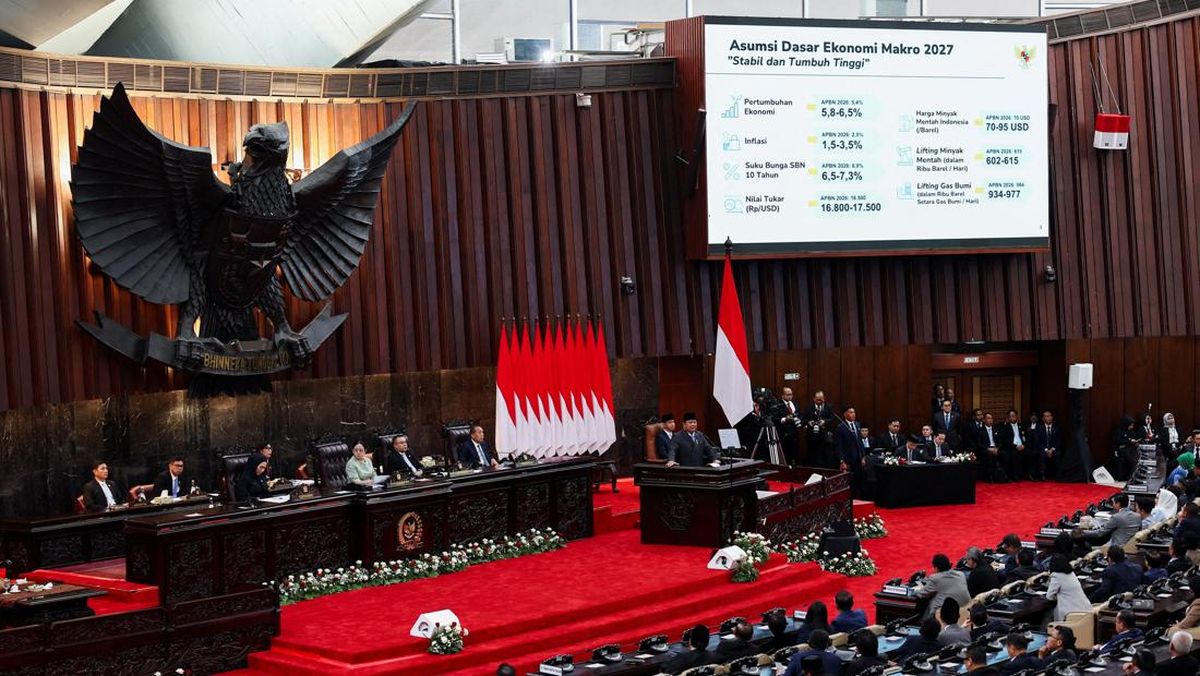
Earlier, in his address in the DPR Plenary Session, Prabowo did not dispute that poverty numbers had not continued to fall despite seven years of growth.
‘Our growth over the last seven years has indeed been good, at 5 per cent per year, for seven years, 5 percent times 7 equals 35 per cent growth. We should be wealthier by 35 per cent, but what happened?’ he said.
‘7 years times 5 per cent equals 35 per cent; our economy grew by 35 per cent, but our people in poverty increased from 46.1 per cent to 49 per cent. A rise of 3 per cent,’ he continued.
He admitted he was puzzled and asked the attendees.
‘How can growth of 35 per cent occur, yet the middle class declines and poverty increases?’ he asked.