
Democracy Loses Meaning When the People are Powerless
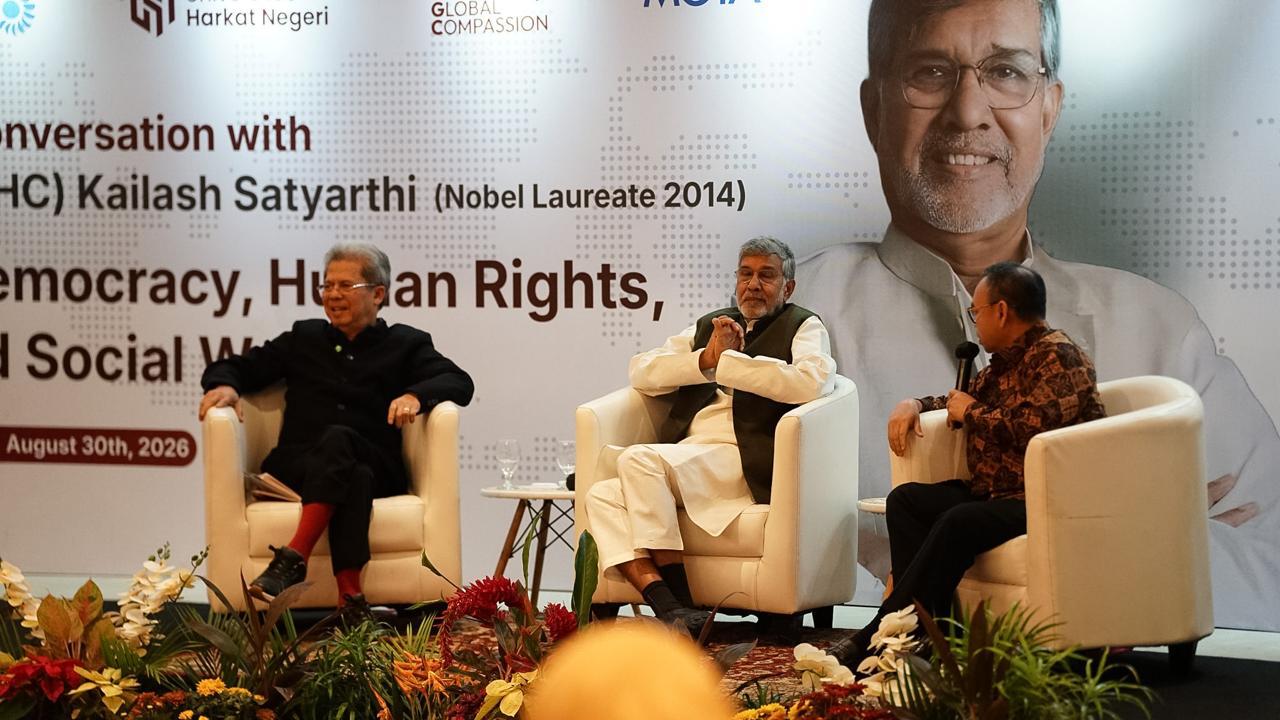
2014 Nobel Peace Prize laureate Kailash Satyarthi has reminded the public that democracy must not be limited merely to election procedures, constitutions, and state institutions. According to him, democracy loses its meaning when the people lack the power to demand and obtain their rights.
Satyarthi delivered this message during a discussion titled ‘A Conversation with Kailint Satyarthi: Democracy, Human Rights, and Social Welfare’ organised by Universitas Harkat Negeri (UHN) in Jakarta. He noted that while elections can be held regularly and constitutions can contain various guarantees for citizens’ rights, these measures are insufficient if society lacks bargaining power against the state and is unable to demand the fulfilment of its rights.
“Rights must not remain merely as words on paper. When rights are snatched away, democracy shrinks. When accountability vanishes, democracy sinks,” Satyarthi stated on Tuesday.
Satyarthi illustrated this with the example of a single mother unable to feed her child or protect her daughter from the threat of human trafficking. He argued that such a woman might not understand the concept of democracy or the language of human rights, yet her struggle is profoundly real. “At that point, democracy loses its meaning, even if all its procedures are functioning normally,”
He assessed that democracy, human rights, and social welfare are often treated as three separate fields, whereas they are actually interconnected; a failure in one area can weaken achievements in the others. He emphasised that including rights in a constitution does not automatically guarantee their fulfilment. More importantly, freedom of expression, the freedom to voice dissent, and the freedom to demand accountability must be genuinely respected.
Satyarthi also highlighted groups often unrepresented in electoral democracy, such as children, persons with disabilities, illiterate citizens, and those living in chronic poverty. “When a leader feels secure with the support of a majority—whether based on religion, culture, or skin colour—it is those groups that are the first to lose protection,”
To illustrate the failure of democracy in protecting vulnerable groups, Satyarthi shared his experience meeting an eight-year-old girl in Pakistan who worked sewing footballs in a dim, cramped room. The child would immediately suck the blood from her finger whenever a needle pricked her to prevent blood from staining the ball, fearing punishment from the foreman. When asked about her dreams, she did not understand the word, but eventually expressed a wish to one day kick a real football. “What sin is greater than robbing a child of their dreams?” Satyable asked.
He argued that the existence of democracy, laws, and welfare programmes is insufficient if the state fails to provide real protection to its citizens. Referring to Indonesia’s Pancasila, he linked it to the Sanskrit term ‘panchashila’ or five core principles. He specifically highlighted the fourth principle regarding wisdom in deliberation and representation, questioning the extent to which law-making and welfare programmes truly absorb the voices and wisdom of the people.
While acknowledging that Indonesia has made progress in reducing child labour, Satyarthi warned against complacency. “Even one child is too many,” he asserted.
The discussion moderator, Todung Mulya Lubis, noted that both Indonesia and India face serious challenges in maintaining democratic quality. He pointed to indicators of democratic regression, including pressure on civil society, universities, and independent media. “Universities appear to be under pressure, with university leaders being criminalised. Civil society is accused of being foreign agents. Independent media seems to be surrendering, and very few are still striving to uphold press freedom,”
Todung also highlighted the persistent issue of poverty in Indonesia. Having spent decades providing legal aid to the poor, he noted that inequality and limited access to justice remain significant challenges. “In reality, we still need more people willing to dedicate themselves to assisting the poor. What is the purpose of government? Is the government for the people, or the people for the government?”
In response, Satyarthi proposed the idea of ‘compassion’ or active care. He emphasised that this concept differs from mere sympathy or empathy. He argued that compassion must be manifested in concrete actions to help victims and change the conditions that cause suffering. “Compassion is not a soft emotion. Compassion is strength,”