
Demak to Protect 91.8% of Its Rice Fields Despite Industrial Estate Expansion
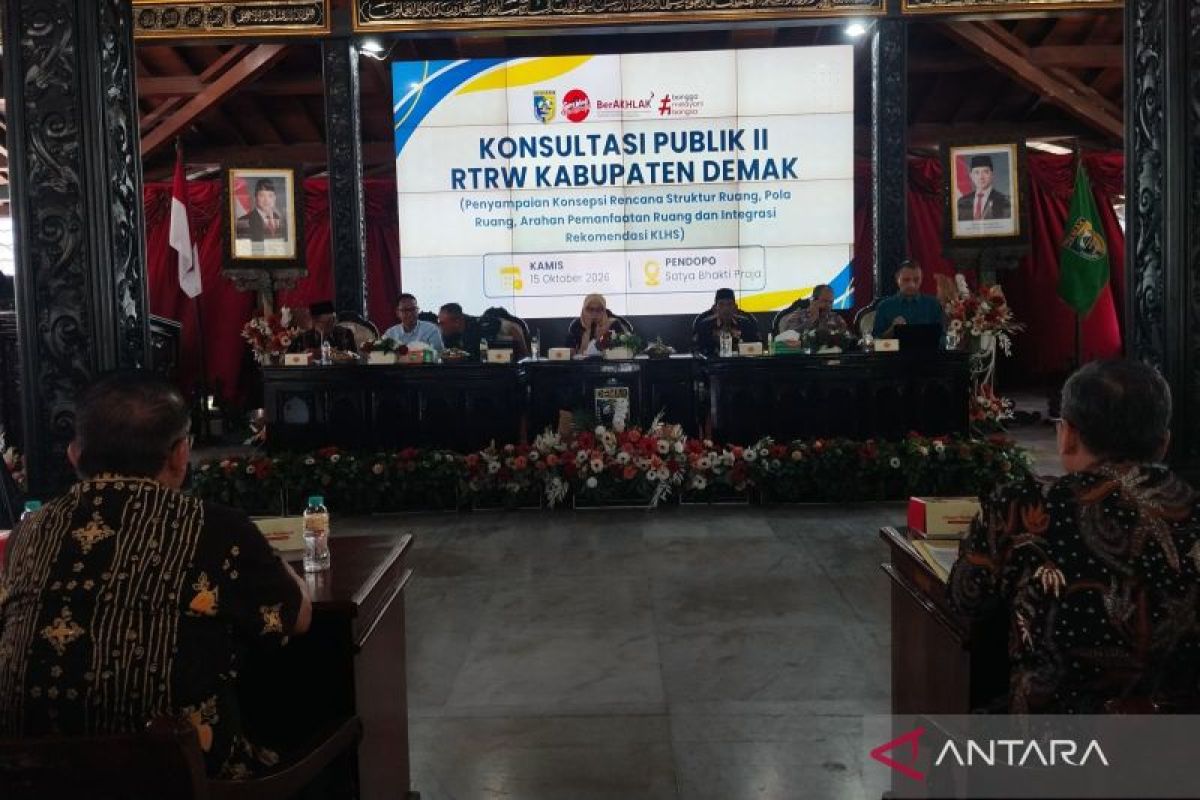
Demak (ANTARA) — The Demak Regency Government in Central Java is aiming to protect at least 50,863.53 hectares, or 91.8% of the regency’s total rice-field area, through a revision of its 2011–2031 Regional Spatial Plan (RTRW), even as it plans to expand an industrial estate.
Demak Regent Eisti’anah said at the second public consultation on the RTRW revision, held at Pendopo Satya Bhakti Praja on Thursday, that protecting agricultural land was a priority for safeguarding regional food security.
“The rice-field area targeted for protection is equivalent to 91.8% of the total rice-field area available in Demak Regency, which is around 55,424 hectares,” she said.
Eisti’anah said the designation of protected rice fields (LSD) must take geographical conditions and regional development needs into account.
As a food-producing buffer region, Demak faces the challenge of balancing agricultural land protection with the need for space for housing, industry and infrastructure development.
Population growth and urbanisation have also increased demand for land, making it necessary to plan spatial use carefully so as not to threaten productive rice fields.
Nationally, the Ministry of Agrarian Affairs and Spatial Planning/National Land Agency (ATR/BPN) recorded that local governments’ proposed designations of Sustainable Food Agricultural Land (LP2B) had reached 87.63% by September 2026, exceeding the 87% target in the 2029 National Medium-Term Development Plan (RPJMN).
The government is continuing to encourage the integration of this agricultural land into spatial-planning documents so that it has legal force to prevent land conversion.
Meanwhile, Nanang Tasunar David Narutomo, acting head of Demak Regency’s Public Works and Spatial Planning Office (Dinputaru), said the RTRW revision also includes plans to expand the industrial estate in Sayung District.
He said industrial development must continue to comply with rice-field protection requirements so that it does not undermine the sustainability of the agricultural sector.
He explained that one of the fundamental differences between the draft revised RTRW and the previous plan is the inclusion of rules protecting rice fields and restricting the conversion of agricultural land.
Industrial development as a driver of the regional economy must therefore be aligned with efforts to preserve productive farmland.
Nanang added that spatial planning should also take account of the livelihoods of local people, including farmers and fishers, as well as environmental conservation.
One approach that could be adopted is mangrove development to support environmental sustainability and local economic activity.
Demak Regional House of Representatives Speaker Zayinul Fata, who joined the public consultation by video conference, stressed the importance of preserving agriculture in the preparation of spatial-planning policy.
He said every district in Demak Regency had food-crop farming potential that needed to be maintained and developed.
“The development of the RTRW must not threaten the agricultural system; it should strengthen it as much as possible,” he said.
Nanang said the draft revised RTRW would undergo further review before being submitted to the ATR/BPN Ministry for discussion and consolidation.
The Demak Regency Government aims to complete the revision at regency level in 2026 before proceeding to the next stages.
The public consultation was also attended by Deputy Regent Muhammad Badruddin, Regional Secretary Ahmad Sugiharto and members of Demak Regency’s Regional Leadership Coordination Forum (Forkopimda).
Source: jawawa.id (https://jawawa.id/newsitem/demak-to-protect-91-8-of-its-rice-fields-despite-industrial-estate-expansion-1792083076)
Originally published by Antara (Indonesian) (https://www.antaranews.com/berita/5789945/demak-bakal-lindungi-918-persen-sawah-meski-perluas-kawasan-industri), translated from Indonesian