
Deliberation Expected to Become the Foundation for Lawmaking in Indonesia
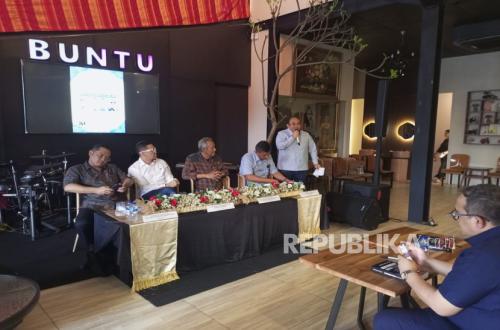
The practice of lawmaking in Indonesia over the past decade is still considered to face various fundamental problems, ranging from minimal public participation to a wave of judicial reviews after a law is passed. This situation forms the background for the launch of the book ‘Musyawarah (Syura)’ by Bambang Saputra.
During the book launch, Bambang explained that his work attempts to offer an ideal concept for implementing deliberation within Indonesia’s constitutional system, particularly in the process of forming legislation. ‘I explain how the ideal concept of conducting deliberation follows its principles and rules as practised in our constitutional system as a great Indonesian nation. In the book, I specifically realise this regarding deliberation in lawmaking. Of course, in the mechanism for forming laws in Indonesia, ideally it is done through comprehensive deliberation, following the existing rules for lawmaking and not violating the principles of deliberation itself. That is the ideal, roughly,’ said Bambang Saputra at the book review event for ‘Musyawarah (Syura): The Politics of Law Formation Desired by the Public’ in Tebet, South Jakarta, Saturday (4/7/2026).
According to Bambang, the writing of the book was motivated by the many problems in the national legislative process in recent years. He assessed that almost all legislative products passed by the DPR together with the government often end up in judicial review lawsuits at the Constitutional Court. Through the perspective of deliberation, Bambang tries to offer a solution so that the lawmaking process is carried out more comprehensively and representatively, and not merely to fulfil procedural formalities. ‘Here I try to find a solution from the perspective of deliberation so that it is more comprehensive, nothing is violated, and it is carried out representatively where every element of who should deliberate is truly represented, not just a formality but a representative substance,’ he said.
Meanwhile, Deputy Chairman of the Legislation Body (Baleg) of the Indonesian House of Representatives (DPR RI), Ahmad Doli Kurniawan Tandjung, assessed that the book could be a source of inspiration as well as material for reflection for the government and the DPR in improving the national legislative system. ‘It is good, it can inspire us, especially those in the government and us in the DPR. So I see this book can actually be viewed from two angles. First, it is also a critique, a critique of us as lawmakers, because this book on deliberation specifically talks about our legislative politics,’ said Doli.
According to Doli, the book criticises the practice of lawmaking which has so far been considered less open and has not fully provided meaningful public participation. ‘So in this book, there is criticism that so far, the lawmaking process has suddenly become closed, with minimal full participation. We are given the knowledge that in the lawmaking process with a background of deliberation, it actually must fulfil several elements, including the element of divinity, then equality, then openness, self-criticism, and so on,’ he said.
In addition to presenting criticism, Doli assessed that the book also offers broader corrections, not only related to the legislative process but also to the constitutional system and Indonesian democracy as a whole. Doli added that one of the important recommendations in the book is the need to revise Law Number 12 concerning the Formation of Legislation. Furthermore, according to him, the current momentum is also right to reformulate a model of democracy and a constitutional system that is more in line with Indonesia’s character.