
Deciles Are Not the Sole Indicator for Receiving Government Assistance!
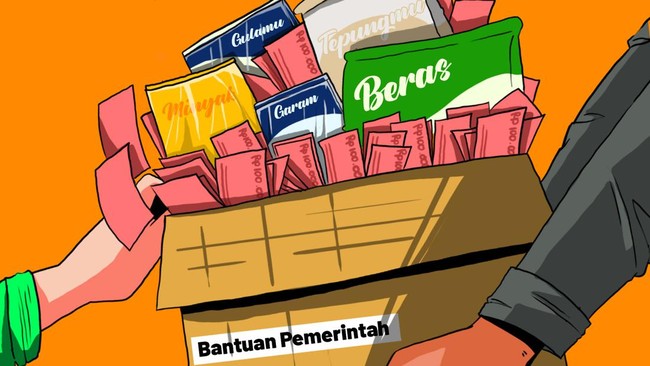
Deciles are not the sole indicator used by the government to distribute social assistance to the public.
Turro Wongkaren, Vice Chairman of the Statistical Society Forum, explained that in statistical terms, a decile is merely part of the recording of the socio-economic condition of the community, known as a social registry, rather than a social beneficiary registry.
“It is important to understand the difference between a social registry and a beneficiary registry. A beneficiary registry is a list of people eligible to receive assistance, whereas a social registry is a list of people or residents categorised by their socio-economic status,” Turro stated when contacted by CNBC Indonesia.
As it functions as a social registry, the data recorder, the Statistics Indonesia (BPS), does not measure the condition of the community to classify them into specific groups, but rather to determine their relative position in terms of welfare levels.
The source of decile data, which is part of the National Socio-Economic Single Data (DTSEN), originates from the Integrated Social Welfare Data (DTKS), the Targeting for the Acceleration of Extreme Poverty Eradication (P3KE), and the Socio-Economic Registration (Regsosek).
This data is then enriched with various administrative data and synchronised periodically with population data managed by the Directorate General of Population and Civil Registration (Dirjen Dukcapil) under the Ministry of Home Affairs.
The variables considered in the grouping into deciles 1-10 include housing conditions, drinking water sources, fuel and energy for cooking, asset ownership, electricity capacity and consumption, family composition, education, occupation, health, and disability.
These variables are measured using the Proxy Means Test (PMT) statistical method to estimate the welfare level of families based on observable characteristics.
“From those expenditures, the decile ranking is created. However, this is not to determine the decile itself, nor to determine who receives what or who is eligible for assistance. Those matters depend on each respective ministry and agency,” Turngo emphasised.
Andy Kurniawan, an expert for the Minister of Social Affairs in the field of Planning and Strategic Policy Evaluation, had previously explained that the DTSEN decile is not a direct measure to determine whether someone is rich or poor, nor is it a measure of income.
According to him, the decile is a relative ranking of the population’s welfare level on a national scale. After being ordered from the lowest to the highest level of welfare, the population is divided into 10 groups called deciles.
“A decile is not a certificate of being rich or poor. A decile cannot be equated with income. You cannot say decile 1 earns this much or decile 10 earns that much,” said Andy.
Because it is relative, an individual’s decile position can change even if their economic condition remains unchanged. This can occur because the condition of other families in the ranking also changes.
“For example, if there is a disaster in Sumatra and many people fall into poverty, my decile will automatically rise. Because if the national ranking is recalculated, some people will drop, and others will rise,” he asserted.
Andy noted that the DTSEN is updated every three months, resulting in four versions of the data per year. A significant change in deciles in Volume 3 occurred following the inclusion of approximately 12 million new data entries from the National Population and Family Planning Board (BKKBN).
He noted that the issue of decile changes became widely discussed as it coincided with the university registration period related to the Indonesia Smart Card (KIP), alongside the update of DTSEN Volume 3.
“These 12 million new data entries are the source of the update in the third volume. This update caused the fluctuations in deciles to feel very significant. BPS is directly evaluating this, and we are taking immediate action on specific cases reported by the community,” said Andy.
He further emphasised that the decile is not the primary requirement for receiving social assistance. The decile is used as one of the considerations in determining priorities, while each programme has its own specific recipient criteria.
“For instance, if there are 10 people in a room entitled to assistance, but the government only has funds for 5 people, the decile functions to select those 5. Those in decile 1 certainly take priority over those in decile 4, and decile 4 takes priority over decile 5. That is how priority is determined,” Andy explained.
Furthermore, the criteria for receiving social assistance are tied to each specific programme. For example, even if someone is in deciles 1 to 4—the priority group for the Family Hope Programme (PKH)—they still cannot receive assistance if they do not meet other criteria, such as being a civil servant (PNS).
An increase in decile does not automatically mean someone has become wealthier and lost their right to social assistance. The determination of recipients still considers programme criteria and available quotas.
“There is a perception that if the decile rises, it means one has become wealthier, and therefore assistance is lost. That is not true at all. And if assistance is lost, the public perception is that it has been revoked or the funds diverted to another programme. That is incorrect. The amount of social assistance remains the same or even increases. The reason some people who meet the requirements do not receive assistance is simply because the quota is limited,” Andy revealed.
Regarding the data changes in DTSEN Volume 3, BPS has released DTSEN Volume 3.1 as a correction to address the significant spikes in decile changes previously observed.
Members of the public who feel their data is inaccurate in the DTSEN can request an update through their village or sub-district government with the assistance of the SIKS-NG operator and ground checks by PKH facilitators.
Source: jawawa.id (https://jawawa.id/newsitem/deciles-are-not-the-sole-indicator-for-receiving-government-assistance-1788533804)
Originally published by CNBC Indonesia (https://www.cnbcindonesia.com/news/20260904161631-4-765045/desil-bukan-indikator-tunggal-untuk-dapat-bantuan-pemerintah), translated from Indonesian