
Dear Local Governments, Here's the Direction of the 2027 TKD Budget Policy
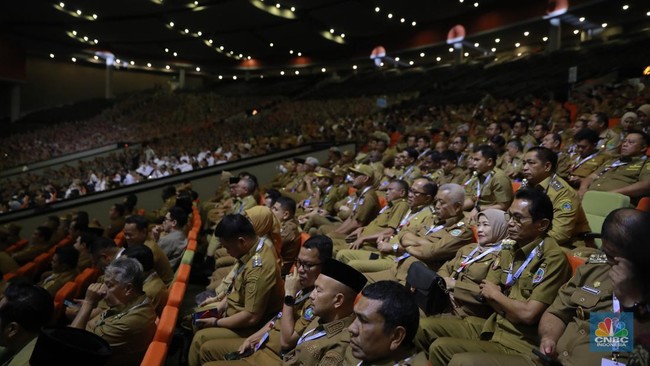
Finance Minister Purbaya Yudhi Sadewa is currently preparing the regional transfer fund (TKD) budget for the 2027 fiscal year. The amount will be adjusted according to the TKD policy designed by the government in the Draft State Revenue and Expenditure Budget (RAPBN) 2027.
Director General of Fiscal Balance at the Ministry of Finance, Askolani, stated that the draft TKD budget will range between 2.55% and 2.79% of Gross Domestic Product (GDP). For comparison, the 2026 figure was equivalent to 2.69% of GDP.
“The TKD-to-GDP ratio is in line with the fiscal policy presented by President Prabowo on 20 May 2026 in the introduction to the KEM-PPKF, where the 2027 ratio ranges between 2.55% and 2.79% of GDP,” Askolani said during a Budget Committee (Panja Banggar) meeting with the House of Representatives (DPR) on Tuesday (23/6/2026).
Askolani explained that the 2027 TKD plan will be prioritised to meet basic regional expenditures, including personnel spending, government operations, and basic public services. The TKD will also be used to reduce vertical and horizontal fiscal disparities between regions.
“We also encourage better central and regional fiscal synergy, and of course, the fourth priority is to support regional competitiveness for higher quality development,” Askolani stated.
Regarding the detailed components of the 2027 TKD, the government has also formulated policy directions, ranging from Revenue Sharing Funds (DBH) to Village Funds. For DBH, the 2027 policy will align central and regional governments to support regional programmes and the President’s priority initiatives.
“In 2027, we will allocate DBH in harmony with state spending policies and to support the implementation of local government programmes, then synergise the use of DBH to support government priority programmes,” he said. The government will also strengthen data quality and the DBH calculation formula using IT systems, while considering local government performance in environmental maintenance and optimising state revenue.
Askolani revealed that the 2027 General Allocation Fund (DAU) will be prioritised to meet regional governance needs and accelerate fiscal and basic service equity across regions by strengthening affirmations for underdeveloped, frontier, and outermost regions (3T). The 2027 DAU targets for 3T regions include support for regional civil servant (ASND) payroll, rehabilitation of classrooms and libraries, procurement of educational facilities and infrastructure, social health protection, and maintenance of health facilities along with procurement of modern medical equipment.
For the 2027 Special Allocation Fund (DAK), the government will allocate it to support the achievement of national priority programmes, accelerate regional development, operationalise public services, and provide affirmation for 3T regions. It will also strengthen the synergy between DAK and ministry/institution spending through the principle of integration, and improve the quality of planning, allocation, implementation, and evaluation.
The Special Autonomy Fund (Otsus) and Additional Infrastructure Fund (DTI) will focus on development in Papua and the continuation of the Aceh Special Autonomy Fund. “We are aligned with the master plan for accelerating Papua’s development, supporting national priority programmes in accordance with special autonomy laws, and using DTI funds for new autonomous regions to support infrastructure for national strategic projects,” Askolani said.
Meanwhile, the Special Privileges Fund for the Special Region of Yogyakarta in 2027 will be allocated to reduce poverty, empower MSMEs, and address regional disparities within Yogyakarta.
Lastly, the 2027 Village Fund will be allocated for sustainable development to reduce extreme poverty in villages and support the continuation of the Merah Putih Village Cooperatives (KDMP). Targets include the construction of KDMP outlets and transport fleets, labour-intensive cash-for-work programmes, and Village Direct Cash Assistance (BLT Desa) for families classified as extremely poor.