
'Deadly Combo': Iran-Linked Forces Target Saudi Arabia and Bahrain, Strike Two Tankers
Jakarta, CNBC Indonesia — Saudi Arabia and Bahrain reported a series of attacks by forces linked to Iran over the weekend. Amid the military escalation, which also hit two tankers in the Strait of Hormuz, Iran’s foreign minister said the government remained open to a deal to end the war with the United States (US).
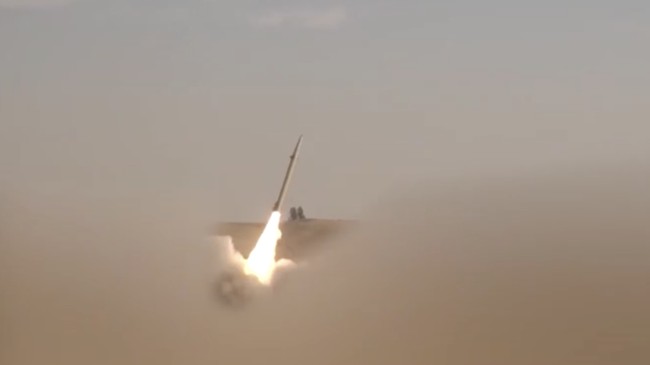
Citing CNBC and the Bangkok Post on Monday (23 November 2026), the Saudi-led Coalition to Support Legitimacy in Yemen said its air defences had thwarted a Houthi attack on Sunday local time. On Saturday night, the coalition had also intercepted and destroyed a Houthi ballistic missile heading towards western Saudi Arabia, an area containing sensitive energy refining and export infrastructure.
“Intercepted and destroyed a drone launched by the Houthi terrorist militia towards the Riyadh region,” the Saudi-led coalition said in a post on social media platform X.
Bahrain, home to the US Navy’s Fifth Fleet, also reported an attack from Iran, ending a pause in the conflict that had lasted several weeks. Bahrain’s Interior Ministry said two people — a Bahraini citizen and a Pakistani resident — were injured in the incident.
“As a result of Iran’s heinous aggression, a civilian industrial facility was targeted, causing a fire at the site. Civil Defence is working to bring the blaze under control,” Bahrain’s Interior Ministry said on X.
Local residents reported seeing smoke rising over Sitra Island on Bahrain’s eastern coast, where several industrial sites are located, including a refinery owned by state oil company Bapco. Iranian state media, meanwhile, reported that the Islamic Revolutionary Guard Corps (IRGC) had launched missiles and drones at US military positions at the Al-Riffa and Awali bases in Bahrain, warning that any violation of Iranian airspace would prompt a firm and forceful response.
“Two radars belonging to the US Army’s Patriot air-defence system were hit,” the IRGC said.
Separate Iranian media reports also claimed that IRGC air defences had intercepted and shot down a US MQ-9 drone over Qeshm Island in the Strait of Hormuz, days after US fighter jets attacked Iranian missile sites on the island last Tuesday. US Central Command (CENTCOM) did not immediately respond to requests for comment on the two Iranian reports.
Strait of Hormuz tensions and oil prices
The war, which began with US and Israeli air strikes on Iranian targets on 28 February, continues to cause major disruption to energy shipments through the Strait of Hormuz, between Iran and Oman. The UK Maritime Trade Operations (UKMTO) reported that two tankers near Oman were hit by unidentified projectiles on Saturday, with one struck in the engine room.
“No casualties have been reported at this time,” UKMTO said.
Iran’s military later reported that a vessel had caught fire after entering a restricted zone and hitting a mine in the strait. It said the tanker had switched off its identification and navigation systems in defiance of warnings and maritime transit regulations, although the US military recently claimed to have cleared all mines from the main route.
Iran continues to restrict vessels passing through the strategic waterway, which before the war carried a fifth of the world’s oil, while the US military escorts ships and maintains a retaliatory blockade of Iranian ports. CENTCOM said last month that it had helped Gulf countries export 1.5 billion barrels of oil through Hormuz since the summer.
Despite rising tensions along a major global oil route, crude prices fell for a third consecutive week as market participants weighed strong Middle Eastern supply flows against rising US inventories. International benchmark Brent crude fell 3.4% over the past week, while US crude plunged 5.2%.
Prospects for peace and Iran’s red lines
On the diplomatic front, Iranian Deputy Foreign Minister Kazem Gharibabadi said a Qatari delegation had visited Tehran on Friday evening and held two hours of talks, without providing further details. Iranian Foreign Minister Abbas Araghchi said his government remained open to negotiating an end to the war, although the framework for a permanent peace, signed by US President Donald Trump and Iranian President Masoud Pezeshkian in June and known as the Islamabad Memorandum of Understanding (MoU), had collapsed.
“The Islamabad MoU is no longer on the table and has no relevance for implementation,” Araghchi told an Iranian newspaper.
“However, the commitments accepted by the US in that MoU, and the principle that implementing those commitments could pave the way for a final agreement, remain acceptable to both sides.”
Araghchi said regional negotiations should nevertheless be given a chance and that the blockade must be lifted in a rational manner. Restrictions in the Strait of Hormuz remain a key point in negotiations with the US. Iran is demanding an end to the war on all fronts, the release of Iranian assets, the lifting of oil sanctions and an end to the US counter-blockade of Iranian ports.
“Our position is clear: unless Iran’s demands are met, discussions about the Strait of Hormuz and its reopening are pointless,” he said.
Economic tensions have also been fuelled by the “economic strangulation” campaign announced by Washington in August to restrict Iran’s trade and financial flows. Gharibabadi told the Tasnim news agency that Tehran considered the economic blockade an act of war, would take all necessary measures to lift it, and would ensure that the US understood its position.
“We have informed the other side, including the mediators,” Gharibabadi said.
In an interview with the Iranian government newspaper Iran Daily, Araghchi also reiterated Tehran’s position on its nuclear programme, which Western countries accuse of being intended to produce a bomb. Iran insists the programme is entirely for civilian purposes. He said Iran would not allow its stockpile of enriched uranium to leave the country.
“I believe a solution can be found, but we have clear red lines: the material will not be taken out of this country,” Araghchi said.
At home, Iranian President Masoud Pezeshkian acknowledged that US and Israeli attacks on energy infrastructure had worsened the country’s energy problems, warning that people should prepare for hardship this winter. The head of Iran’s national electricity company, Mohammad Allahdad, announced that rolling power cuts would begin on Sunday.
“Given the country’s fuel supply situation, the electricity sector has been forced to impose distribution restrictions,” he said.
Source: jawawa.id (https://jawawa.id/newsitem/deadly-combo-iran-linked-forces-target-saudi-arabia-and-bahrain-strike-two-tankers-1795395065)
Originally published by CNBC Indonesia (https://www.cnbcindonesia.com/news/20261123062855-4-787402/kombo-maut-iran-houthi-serbu-saudi-bahrain-tembak-rudal-ke-2-tanker), translated from Indonesian