
DBS Reveals Q4 2026 Investment Roadmap: Stocks, Bonds, Gold, and Alternative Assets
The DBS Chief Investment Office team observes that the global financial market is entering the fourth quarter of 2026 in a relatively resilient condition, although investors face pressures from high energy prices, rising bond yields, geopolitical tensions, and policy uncertainty.
In the DBS Chief Investment Office 4Q26 Insights, DBS assesses that risky assets are still capable of withstanding pressures, supported by solid corporate earnings performance and continued capital expenditure (capex) for artificial intelligence (AI).
However, DBS believes that increasingly selective market conditions require investors to pay closer attention to the fundamental quality of companies. Factors such as funding requirements, free cash flow, and valuation are key considerations in determining investment assets.
“Investors are advised to remain invested through a diversified portfolio,” stated the DBS Chief Investment Office team in Jakarta on Monday (28/9/2026).
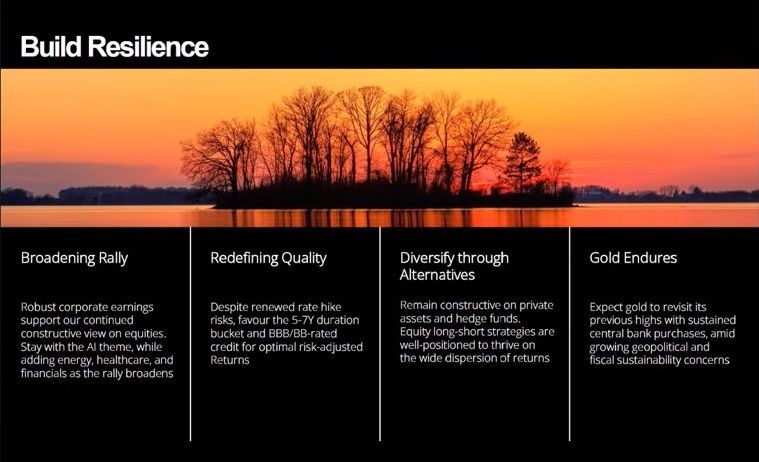
According to DBS, diversification allows investors to remain in the market by spreading investments across various asset classes. This strategy can also reduce dependence on a small group of technology stocks that previously acted as the primary market drivers.
Stock market movements are beginning to show a broader pattern. The energy, healthcare, and financial sectors are starting to record positive momentum, while the technology sector is entering a consolidation phase.
Nevertheless, DBS assesses that the AI theme still holds long-term prospects. Investor focus is shifting from AI infrastructure providers to companies capable of utilising the technology to enhance productivity, strengthen margins, and drive revenue growth.
Companies capable of adopting AI with lower capex requirements are a particular point of interest. Opportunities are also seen in sectors that benefit from stronger capital market activity, energy resilience, and increased operational efficiency.
In the bond market, the challenge of higher interest rates persisting for longer remains. Large-scale government bond issuances, increased borrowing by large-scale technology hyperscalers, inflation that has not yet fully subsided, and reduced forward guidance from the Federal Reserve have all contributed to rising term premiums.
DBS notes that risk disparities in the credit market are becoming more apparent. Therefore, bond selection should be based not only on credit ratings but also on cash flow conditions and the issuer’s ability to manage debt.
Under these conditions, DBS prefers bonds with durations of five to seven years and issuers rated BBB/BB that possess strong cash flows, controlled debt levels, and a credible capacity to reduce debt.
Portfolios can also be supplemented with instruments such as Treasury Inflation-Protected Securities (TIPS), agency mortgage-backed securities (MBS), selective financial sector stocks, and collateralised structures.
Beyond stocks and bonds, DBS sees that alternative assets still play a role in building portfolios that are more resistant to changing market conditions. These assets are deemed relevant when conventional stocks and bonds do not always provide the same diversification benefits amidst inflationary pressures.
Gold is one of the assets attracting attention due to potential support from central bank purchases, demand from Asia, concerns regarding fiscal sustainability, and investment trends related to currency debasement trades.
Meanwhile, private assets and hedge funds are seen as potential sources of growth, income, and additional yield opportunities. These include opportunities in secondaries, co-investments, asset-based senior financing, infrastructure with contract-based income, relative value strategies, and equity long-short strategies with low net exposure.
“A diversified allocation to alternative assets can help mitigate portfolio declines,” said the DBS Chief Investment Office team.
Regarding the global economy, the United States continues to receive investment support related to AI and relatively resilient consumption. Europe and Japan have also recorded better-than-expected performance despite facing rising energy costs.
In Asia, technology exports and manufacturing investment are helping to offset weaker domestic demand in China. This condition provides space for several central banks to remain focused on controlling inflation.
DBS is also monitoring political developments and fiscal policy in the United States ahead of the midterm elections. In DBS’s base case scenario, the US Congress is expected to be divided, meaning large-scale legislative changes may be limited.
The divergence of interests between the Federal Reserve’s mandate to maintain price stability and the US Treasury’s preference for lower long-term yields also has the potential to maintain uncertainty in interest rates and asset valuations.
Given these conditions, DBS believes investors need to maintain portfolio balance and be more selective in choosing instruments. Investment focus should not only follow broad market trends but also consider companies and assets with strong fundamentals, clear earnings prospects, healthy cash flows, and the ability to adapt to economic and technological changes.