
DBS Insights Forum Reveals Investment Opportunities Amid Global Rivalry
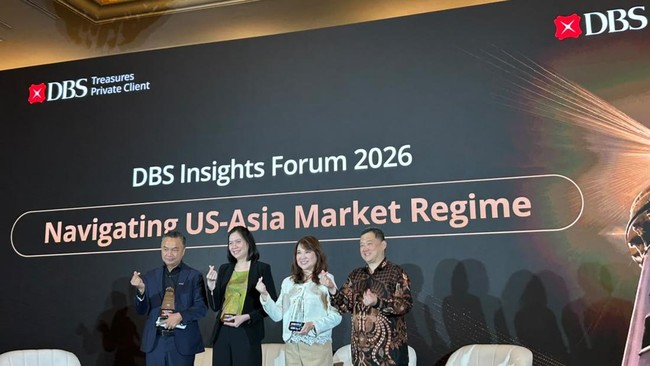
Global economic uncertainty triggered by geopolitical shifts, interest rate policy direction, and financial market volatility demands that investors make faster and more measured decisions. Responding to this need, Bank DBS Indonesia held the DBS Insights Forum 2026: A New Lens on a Multipolar World, bringing together geopolitical, international relations, and investment experts to discuss Indonesia’s economic prospects, policy direction, and relevant investment strategies for the second half of 2026. The forum featured Dino Patti Djalal, Founder and Chairman of the Foreign Policy Community of Indonesia (FPCI), several leading investment managers, and experts from Bank DBS Indonesia. They shared views on the impact of geopolitical developments and global policies on the Indonesian economy, while identifying investment opportunities amid evolving market dynamics. During the forum, Dino revealed that while turbulent global geopolitical conditions, such as the security situation in the Middle East and rivalry between major powers, must be watched and addressed wisely, Indonesia’s geopolitical position remains relatively safe. ‘There are many conflicts, many wars, and that is concerning for all of us, but not one is aimed at us. So we are not in the crossfire,’ Dino said at the DBS Insights Forum 2026 in Jakarta on Wednesday (15/7/2026). In a session themed ‘Navigating US-Asia Market Regime’, Dino stressed that Indonesia is not a direct target of these tensions. However, he cautioned that the biggest challenge is no longer security, but how Indonesia maintains market confidence. In this regard, the government needs to deliver policies that provide a sense of security for investors, as investors will seek the safest countries to place their capital. ‘In my view, we are safe, as seen from our S&P rating. We remained at BBB, and our image is good, but we lack outward articulation. If I were to ask, for instance, who from Indonesia can explain things logically, charmingly, and articulately to the IMF or World Bank? I have not seen that person yet,’ he added. In the same session, Djoko Soelistyo, Head of Investment & Insurance Products at PT Bank DBS Indonesia, outlined three major shifts currently influencing global investment direction. First, inflation today is different from the last 10 years, which will automatically impact interest rates. ‘We are currently seeing that the interest rate trend appears to be relatively higher compared to the average of the last 10 years. The impact of high interest rates affects other things, including economic growth. If inflation is too high, there will be too much money circulating, and that influences the amount of investment and the products we invest in,’ he explained. Second, the development of Artificial Intelligence (AI) is a trend that must be watched in the current macro environment, as its use can change the landscape of industries such as banking, manufacturing, and robotics. ‘For example, we see many industries like banking using AI extensively to help verify or assess customers and their needs,’ Djoko clarified. Third, change stems from geopolitical fragmentation driven by ongoing wars, which impacts energy supply chain disruptions. Based on this, Bank DBS Indonesia’s investment strategy, Djoko continued, does not only focus on technology but also on instruments that benefit from high interest rates, such as bonds. On the same occasion, Laurentia Amica Darmawan, Head of Equity at PT BNP Paribas Asset Management, stated that investors must realise the era of cheap funding is likely over. This is marked by rising bond yields in Japan and G7 countries, signalling that the cost of funds in global markets will remain high. Amica added that AI investment needs, estimated to reach US$700 billion to US$800 billion in 2026, are expected to be largely supported by bond issuance. Given these conditions, she assessed that investment strategies must return to focusing on company fundamentals. Investors are advised to select issuers with strong balance sheets, healthy cash flows, competitive advantages, and the ability to maintain profit margins sustainably. ‘So everything goes back to the fundamentals at the current moment, where we are looking for companies with strong balance sheets, pricing power, and fairly strong cash flow,’ Amica stated. Meanwhile, Katarina Setiawan, Chief Economist at PT Manulife Aset Manajemen Indonesia, assessed that Asia remains promising for the long term, as the region does not rely solely on China but has complementary sources of growth. She outlined four main themes that will drive regional growth: technology and AI, energy, domestic economic growth, and manufacturing base diversification through the China Plus One strategy. In terms of AI, South Korea and Taiwan are seen as the biggest beneficiaries through their semiconductor and memory industries. For the energy transition, China leads in renewable energy and battery development, South Korea excels in electrical technology, and Indonesia holds a strategic position as a producer of critical minerals like nickel.