
Day Shift as a Labourer, Night Shift as a Ride-Hailing Driver: Central Java Workers’ Response to Low Wages
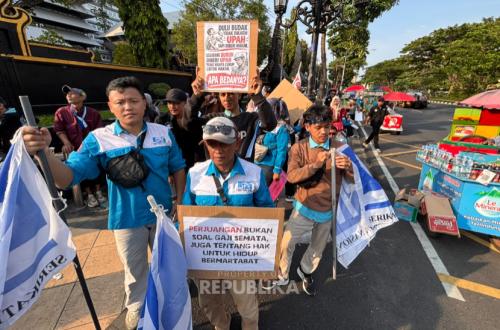
Aji, 48, a member of the Independent Workers’ Federation–Confederation of the Indonesian Workers’ Alliance Congress (FSBI-KASBI) from Semarang, said he now works part-time as an online motorcycle taxi driver. He said he needed a second job to meet the needs of himself and his family.
“A salary of Rp2.3 million or Rp3.7 million would not be enough to support a family. I have two children,” Aji said in an interview on the sidelines of a demonstration outside the Central Java Governor’s Office in Semarang on Thursday (12 November 2026).
As Aji noted, Central Java’s provincial minimum wage (UMP) is currently Rp2.3 million a month, while Semarang’s municipal minimum wage (UMK) is Rp3.7 million. At the demonstration, organised by the Central Java Militant Workers Coalition (KOMBAT), workers demanded an increase in the minimum wage in line with the required decent living standard (KHL).
Aji said workers in Central Java took to the streets every year to demand better wages. “But the increases are nowhere near adequate,” he said.
Although he has taken up part-time work as an online motorcycle taxi driver, Aji stressed that his earnings from it were unpredictable. He therefore had to work hard to ensure that his total income covered all his family’s needs.
“FSBI tried to calculate the KHL ourselves yesterday and arrived at Rp16.1 million. That is for a family of four: a wife and two children,” Aji said.
Aji said he hoped the government would raise the 2027 UMP and UMK to levels that meet the KHL. Decisions on the following year’s UMP and UMK are usually finalised at the end of November.
Maksuri, head of the Central Executive Board of the National Workers’ Union (SPN), said Central Java’s minimum wages were among the lowest nationally. Maksuri, who is from Jepara regency, said the UMK there was currently Rp2.7 million. He noted that minimum wages were calculated to cover the needs of a single worker.
According to Maksuri, even single workers in Jepara struggled to make ends meet on Rp2.7 million. “What about those with a wife and two children?” he asked on the sidelines of the demonstration with KOMBAT outside the Central Java Governor’s Office.
Maksuri said many workers therefore had to take on additional jobs to support their families. “So workers drive online motorcycle taxis at night. Otherwise, how can they make a living, pay rent, send their children to school and so on? As I said earlier, Central Java has the lowest wages of any province in Indonesia,” he said.
Maksuri said many SPN members also had to work part-time to meet their own and their families’ needs. “Wages in Central Java are now far behind those in other provinces. Meanwhile, the government sets the prices of basic goods. Take fuel, rice, cooking oil, vegetables and so on. They cost the same in Central Java. In fact, in the big cities, they can be more expensive here than elsewhere,” he said.
Maksuri added that his examples did not even include housing or children’s education. “We want our children to go to school and university, and we want a home to live in. Wages have to be decent. If we do the sums on current wages, there will be nothing left,” he said.
Maksuri said Central Java’s UMP should be set at Rp3.7 million a month, but stressed that this figure was only a minimum threshold.
While the demonstration was under way, several KOMBAT representatives were received for a meeting with Iwanuddin Iskandar, assistant for government and public welfare at the Central Java Provincial Secretariat, and Ahmad Aziz, head of the Central Java Manpower and Transmigration Office. The workers presented their concerns and demands, particularly that wages should meet the KHL.
Speaking to reporters after the meeting, Iwanuddin rejected the description of Central Java as a “low-wage” province. “We would call it competitive. That means it is attractive to investors to come here. Why? Because wages are competitive and the workers are skilled,” he said.
Iwanuddin said workers’ wages would rise in line with productivity. “If productivity increases, wages will automatically rise. It is impossible for employers to be happy and production to run smoothly while workers’ welfare is ignored,” he said.
Nevertheless, Iwanuddin said the Central Java Provincial Government had received all the workers’ demands and would convey them to the central government.