
Data Speaks: US-Iran War Triggers World's Worst Energy Crisis
The United States (US)-Israel war against Iran, combined with the closure of the Strait of Hormuz, has triggered the largest oil supply disruption in history in terms of daily production losses. This is revealed by Reuters’ calculations based on data from the International Energy Agency (IEA) and the US Department of Energy.
The IEA has even described this crisis as the worst, especially when combined with the ongoing impact of Europe’s gas crisis resulting from Russia’s invasion of Ukraine in 2022.
“This is the worst energy crisis the world has ever faced,” the IEA wrote in its report, quoted on Wednesday (22/4/2026).
Unlike past energy shocks, the current Iranian conflict does not only strike crude oil but also natural gas, refined fuels, and fertilisers. This situation reflects new vulnerabilities due to rising global energy demand and the increasingly complex trade chains.
If the 1970s crisis was triggered by an embargo deliberately squeezing oil supplies, the current shock is occurring simultaneously across the entire energy chain, from oil to gas and its derivatives.
The IEA notes that the peak supply loss in the current crisis reached more than 12 million barrels per day, equivalent to about 11.5% of the estimated global oil demand of 104.3 million barrels per day this year.
This figure far exceeds previous crises, such as the 1973-1974 Arab oil embargo of 4.5 million barrels per day, the 1978-1979 Iranian Revolution of 5.6 million barrels per day, and the 1991 Gulf War of 4.3 million barrels per day.
Not only oil, but this conflict has also halted around one-fifth of global liquefied natural gas (LNG) production from Qatar. This situation exacerbates pressure on the world energy market, which is now far more reliant on gas than in previous decades. Disruptions have also spilled over to the downstream sector, where production of fuels from refineries in the Gulf region is disrupted, triggering shortages of jet fuel and diesel in various areas.
Over 52 days of conflict, Reuters estimates the total supply loss at around 624 million barrels. This figure is expected to continue increasing, even if the conflict eases in the near future, because energy supply recovery typically takes a long time.
Nevertheless, in historical records, the 1978-1979 Iranian Revolution still recorded a larger cumulative impact. The US Department of Energy noted an average production drop of 3.9 million barrels per day during the 1978-1981 period, equivalent to about 4.27 billion barrels.
Energy journalist Ian Seymour described that decline as one of the most significant in oil industry history. “Iran produced around 6 million barrels per day at the end of 1978, but it fell to an average of 3.1 million barrels per day in 1979,” he said.
Unlike previous crises, producer countries with reserve capacity such as Saudi Arabia and the United Arab Emirates are unable to cover the supply shortfall this time. This is because they are also affected by disruptions to distribution routes through the Strait of Hormuz, which is a vital global energy trade route.
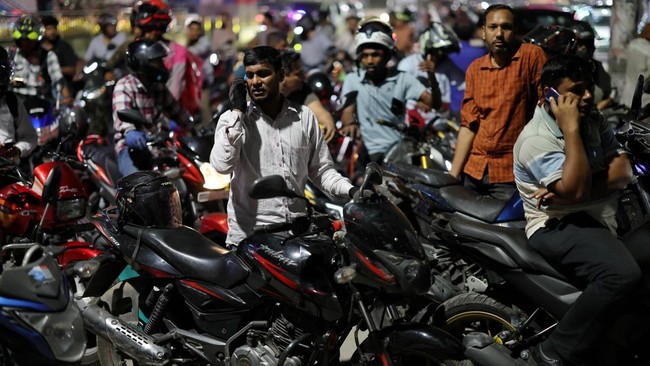
The impact of the current crisis also feels different geographically. If the 1973 Arab oil embargo severely hit the United States, causing long queues at petrol stations, this time the pressure is first felt by countries in Asia and Africa experiencing fuel supply shortages.
In comparison, the 1991 Gulf War caused a supply loss of around 516 million barrels, smaller than the current crisis, while disruptions from Russia’s invasion of Ukraine in 2022 were relatively limited with a production drop of around 1 million barrels per day.