
Data-driven Education on Palm Oil Plantation Commodities for Students
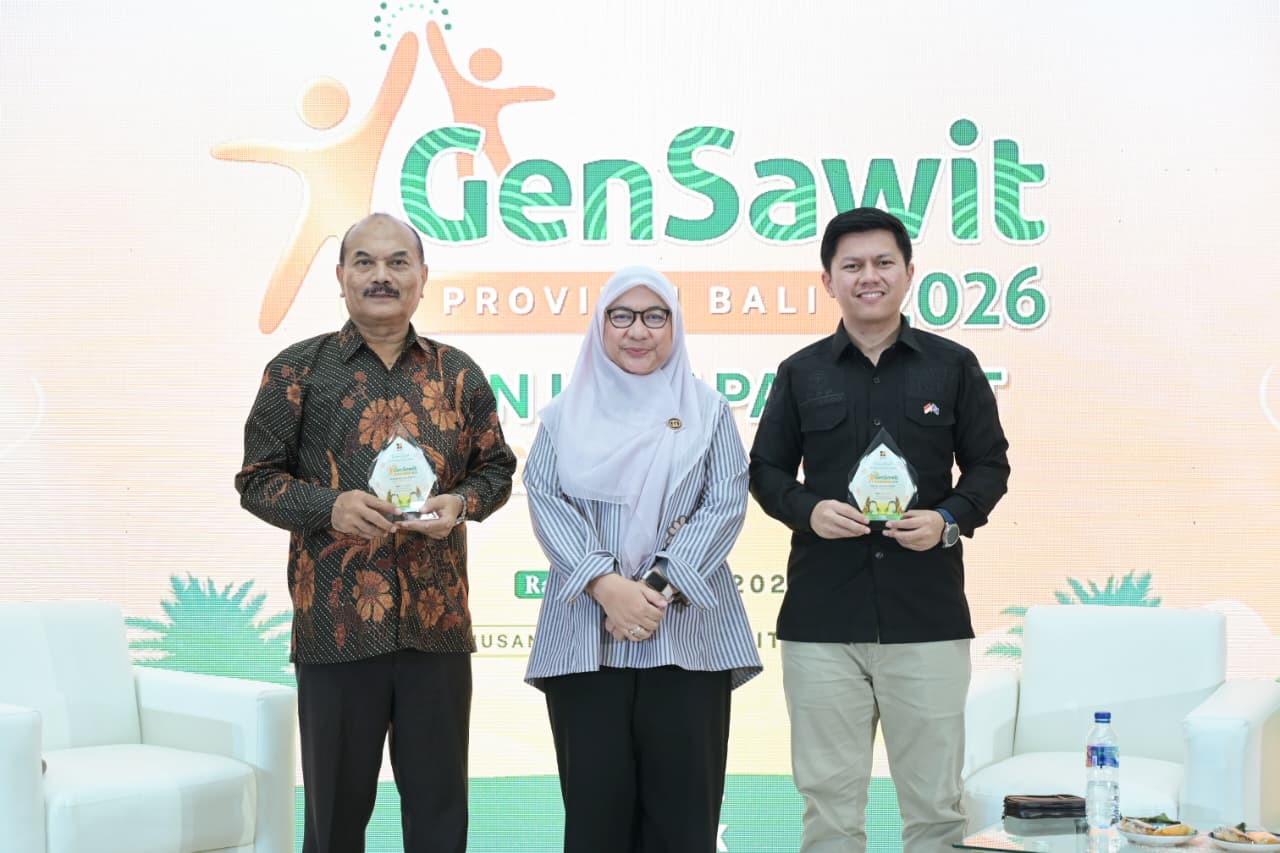
PT DSI Persero will fully assume export functions starting January 2027. The Badan Pengelola Dana Perkebunan (BPDP) in collaboration with Universitas Udayana organised GenSawit 2026 at Universitas Udayana, Denpasar, Bali on 20 May 2026. In the event, speakers from IPB University and the Asosiasi Petani Kelapa Sawit Indonesia Pusat were invited, and around 350 students from several universities in Bali attended.
At the opening of the event, Aida Fitria, Head of the Cooperation and Institutional Relations Division at BPDP, said GenSawit was one of BPDP’s efforts to raise literacy among the younger generation about the strategic role of the plantation sector, particularly the palm oil commodity for national development.
‘Young people have an important role in delivering solutions through research, technology, digitalisation and the development of innovative ideas. Students are not only expected to be recipients of information, but also agents of change able to build data- and science-based narratives,’ Prof. Dr. Ir. Yanto Santosa from IPB University said.
He noted that the youth and students play an important role in building a more objective view of strategic issues, including the Indonesian palm oil industry. In the digital era, information flows are rapid, but not all information is accompanied by complete and verifiable data.
The palm oil issue often evolves not only on the basis of scientific facts, but also influenced by opinion, global economic interests, and incomplete information. Therefore, it is important for young people not to accept narratives uncritically, but to cultivate critical, analytical, fact-based thinking.
‘Students, as intellectuals, are expected to become public literacy agents who foster healthy and balanced discussions. A critical attitude does not mean rejecting or accepting a topic unthinkingly, but rather testing information, comparing sources, understanding context, and seeking constructive solutions. A data-based approach helps the younger generation view issues more fairly and avoid getting trapped in polarised opinions. Moreover, the younger generation should understand that sustainability challenges are a shared responsibility. The palm oil industry must continually strive to be more sustainable, transparent and environmentally friendly, but criticisms of palm oil must also be expressed objectively and proportionally,’ he said.
‘With this mindset, young people will not only become consumers of information, but also part of the solution through ideas, innovations and real contributions to Indonesia’s future. Ultimately, a developed nation requires a generation not easily swayed by baseless narratives, but able to stand on data, science and intellectual integrity. With this attitude, the younger generation can actively safeguard national interests while promoting a palm oil industry in Indonesia that is more competitive and sustainable at the global level,’ added Prof. Dr. Ir. Yanto Santosa.
The IPB University professor also stated that a data-based approach helps build a more balanced narrative on the socio-economic impacts of palm oil. The industry has become a livelihood for millions of workers and smallholders across Indonesia.
This fact has often received limited attention in international negative campaigns. Through scholarly publications, international forums, and collaboration among universities and global research institutions, Indonesia can present a more comprehensive perspective and not merely view palm oil from an environmental angle.
Dr. (cn) Djono A. Burhan, S.Kom, MMgt (Int. Bus), CC, CL, Head of International Relations and HR Development at DPP Apkasindo (Asosiasi Petani Kelapa Sawit Indonesia Pusat) also conveyed that the role and contribution of Indonesian palm oil farmers is substantial to the industry’s sustainability, as 41% or 16 million farmers and their families rely on palm oil for their livelihoods.
Not only areas that are central to palm oil benefit, but a look at the toiletries in my hotel accommodation during GenSawit 2026 in Bali shows that the raw material in the soap contains Elaeis Guineensis Oil. This cannot be denied that farmers also contribute to Bali’s tourism, even though Bali has no palm oil land or trees.
This underpins palm oil farmers’ hope to work together to sustain the industry’s sustainability by voicing the benefits of palm oil for both the industry and for Bali’s very famous tourism sector.
‘Palm oil farmers have also moved into the second generation and are increasingly aware of information and technology, where palm oil farmers are driving intensification or productivity increases on existing palm oil estates. Hence, farmers use quality seeds so they can provide livelihoods for their families for at least the next 25 years,’ Djono A. Burhan said. (H-2)
Operational practices and sustainability commitments to keep the palm oil industry sustainable continue to be socialised to the public.
Tanzania’s ambassador Macocha Moshe Tembele emphasised the importance of international collaboration in releasing palm oil genetic resources from Serdang Bedagai.
GAPKI, RPN, and Socfin Indonesia released palm oil genetic resources originating in Tanzania to create climate-adaptive elite varieties.
The Indonesian Palm Oil Association held the Sobat Sawit (Soswit) Goes to School programme at SMK Negeri.