
Data Centres Enter Villages: Residents Suffer While Business Owners Reap Huge Profits
Amid the increasingly massive development of artificial intelligence (AI) technology, tech giants are racing to build large-scale data centre infrastructure as a backbone. Ultimately, the scale of investment is aimed at fulfilling the ambitions of huge conglomerates to maximise profits. The promise is that AI will bring great benefits to the digital economy through increased productivity, efficiency, and innovation. However, there is a high price to pay to drive the AI revolution. The working class is haunted by anxiety that their positions will be replaced by advanced AI systems. Evidence is already occurring everywhere, with waves of layoffs continuing and companies slowing the recruitment of new employees. Many openly state that AI adoption has slashed operational costs, including costs for human labour. This proves that efficiency which is positive for business owners turns out to have a detrimental impact on lower-middle class working communities. Many university graduates struggle to find jobs and are forced to work in the informal sector, which is full of uncertainty. Furthermore, there are other damaging impacts of AI, such as increasingly sophisticated fraud schemes causing large financial losses, and disinformation more frequently encountered on the internet through deepfake videos.
Disaster from Data Centres in the US
Other damage stems from the proliferation of AI data centre construction everywhere. For developing countries in the Southeast Asian region, incoming foreign investment to build data centres is often framed as a positive to increase state revenue. Yet again, there is a high price to be paid, and unfortunately, the general public must bear it. Environmental activists have long warned of the risk of water and electricity crises due to data centre construction. This is because data centres require vast amounts of water to keep servers cool, as well as huge electricity supplies to run systems 24 hours a day. In the 2023-2025 period, the number of megawatts of energy storage under construction in major US markets, including Texas, California, and Virginia, more than doubled. Projections indicate data centre energy consumption could rise from 4% to 12% of total US electricity usage by 2028. Behind these statistics, however, are real human stories of victims. One such case befell the couple Beverly and Jeff Morris. Perfect Union, a media outlet focusing on working-class issues, visited the couple’s residence in Mansfield, Georgia, USA. Georgia is the region with the sharpest data centre growth. Currently, 105 data centres are already established in the state. There are two reasons Georgia is heavily targeted for data centre construction. Firstly, industrial electricity rates in the state are 42% below the national average. Secondly, Georgia provides massive tax breaks to data centre operators. However, local residents must bear the consequences of living with incessant noise, lights glaring until midnight, environmental pollution, and crazy increases in electricity bills.
‘Paradise’ Becomes ‘Hell’ of Pollution
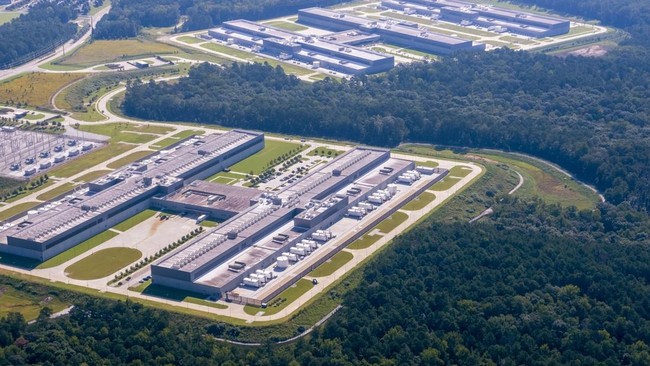
Beverly and Jeff bought their home in Mansfield in 2016. They chose a residence in a suburban area to escape the hustle and bustle of Atlanta. For them, this plot of land was not just a home, but also a sanctuary and the foundation for their farming livelihood. “When we found this place, we decided this was it. It was perfect,” Beverly explained in an interview with Ben Lieberman published by Perfect Union. However, their rural paradise was disturbed when Mark Zuckerberg’s Meta Platforms began building a giant data centre in 2018, covering 2 million square feet or about 18.5 hectares. It is only 365 metres from Beverly and Jeff’s home. The impact is severe. Beverly showed the water pressure at her kitchen sink tap, which was barely a trickle. Severe contamination means Beverly cannot access clean water. She and Jeff must collect water in supply bottles for daily use, such as flushing the toilet. “This condition frustrates us, because it feels like fighting an impossibly high wall that cannot be penetrated. Nothing can be done, and they [Meta] do not care,” Beverly told Ben Lieberman. While the community bears great suffering, Meta instead booked net revenue that grew significantly to US$62.4 billion in 2023, up 60% from the previous year. To build the giant data centre neighbouring Beverly and Jeff’s home, Meta had to cut down pine trees and replace them with a source of pollution. The local ecosystem was damaged and the rural landscape changed drastically. Not just air pollution, light pollution also constantly disturbs Beverly and Jeff’s life at night, disrupting the natural day and night cycle. “The light is so bright,” said Beverly. She also showed a video taken during the construction of the giant data centre. From her house window, thick clouds of dust were visible, making her residential area full of haze. “This is all because of Meta,” she said. Because of Meta, electricity consumption in Mansfield increased by 34%, reaching 14,975,435 MWh in 2023. Water consumption also increased by up to 200 million gallons annually. Meta’s giant data centre also placed significant pressure on local rural infrastructure that was never designed to accommodate large industry.