
Data Centre Business Booms, and SEMA Reaps the Benefits
JAKARTA — The rapid development of artificial intelligence (AI) and digitalisation is creating opportunities for PT Semacom Integrated Tbk (SEMA). The electrical systems provider sees potential in the construction of facilities for storing and processing data.
In its latest research, dated 14 October 2026, Phintraco Sekuritas highlighted SEMA’s significant exposure to data centre projects. Based on management’s presentation during a visit to SEMA’s production facility in Bogor, Phintraco Sekuritas analyst Aditya Prayoga noted that more than 70% of SEMA’s business is currently related to data centres.
That contribution has also grown significantly over the past two to three years, as demand for electrical infrastructure to support data centre expansion has increased.
The government is also promoting the development of data centres and digital infrastructure to drive economic growth. Coordinating Economic Affairs Minister Airlangga Hartarto has said that Indonesia’s digital economy was approaching US$100 billion in 2025, which he described as the largest in South-east Asia.
The government has also recorded additional investment interest in the sector, amounting to around 1.3 GW of data centre capacity in Indonesia, valued at between US$15 billion and US$20 billion. In other words, every additional 100 MW represents around US$1.2 billion to US$1.5 billion in investment.
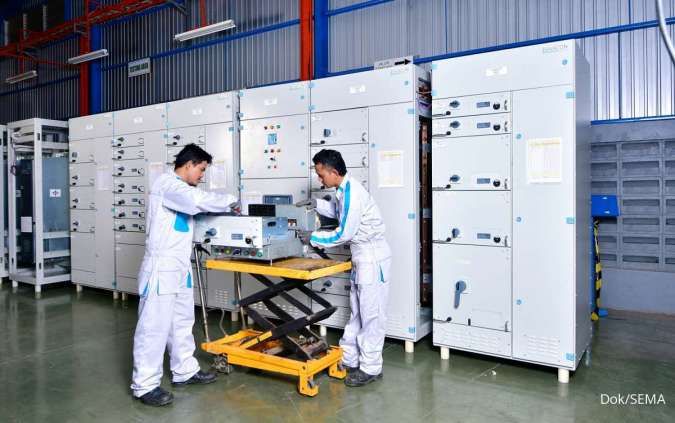
SEMA, founded in 2009, provides electrical solutions. It also manufactures electrical panels used to distribute and manage power supplies according to customers’ needs, including for commercial buildings, industrial facilities and data centres.
SEMA works with several major global players, including Siemens and Hyundai Electric. Its product portfolio includes Siemens’ SIVACON and SIMOPRIME ranges, as well as Hyundai Electric’s HiMCC and HMS products.
“Through these partnerships, the company has access to global technology and product standards, while also supporting the availability of raw materials and strengthening its capabilities,” Aditya said in the research cited by KONTAN on Wednesday (14 October).
SEMA currently operates a 7,000-square-metre factory in Bogor, with production capacity of 200 electrical panels a month, or about 2,400 a year.
The company can also increase output through a long-shift arrangement when demand rises. In addition to panel sales, SEMA provides after-sales maintenance services once warranty periods have expired.
SEMA’s low-voltage electrical panels are priced at around Rp200 million to Rp300 million per unit. Medium-voltage panels are more expensive, at around Rp2 billion to Rp3 billion each.
“The difference is driven by product specifications and complexity, meaning the value of SEMA’s contracts can vary depending on the type of panel ordered,” he added.
SEMA also provides maintenance after warranty coverage ends. Although this accounts for a relatively small share of total sales — less than 10% — the after-sales business could generate recurring income through regular maintenance contracts while helping to maintain long-term customer relationships.
Although SEMA has growth opportunities arising from data centre expansion, Phintraco Sekuritas says those prospects need to be accompanied by an improvement in the company’s financial performance.
Source: jawawa.id (https://jawawa.id/newsitem/data-centre-business-booms-and-sema-reaps-the-benefits-1792029026)
Originally published by insight.kontan.co.id (https://insight.kontan.co.id/news/bisnis-data-center-berkembang-sema-terciprat-berkahnya), translated from Indonesian