
Dassault Aviation, Thales, and the Integration of Air Defence Systems
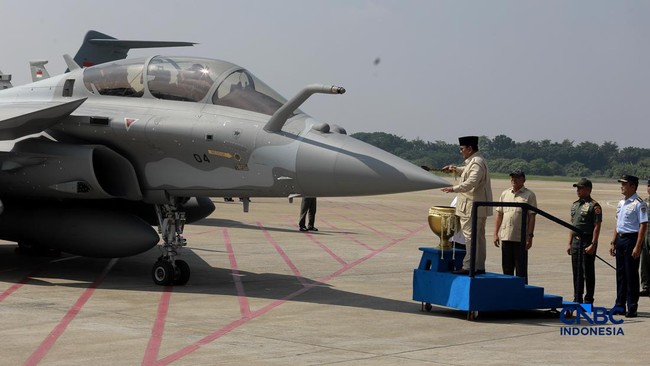
Dassault Aviation has delivered six Rafale F4i jets to Indonesia out of a total order of 42 units, with the remainder to be handed over gradually until 2029. The acquisition of the Rafale F4i represents a leap for Indonesia, which since 1989 has operated fighter jets with 1980s technology, although a number of F-16s were upgraded with early 2000s technology several years ago. With fewer global aerospace industries producing fighter jets, Indonesia’s options for 4.5 generation fighters are dwindling. Options will become even more limited if the country intends to purchase fifth-generation fighter aircraft in the 2030s.
ThalesRaytheonSystems has begun the phased delivery of 13 GM400α air defence radars, with the first radar in Banjarbaru currently undergoing acceptance testing, while the second awaits the completion of infrastructure in Takalar. The presence of the GM400α, with a contract value of €354 million, is urgently needed not only to build a new air defence radar network in areas that have so far lacked optimal radar coverage, but also to replace a number of technologically obsolete radars. For a long time, the modernisation of air defence radars has been slow because procurement programmes were always in small quantities. It was only during the 2020-2024 Minimum Essential Force (MEF) era that the Ministry of Defence acquired 25 units.
However, 12 of these units, with a contract value of €321.4 million, have raised doubts and questions regarding their technological aspects and operational capability. The 12 radars in question have never been produced before, aside from the fact that the manufacturer has only previously been involved in the field of civil aviation radar. According to plan, the 13 GM400α radars will be installed from the South Kalimantan region to Papua, combining new radar units with existing ones. The radar, which operates on frequencies from 2 GHz to 4 GHz, is expected to strengthen air defence capabilities in central to eastern Indonesia, which has been a weak point since the 1960s.
On the other hand, although three radar units in Papua have adopted the Master T radar, over time this radar has begun to become technologically obsolete if it does not undergo a capability enhancement programme. There are also predecessor generation radars to the Master T that are still operated in both regions, such as the AR-325 produced by Plessey (now BAE Systems) and the TRS-2215 made by Thomson CSF (now ThalesRaytheonSystems). To modernise air defence capabilities in western Indonesia, the Ministry of Defence plans to install 12 new Czech-made radars to replace old radars such as the TRS-2215 and TRS-2230.
Additionally, a capability enhancement programme is currently underway for the Master T radars operating in the region, given that the technology used is becoming outdated. However, as previously mentioned, there are a number of doubts and questions about the radar contract awarded to Retia, where the contract has been amended multiple times for radars that have never been produced before. Among the reasons for the contract amendments are the continuously changing delivery schedules as a consequence of various technical obstacles in the radar production activities by a manufacturer that has never had a portfolio in air defence radars.
The Indonesian Air Force, as the user of the Rafale F4i, has decided to station the fighter jets in western Indonesia, specifically in Pekanbaru and Pontianak. To support the future operations of the Rafale F4i, there are plans to integrate the air defence radars and the fighters to create an air picture, so the Rafale F4i does not rely solely on its RBE2 AESA radar. The integration involves a connection between the Rafale’s LCall Tactical Data Link (TDL), produced by Thales, and the GM400α radar, enabling the transmission of radar-captured imagery to the fighter jet. An air picture is part of situational awareness, ensuring that pilots and other relevant parties have complete information and data regarding the tactical situation.
A critical question arises: how will the French-made fighters be operated optimally in western Indonesia if there is operational uncertainty regarding the air defence radars deployed there? Even if Retia can deliver the 12 radars ordered by Indonesia, questions remain about their operational performance. Furthermore, how will these radars be integrated to support fighter assets like the Rafale, which are specifically stationed in the western part of the country? The emergence of such questions is inseparable from the undeniable fact that the radars purchased by the Ministry of Defence have never been produced before, meaning there is no empirical data to serve as a benchmark for formulating assumptions about their operational performance. It was mentioned earlier that the GM400α radars will be stationed in central and eastern Indonesia, so technically there will be no issue when they need to be integrated with the Rafale F4i to create an air picture. The critical issue is how integration will occur in western Indonesia if the Ministry of Defence proceeds with the procurement contract for the 12 Czech radars. Besides the question mark over the radars’ operational performance, integrating these radars into the SkyView system operated by the Indonesian Air Force is the next critical issue. Technically, integration can be carried out if the manufacturer opens the radar’s source code so it can connect with SkyView, as the Retia radar cannot be integrated directly with the Rafale F4i via the LCall TDL.