
Dasco, OJK and Danantara Respond to MSCI
The Jakarta Composite Index (JCI) fell sharply in trading on Friday (16 October 2026). It opened at 5,393.92, down 469.86 points or 8.01% from the previous close of 5,863.78, and immediately triggered a trading halt. The decline widened to more than 11% by the close.
The fall was triggered by Morgan Stanley Capital International (MSCI) announcing a consultation on downgrading Indonesia’s capital market from Emerging Market to Standalone Market status. MSCI cited concerns about transparency in share ownership structures and suspected coordinated trading, prompting fears among market participants that foreign funds could exit in large volumes.
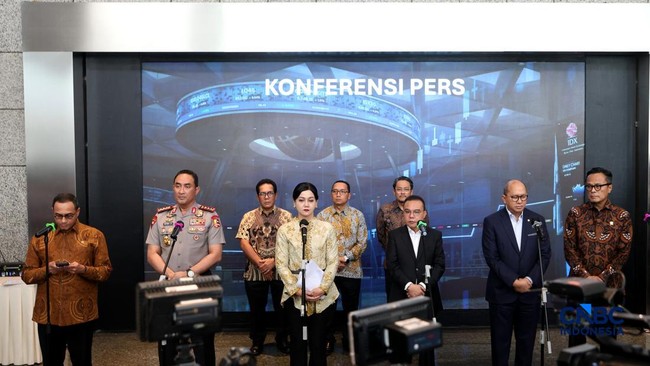
Amid the turmoil, Deputy Speaker of the House of Representatives Sufmi Dasco Ahmad, Danantara Indonesia chief executive Rosan Roeslani, and National Police Chief General Suyudi Ario Seto arrived at the Indonesia Stock Exchange (IDX) building at around 1pm local time. They went straight to the IDX boardroom.
Dasco said Parliament was continuing to monitor developments at the IDX and had asked the exchange authorities to keep improving, including by taking on board feedback from international index providers. He also questioned the timing, saying MSCI was expected to conduct its consultation review in November but had issued what he called a review early that morning, even though the exchange had already been preparing measures to address it.
“MSCI was only supposed to conduct its consultation review in November, but then early this morning it issued what was effectively a review. This coincided with the exchange already carrying out processes to accommodate reviews that were actually only due in November,” he said at the IDX building in Jakarta on Friday (16 October 2026).
Dasco said the Financial Services Authority (OJK) and the IDX had been carrying out that process. He added that he had held a coordination meeting that day with OJK Chief Executive Friderica Widyasari Dewi, OJK commissioner for capital markets Hasan Fawzi, Danantara chief executive Rosan Roeslani and Danantara chief operating officer Dony Oskaria.
He also asked the National Police Chief to attend, saying each party would provide information within its remit. Dasco later stressed that the investigation announced by the police would cover securities firms and individuals suspected of involvement.
National Police Chief General Suyudi Ario Seto said the police would deploy a Criminal Investigation Agency (Bareskrim) team to investigate suspected capital-market offences. The move followed information and complaints received by the police. Suyudi said the police would gather evidence and take firm action to provide legal certainty over the matter.
Danantara Indonesia said it was ready to invest in the Indonesian capital market amid Friday’s fall in the JCI. Chief executive Rosan Roeslani said the current share-price weakness could provide an opportunity for long-term investment in Indonesian companies, particularly state-owned enterprises (SOEs). He also welcomed efforts by the OJK and the IDX to promote capital-market reform.
“As Danantara, we see this as a moment because the valuations of our SOE companies are arguably low at present. We see this as an opportunity,” Rosan said.
Hasan Fawzi, OJK Chief Executive for Capital Markets, Derivatives Finance and Carbon Exchanges, stressed that enforcement and penalties were part of accelerating capital-market reform and were not new. The OJK has so far sanctioned 835 parties, imposing fines totalling more than Rp390 billion. He said every issuer with high shareholder concentration (HSC) was being examined, without exception, for indications of criminal conduct.
Of 61 issuers identified as having HSC, 31 are suspected of criminal violations. In its enforcement work, the OJK identified three issuers under investigation: PT Dian Swastatika Sentosa Tbk (DSSA), PT Barito Renewables Energy Tbk (BREN) and PT Petrindo Jaya Kreasi Tbk (CUAN). DSSA is being examined for the 2023–2026 period over suspected breaches of Articles 91 and 92 of the Capital Market Law, while BREN and CUAN are being examined over suspected violations relating to their respective initial public offerings (IPOs), under Article 107 of the law.
The OJK’s examination found that shares offered to the public had been allocated to groups connected to the controlling shareholders. The authority is tracing fund flows related to BREN and CUAN, issuers owned by Prajogo Pangestu, while DSSA is owned by Franky Oesman Widjaja. The OJK has summoned parties connected to each issuer as part of the process.
The share orders resulted in very large allocations to particular parties whose identities were obscured, limiting the number of shares available to the public (free float). Based on these findings, the OJK imposed administrative fines of Rp200 billion on DSSA, Rp500 billion (equivalent to about US$27.8 million) on BREN and Rp100 billion on CUAN.
OJK Chief Commissioner Friderica Widyasari Dewi stressed that the authority and other capital-market regulators had made every effort through the reforms under way. Her remarks came in response to the Indonesian sharemarket’s plunge following the MSCI-related concerns.
She said concrete steps had been taken to improve transparency, including lowering the threshold for disclosure of share ownership from 5% to 1% and expanding investor classifications from nine categories to 39. The minimum free-float requirement is also being raised gradually.
“All of this, along with enforcement, is also acceptable to the global investor community,” she said.