
Darunnajah University Holds International Conference on Waqf
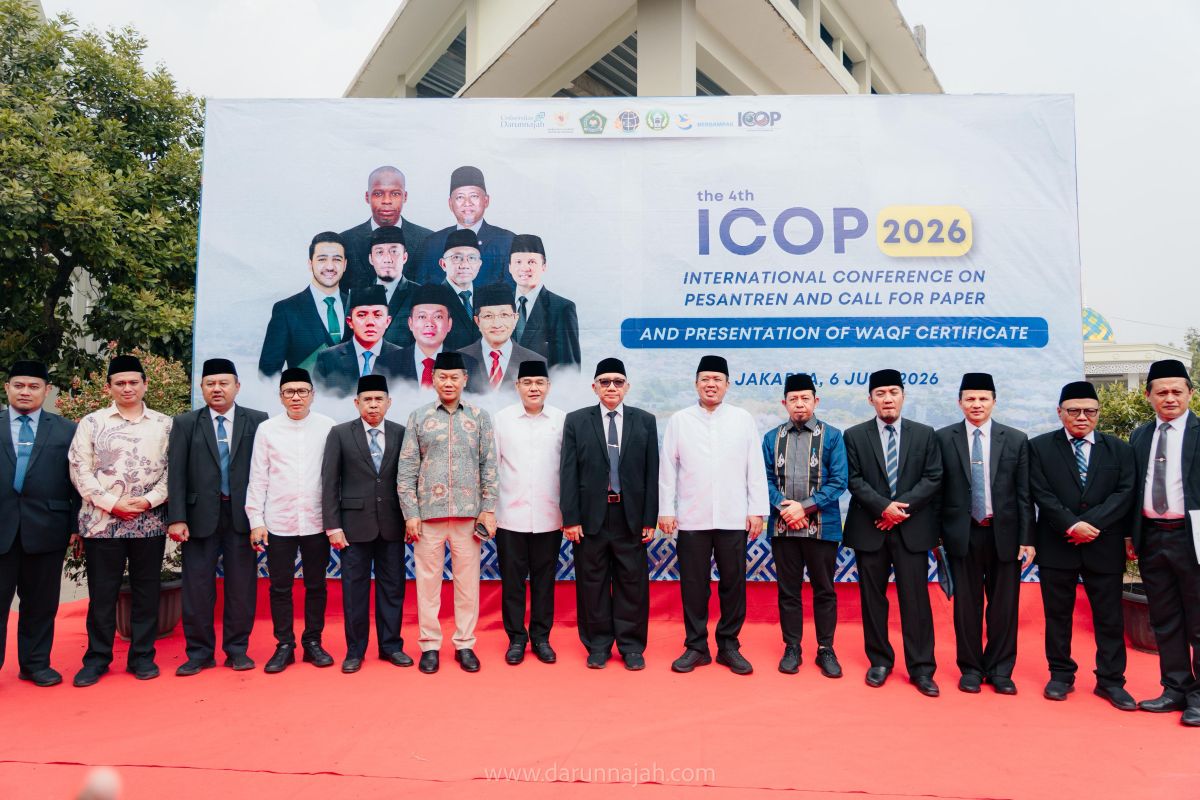
Jakarta (ANTARA) - Darunnajah University held The 4th International Conference on Pesantren (4th ICOP) 2026, which highlighted the role of endowment funds and waqf as Islamic financial instruments for educational financial independence, entrepreneurship development, and the acceleration of science and technology innovation.
“Islamic educational institutions must once again take a leading role in managing waqf in a modern and impactful manner,” said the President of Darunnajah University, KH. Hadiyanto Arief, during the opening of the conference in Jakarta on Saturday.
He stated that it is time for the Muslim community, particularly pesantren (Islamic boarding schools), to lead again in managing waqf professionally, productively, and impactfully. “That is the impact mission that serves as the calling for this conference,” he said.
He reminded attendees that the endowment models supporting the world’s major universities are deeply rooted in the Islamic tradition of waqf, such as Al-Azhar in Cairo, Egypt, which has stood firmly for over a thousand years based on a waqf system.
According to Arief, as tangible evidence within the country, Darunnajah has grown from an initial area of 700 square metres to managing over 1,200 hectares of productive waqf land with 23 branch campuses, 14 of which were directly established through community waqf.
Darunnajah University is a higher education institution under the auspices of Pondok Pesantren Darunnajah, Jakarta, which is committed to developing an independent, innovative, and impactful Islamic education ecosystem.
Meanwhile, the Minister of Agrarian Affairs and Spatial Planning/National Land Agency (ATR/BPN), Nusron Wahid, provided strong support through policies for waqf asset management that are not only legally secure but also economically productive. He emphasised the government’s commitment to accelerating the certification of waqf land to secure community assets and prevent potential future disputes, which often act as “fire in the chaff.”
Nusron also outlined plans for regulatory breakthroughs regarding Building Use Rights (HGB) on waqf land. “We want to create regulatory breakthroughs for the sake of community empowerment. Third parties or investors will eventually be able to build commercial infrastructure and lease it on waqf land from the Nadzir (waqf manager), so that land that was previously passive can generate high economic value,” he said.
He added that such regulations are expected to stimulate the potential of productive waqf in Indonesia to become an engine of community independence, with management capable of surpassing the achievements of other Islamic nations.
The 4th ICOP featured expert speakers from several countries, including Dr. Nuruddin Anis (Sharjah University, UAE), Prof. Dr. S. Salahudin Suyurno (UiTM, Malaysia), and Prof. Dr. Aliyu Dahiru Muhammad (Nigeria).
The conference was also attended by leaders of pesantren and Islamic higher education institutions from various regions, including Pondok Pesantren Lirboyo, Al Falah Ploso, Buntet, UNIDA Gontor, and Al-Amien Prenduan.
Through the call for paper sessions, the 4th ICOP presented eight comprehensive sub-themes, ranging from waqf governance, digital transformation of waqf finance, socio-economic impact measurement, and ESG investment, to the harmonisation of cross-border waqf regulations.