
Darunnajah Proves Waqf Can Build 23 Campuses
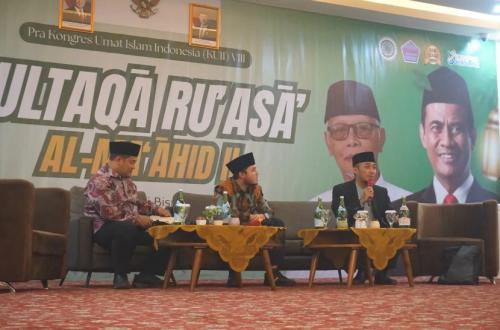
JAKARTA — The Pesantren Commission of the Indonesian Ulema Council (MUI) held Multaqa’ Ru’asa’ al-Ma’ahid II at the STMIK AMIK Bandung campus on Saturday (18/7/2026). The forum, part of the run-up to the eighth Indonesian Islamic Community Congress (KUII VIII), carried the theme “Analysis of Potential and Business Incubation of Islamic Boarding Schools” and brought together pesantren leaders, academics and stakeholders to discuss strategies for strengthening pesantren economic independence in the digital era.
KUII VIII itself is scheduled to take place on 24–26 July 2026 in Jakarta. Muhammad Iqbal, Secretary of the MUI Pesantren Commission, said the forum was part of the MUI’s effort to prepare strategic recommendations ahead of KUII VIII, particularly in the field of pesantren economic empowerment.
“Alhamdulillah, today the MUI Pesantren Commission is holding the second Multaqa in the lead-up to KUII VIII. This time the theme is pesantren economic independence,” he said.
One of the key speakers at the forum was the President of Darunnajah University (UDN), Dr KH Hadiyanto Arief, S.H., M.Bs., who presented best practices in pesantren management based on productive waqf. In his presentation, he stressed that Islamic educational institutions must once again take a leading role in managing waqf in a modern, professional and broadly impactful manner.
“From an initial plot of 700 square metres, Darunnajah has now developed more than 1,200 hectares of productive waqf land supporting 23 branch campuses, 14 of which were born directly from community waqf,” said KH Hadiyanto Arief. He reminded the audience that the endowment model underpinning the world’s great universities, such as Al-Azhar in Cairo, is deeply rooted in the Islamic tradition of waqf.
The presentation aligned with the spirit of the forum, which encouraged pesantren to build an integrated digital economic ecosystem connecting governance, education, production and distribution within a single mutually reinforcing system. The forum also highlighted the importance of the Santripreneur programme, run in partnership with STMIK AMIK Bandung, to equip students with digital marketing skills.
Data from the Ministry of Religious Affairs records 42,849 pesantren across Indonesia, with a registered student population of 6.3 million. However, according to the Indonesian Waqf Board, only around 9.27 per cent of waqf land in Indonesia is of productive value. This shows that the management of productive waqf in the education sector still has considerable room for development.
M Faried Muttaqin Iskandar, Vice Chairman of the MUI Pesantren Commission, said the pesantren economy is not merely a matter of money circulation, but a strategic instrument for safeguarding izzah (dignity) and the sustainability of Islamic educational institutions. “Our main goal is to understand the concept and empowerment of the economy for pesantren independence,” he told the assembled pesantren leaders.
Source: jawawa.id (https://jawawa.id/newsitem/darunnajah-proves-waqf-can-build-23-campuses-1784605961)
Originally published by Republika (https://khazanah.republika.co.id/berita/tii9nu451/darunnajah-buktikan-wakaf-bisa-bangun-23-kampus), translated from Indonesian