
Darul Fallah Agricultural Islamic Boarding School: Producing Santri as Guardians of Food Security
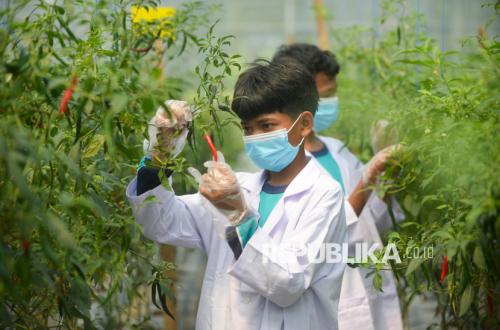
Amid national food security challenges and the declining interest of the younger generation in the agricultural sector, Pesantren Pertanian Darul Fallah in Bogor Regency, West Java, has chosen a different path. This Islamic educational institution combines religious education with agriculture, plantations, livestock, and fisheries as part of its curriculum to produce santri who are self-reliant and able to contribute to safeguarding food security.
The pesantren, located in Kampung Lemahdhuhur, Desa Benteng, Ciampea District, Bogor Regency, has developed a practice-based educational model. Santri not only study in classrooms and the mosque but also go directly into the fields, gardens, livestock pens, and agricultural business units.
Deputy Head of Education at the pesantren, Ustadz Iman Tohaga, said that the choice of agriculture as the pesantren’s identity is a mandate from the founders who wanted religious education, namely dakwah, to go hand in hand with entrepreneurship.
“Indonesia is an agrarian country. Therefore, education is not enough if it only takes place in the mosque or classroom, but must also go down to the land. Santri not only gain religious knowledge but also life skills that can be applied in the community,” said Ustadz Iman during a conversation with Republika.co.id at Pesantren Pertanian Darul Fallah on Tuesday (4/8/2026).
According to him, Pesantren Pertanian Darul Fallah has developed an integrated curriculum that combines religious education with agriculture, plantations, and livestock through competency-based learning and direct practice.
Ustadz Iman explained that philosophically, santri need to understand agriculture because the food sector is one of the main pillars supporting the life of the nation. Through this education, the pesantren aims to produce a generation that has dakwah capabilities while also being able to contribute to community economic development.
To achieve this goal, Pesantren Pertanian Darul Fallah has built three main characteristics for its santri. First, fikriyah syakhsiyah, which is the formation of thinking ability, insight, and competence so that santri are able to compete in society.
Second, ruhiyah syakhsiyah, which is strengthening spirituality through deepening religious knowledge so that santri are ready to become preachers when they return to the community. Third, amaliyah syakhsiyah, which is equipping santri with practical skills through agricultural, livestock, fisheries activities, and various other self-reliance programmes.
“We are now also developing the concept of urban farming to keep up with the times and the character of the younger generation of learners. Santri do not only learn theory but directly practise it in the field,” said Ustadz Iman.
Ustadz Iman said that after santri graduate from the pesantren, they will have two characteristics: first, an entrepreneurial character, and second, a life laboratory related to applied science. As a result, 20 percent of the curriculum at the pesantren is based on entrepreneurial and agricultural practice.
Regarding the curriculum applied at the pesantren, Ustadz Iman explained that it is in accordance with a strong foundation in Islamic teachings. The Quran frequently invites people to observe plant growth, the falling of rain, and the benefits of livestock as a form of learning about the importance of preserving nature and utilising resources responsibly.
“When santri return to the community, they do not only preach through words but also through work and economic empowerment,” he said.
In the view of Pesantren Pertanian Darul Fallah, food security is understood as food self-reliance and maintaining the continuity of life. Santri are taught to plant, care for, harvest, and consume their own agricultural produce, thereby creating a cycle of self-reliance.
“Agricultural produce not only meets the needs of the pesantren but also benefits the surrounding community through various agricultural and livestock commodities,” said Ustadz Iman.
Ustadz Iman also explained that in the Islamic perspective, food security is part of Hifz al-Hayat, namely preserving the continuity of life, which is one of the main objectives of maqashid sharia. Thus, food security can be understood as an effort to maintain the stability of life, whether economic, food, or social life.
“Food is a primary need. When food is safeguarded, economic, social, and family life will also become stronger. Therefore, safeguarding food security is part of safeguarding human life and then safeguarding human progeny,” he said.
Source: jawawa.id (https://jawawa.id/newsitem/darul-fallah-agricultural-islamic-boarding-school-producing-santri-as-guardians-of-food-security-1786935133)
Originally published by Republika (https://khazanah.republika.co.id/berita/tjjasj430/pesantren-pertanian-darul-fallah-cetak-santri-penjaga-ketahanan-pangan), translated from Indonesian