
Danone Indonesia Relies on Solar Energy for Factory Operations
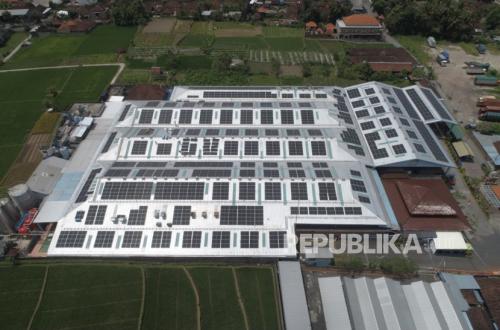
Danone Indonesia is utilising solar energy to support more efficient and low-emission operations. To date, the company has operated Solar Power Plants (PLTS) at 11 production facilities with a total installed capacity of more than 10.4 megawatt peak (MWp).
Director of Public Affairs & Sustainability at Danone Indonesia, Karyanto Wibowo, stated that the use of solar energy is one of the company’s steps to reduce its operational carbon footprint while improving energy efficiency. He noted that this initiative is part of a broader decarbonisation strategy that also includes environmental rehabilitation and conservation, biodiversity protection, transport optimisation, operational efficiency, and the use of biomass as an alternative energy source.
“The utilisation of solar energy across various production facilities is a concrete step for us in reducing our operational carbon footprint while enhancing energy efficiency. All these efforts are part of Danone Indonesia’s long-term commitment to support Indonesia’s Net Zero Emissions target,” Karyanto said in a statement on Thursday (17/7/2026).
The 11 production facilities equipped with solar power plants are located in Klaten, Ciherang, Banyuwangi, Mekarsari, Mambal, Cianjur, Langkat, Prambanan, Yogyakarta, Sentul, and Ciracas. The adoption of solar energy is part of the company’s broader push to increase the use of renewable energy in its operations.
Beyond solar energy, Karyanto explained that the company is running various other decarbonisation programmes, including planting more than 2.6 million trees across a 6,000-hectare conservation area, developing 20 biodiversity parks (KEHATI), optimising transport and operational efficiency, and utilising rice husk boilers as an alternative energy source at its production facilities.
Karyanto added that the use of solar energy in Indonesia is aligned with Danone’s global commitment as a member of RE100, which targets 100 per cent renewable electricity across all global operations by 2030.
For its implementation of solar energy, Danone Indonesia received the Solar Awards 2026 in the industrial category during the Indonesia Solar Summit (ISS) 2026 held in Bali from 14 to 16 July 2026. The award recognises institutions that have demonstrated tangible implementation of solar energy.
Fabby Tumiwa, Chief Executive Officer of the Institute for Essential Services Reform (IESR), said the Solar Awards are a form of appreciation for institutions that have shown real implementation of solar energy. “Through this award, we hope more best practices will emerge to drive the development of the solar energy ecosystem while strengthening the transition towards a low-carbon economy in Indonesia,” Fabby said.