
Danantara Unveils Five-Year Strategy to Transform State-Owned Enterprises
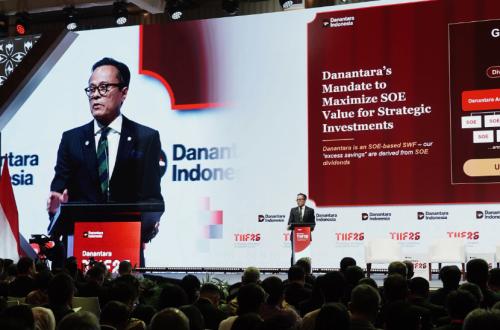
JAKARTA — Danantara Indonesia is preparing a five-year roadmap to transform state-owned enterprises (SOEs), aiming to improve company performance and the competitiveness of national industry. The strategy includes SOE consolidation and restructuring, technology development, increased industrial capacity and investment in strategic sectors.
Danantara Indonesia Chief Operating Officer Dony Oskaria said SOE transformation was necessary for state-owned companies to make a greater contribution to economic growth. The reforms involve improving corporate structures, strengthening human resources, changing corporate culture and making use of technology.
Dony made the remarks at the Danantara Indonesia International Forum (DTIIF) 2026, held at the Fairmont Jakarta on Monday, 26 October 2026. The forum brought together government, business and other stakeholders to discuss national industrial transformation and investment strategies.
“Through consolidation, restructuring, stronger human resources and the use of technology, we want to improve company performance so that companies can make a greater contribution to Indonesia’s economy,” Dony said in a press release on Tuesday, 27 October 2026.
Dony said the transformation was also intended to increase SOEs’ ability to generate profits that could be reinvested. Business development would therefore rely not only on expansion, but also on improving the productivity and performance of existing operations.
Airport management is one of the areas targeted for reform. Danantara is seeking to improve the passenger experience while developing revenue streams beyond aviation services, known as non-aeronautical revenue.
Alongside SOE reform, Danantara sees technology development as a strategy for increasing the added value of domestic industry. This includes strengthening capabilities in product design, research and development, and large-scale production.
Danantara Indonesia Chief Technology Officer Sigit Puji Santosa said greater industrial capacity was needed for Indonesia to produce higher-value-added goods. Mastery of technology and the ability to make more complex products were necessary to improve competitiveness in international markets, he said.
During the Danantara Grand Design & Strategic Portfolio Outlook session, Sigit outlined an industrial development strategy based on three principles: increasing industrial complexity, deepening domestic capabilities and developing businesses at a scale that can compete globally.
“We need to improve industrial capabilities, from design and research and development through to mass production, so Indonesia can create greater added value. We are developing projects across several priority industrial clusters to strengthen national capacity and build a more competitive industry,” Sigit said in a press release on Tuesday, 27 October 2026.
The strategy identifies technological mastery as one factor in increasing the added value of industrial products. Building domestic capacity is also expected to expand the role of Indonesian companies in production chains.
On funding, Danantara emphasised the importance of balancing investment returns with strategic benefits to the economy. Investment decisions should take into account risk and a project’s ability to generate long-term value.
Danantara Indonesia Chief Investment Officer Pandu Patria Sjahrir said financial discipline and risk management were fundamental to selecting investment projects. Strategic investments must also make commercial sense to remain sustainable, he said.
Pandu made the remarks at DTIIF 2026, where the management of Danantara’s strategic investment portfolio was also discussed. Projects are intended to generate returns while supporting national economic development.
“Every investment needs to take account of both commercial returns and strategic impact, while maintaining risk management and financial discipline. We want to ensure that investments create long-term value and support the development of Indonesia’s strategic sectors,” Pandu said in a press release on Tuesday, 27 October 2026.
One project presented was a waste-to-energy scheme valued at around US$1.5 billion. It was cited as an example of an investment combining infrastructure development with the need to manage waste.
Pandu said bond issuance for the project attracted demand of almost four times the amount offered, or was nearly four times oversubscribed. Around 75 per cent of total demand came from investors in the United States and Europe.
The strong demand points to international investor interest in financing sustainable infrastructure projects in Indonesia. However, high bond demand does not in itself demonstrate the project’s eventual economic benefits or performance once operational.
At the same forum, Asian Development Bank Institute (ADBI) Dean and Chief Executive Officer Bambang P. Brodjonegoro highlighted the importance of technology in increasing added value in manufacturing, agriculture and services.
Bambang also stressed the need to balance increased investment in research and development with reliable energy supplies during the transition.
Meanwhile, Economic Research Institute for ASEAN and East Asia (ERIA) President Tetsuya Watanabe said the government should share early-stage risks with the private sector in developing advanced technologies. The success of technology development should be assessed by implementation and results, rather than simply by the number of ideas generated, he said.
DTIIF 2026 also featured two Nobel Prize-winning economists, Peter Howitt and Thomas J. Sargent. Government officials and international technology industry figures attended to discuss investment priorities, industrial transformation and technology development.
Government representatives at the forum included Bank Indonesia Governor Destry Damayanti, Finance Minister Suahasil Nazara, Minister of Higher Education, Science and Technology Brian Yuliarto, and National Development Planning Minister and Bappenas chief Rachmat Pambudy.
SpaceX Regional Vice President Chris Walker and Airbus Defence Southeast Asia Head Jose Corcia appeared in the “Intelligence at the Edge” session alongside Indonesian Engineers Association President Ilham Akbar Habibie.
The implementation of Danantara’s five-year roadmap will be one factor shaping the direction of SOE transformation and national industrial development. The effectiveness of restructuring, investment capacity and improvements to domestic technological capabilities will be crucial to achieving its goals.