
Danantara Ready to Invest as IDX Composite Plunges 11.57%
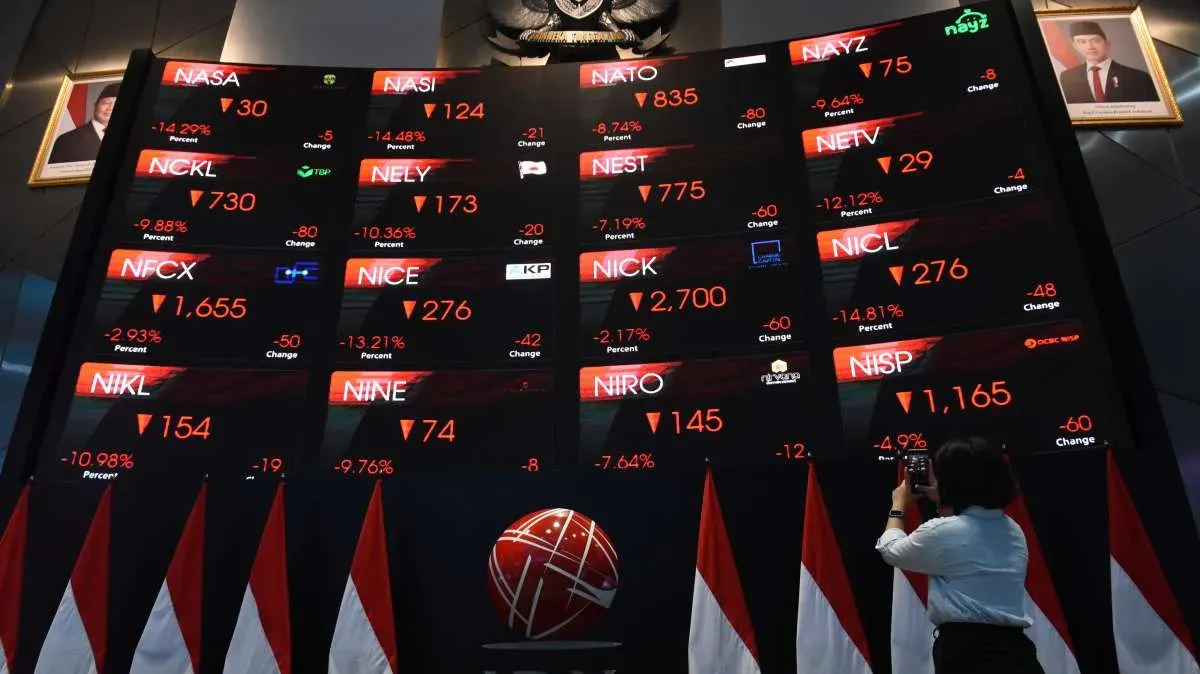
The sharp correction in Indonesia’s stock market has opened up potential investment opportunities for the Daya Anagata Nusantara Investment Management Agency (BPI Danantara). Danantara CEO Rosan Roeslani said the agency was ready to invest in shares of state-owned companies after the Indonesia Stock Exchange Composite Index (IHSG) fell 11.57% at the close of trading on Friday (16 October 2026). According to data reported by Kontan, the index ended the session at 5,185.10.
So far in 2026, the benchmark stock index has fallen 40.04%, while the IDX BUMN20 index has declined 31.98% since the start of the year. Market pressure emerged after MSCI announced a consultation on a proposed change to Indonesia’s index classification from Emerging Market to Standalone Market. A final decision on the proposal is scheduled by the end of June 2027 at the latest.
Rosan said falling share prices could offer Danantara an opportunity to take long-term investment positions, rather than pursue profits through frequent short-term trading.
“We see this as an opportunity for the future. As Danantara, we always view investment as a long-term investment, not as an investor that goes in and out and can enter at any time,” Rosan said at a press conference at the Indonesia Stock Exchange on Friday (16 October 2026). In remarks cited by Kontan and Kompas TV, he expressed confidence in the fundamentals of listed state-owned companies. He highlighted the banking sector, which he said was still valued below comparable companies, and described the outlook for infrastructure and telecommunications as positive.
The optimism is also reflected in plans for several state-owned companies to launch initial public offerings (IPOs) in 2027. According to Kontan, Danantara is targeting companies in the financial, infrastructure and mining sectors for listings. Alongside the investment and IPO plans, state-owned enterprise restructuring has received support in the form of a 0% tax incentive for certain transactions. The provision appears in the annex to Director General of Taxes Regulation No. PER-12/PJ/2026, although technical rules for a 0% final income tax rate are still being drafted.
Rully Arya Wisnubroto, chief economist and head of research at PT Mirae Asset Sekuritas Indonesia, said state-owned shares still offered opportunities, but investors needed to assess each company individually. Balance-sheet strength, asset quality, cash-generation capacity and reliance on government policy were key differentiating factors. Rully stressed that restructuring incentives would deliver tangible benefits to shareholders only if companies improved efficiency, profitability and balance-sheet quality.
Mergers or business reorganisations do not automatically create value unless they are accompanied by operational improvements and disciplined capital use. Rully said the challenges posed by MSCI were not limited to share prices. Transparency, corporate governance and market accessibility also mattered to global investors, meaning low valuations might not be enough to attract foreign funds if perceptions of risk in Indonesia increased.
He said companies with healthy balance sheets, strong cash flows and business models relatively independent of government assignments were better placed than companies with high debt and substantial funding needs. Investors should also monitor capital expenditure, dividend policies, asset quality and changes in capital allocation under Danantara.
For portfolio strategy, Rully advised against aggressively selling high-quality state-owned shares solely because of the market correction. However, he did not yet recommend large-scale repurchases, preferring gradual investment in fundamentally strong shares while maintaining portfolio liquidity. Capital-market observer Edwin Sebayang said government support for state-owned companies needed to translate into higher profits, stronger cash flows, more efficient capital use and protection for minority shareholders over the next two years.
Edwin said the success of restructuring and capital management would determine whether the policy genuinely strengthened listed companies’ performance. He also said 2027 state-owned enterprise IPOs could attract interest because investors were already familiar with the businesses, disclosures could improve and access to funding would widen. However, investor demand could be limited if the market had not recovered, offer prices were too high, the public float and liquidity were insufficient, or governance uncertainty remained.
He cautioned that the IHSG’s decline should not be the sole basis for investment decisions. Investors should tailor their actions to their purchase price, the share’s weighting in their portfolio, investment horizon, liquidity needs and the fundamentals of each company.
Rully also said Danantara’s involvement in the exchange demutualisation process would not directly determine the operating performance of state-owned listed companies. The policy’s impact was more closely related to capital-market governance and oversight, while any improvement in the exchange’s independence and investor confidence would depend on how it was implemented and supervised.
Source: jawawa.id (https://jawawa.id/newsitem/danantara-ready-to-invest-as-idx-composite-plunges-11-57-1792425021)
Originally published by suaraindependentnews.id (https://www.suaraindependentnews.id/danantara-investasi-saat-ihsg-anjlok), translated from Indonesian