
Danantara COO Reveals Details of SOE Performance Improvements
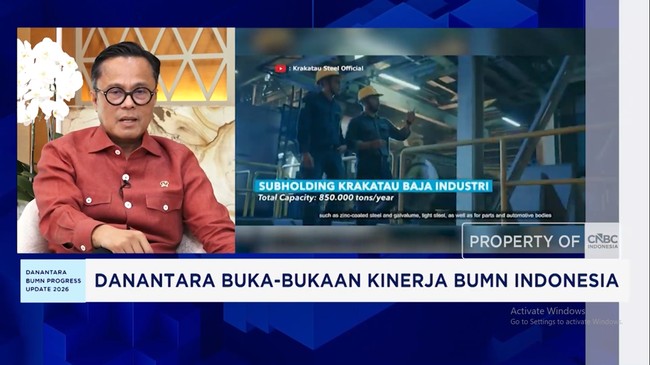
Chief Operating Officer of BPI Danantara Dony Oskaria has opened up about the performance improvements of state-owned enterprises (SOEs) under Danantara’s management. The key to improving SOE performance is the result of business transformation, management overhaul, efficiency measures, and restructuring.
Several SOEs such as PT Semen Indonesia Tbk, PT Pegadaian, PT Pupuk Indonesia, PT Timah Tbk, and PT Krakatau Steel Tbk have recorded stellar performance in recent times.
“Actually, this is one of the things that needs to be conveyed to the public. Of course, many are asking whether this improvement happened by itself or whether there was intervention from Danantara, and of course we are not just saying that this is because of intervention or transformation that was carried out. But please ask and validate with each company yourself,” he said on CNBC Indonesia’s Squawk Box on Monday (24/8/2026).
As an example, Dony explained that Semen Indonesia’s previous business model was considered ineffective. This was because overly centralised sales meant factories such as Semen Padang and Semen Tonasa lost direct access to the market.
Danantara then tried to change this structure by returning the sales function to each unit, strengthening the management team, improving the distribution system, and reducing production costs.
Thanks to this strategy, Semen Indonesia managed to record more competitive production costs. The company is targeted to be able to generate a profit of up to Rp 1 trillion in 2026.
A similar approach was also taken by Pegadaian to improve its performance. In this context, Pegadaian transformed digitally to increase penetration into new markets. One of these was strengthening its gold business through a digital platform called Tring!, as well as developing a bullion bank ecosystem. Seeing this, Dony is optimistic that Pegadaian will be able to achieve a profit of Rp 12 trillion in 2026.
In addition, Pupuk Indonesia underwent a change in its business model from cost plus to mark to market. This change succeeded in reducing costs, increasing production, opening up export opportunities, and boosting the company’s profits.
Dony continued that, based on Danantara’s mapping, the main problems of SOEs so far stem from three things: excessive investment, financial engineering, and fraud. Therefore, Danantara now requires every investment to calculate its rate of return or return on investment.
In addition, Danantara also continues to make efforts to impair various assets and companies that are deemed not to reflect their true condition. He stressed that companies must no longer polish their financial reports just to appear healthy.
“Especially the reality that we are making improvements in the performance of other companies. I am very happy to see them one by one. Krakatau Steel, imagine when we took over Krakatau Steel, its debt was Rp 26 trillion, not a single factory was running, it had a blast furnace that was idle and not operating, it had one HSM that was burnt and also not operating, the company was empty, there was no activity at all. Then we started restructuring Krakatau Steel, helped by an extraordinary Managing Director,” he explained.
Ultimately, the performance improvements of these SOEs do not only impact the strengthening of Danantara’s position. More than that, the benefits of the performance improvements carried out by these SOEs will be felt by the wider community.