
Danantara COO Exposes Pharmaceutical SOE Problems Amid Investor Dispute
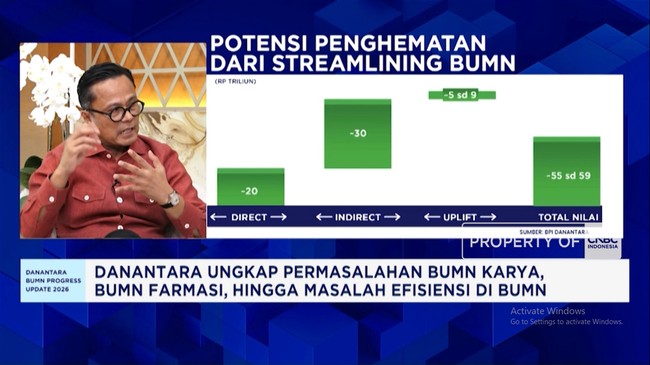
Chief Operating Officer of BPI Danantara Dony Oskaria has spoken out about various problems faced by state-owned enterprises (SOEs) in the pharmaceutical sector. The problems include factory investment, low utilisation, high debt burdens and issues with pharmacy networks.
He admitted that when Danantara carried out its transformation, the condition of PT Kimia Farma Tbk was concerning. The company’s financial position was unhealthy due to investment decisions that did not consider return on investment.
“This was caused by excessive investment. Investment that was not measured by return on investment. They built many large factories with low utilisation. Because the factory investment was so large, there were financing costs through debt and depreciation, causing the company to lose money, while utilisation was only 40%,” Dony said on Squawk Box CNBC Indonesia, Thursday (27/8/2026).
The second problem, he continued, also affected Kimia Farma’s subsidiary, PT Kimia Farma Apotek, which has more than 1,000 pharmacies. Previously, the company received investment of Rp 1.5 trillion from the Indonesia Investment Authority (INA) together with a partner from China. However, when the verification process was carried out, problems emerged with inventory data.
“Along the way, the data presented by Kimia Farma Apotek was false. Because the data was false, the investor complained. How was it false? All the inventory — you can imagine we have more than 1,000 pharmacies — the data, the stock, was manual and could not be verified. When they carried out verification, the data was all false,” Dony revealed.
Ultimately, the problem led to a dispute with the investor. As a result, Kimia Farma had an obligation to return the investment along with penalties and other costs. Consequently, Danantara pushed for restructuring by replacing management and improving the information technology systems at Kimia Farma Apotek.
At the holding level, Kimia Farma also faced financial constraints that caused the number of products produced to be continuously reduced. As a result, only 99 products are currently produced by the company.
In order to save Kimia Farma, Danantara also carried out an equity injection as well as debt restructuring. These efforts have begun to yield results, as Kimia Farma has recorded a profit this year.
Nevertheless, Dony acknowledged that not all SOEs can be saved. In this regard, he cited Indofarma as an example, which is considered to have a business scale that is too small, limited production capacity, few flagship products, and debt and asset conditions that are no longer balanced.
As is known, Danantara has established a number of parameters to determine which SOEs are still worth saving or must enter the liquidation process. Dony said the SOE rescue process will be carried out in stages, given that there are thousands of companies and entities that need to be handled.
Source: jawawa.id (https://jawawa.id/newsitem/danantara-coo-exposes-pharmaceutical-soe-problems-amid-investor-dispute-1787824295)
Originally published by CNBC Indonesia (https://www.cnbcindonesia.com/market/20260827152516-17-762796/ngeri-sengketa-dengan-investor-bos-danantara-buka-borok-bumn-farmasi), translated from Indonesian