
Danantara Advances Eight Waste-to-Energy Projects: Prospects for CDIA, BIPI, BNBR and OASA
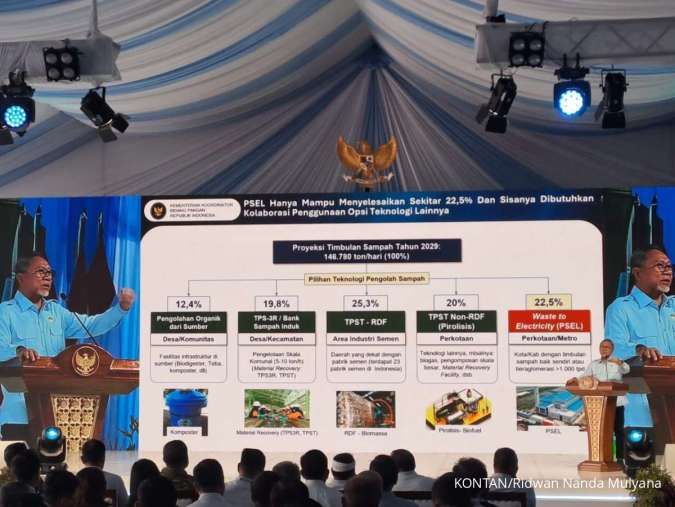
KONTAN.CO.ID – JAKARTA. Danantara Indonesia, through PT Daya Energi Bersih Nusantara (Denera), is pressing ahead with the second phase of its waste-to-energy (WtE) programme, known as Pengolahan Sampah menjadi Energi Listrik (PSEL), with an investment of Rp 18 trillion.
For phase II, Danantara is targeting eight locations in Indonesia: Greater Medan, Bekasi Regency, Lampung, Serang, Semarang, Surabaya, Greater Bogor 2 and Greater Yogyakarta.
Denera CFO Ramadan Harahap said in an official statement that preliminary funding commitments received had exceeded US$4 billion, or around 3.6 times the target financing requirement.
The funding support comes from a consortium including 13 international banks, multilateral financial institutions such as the Asian Development Bank (ADB), Asian Infrastructure Investment Bank (AIIB), Islamic Development Bank (IsDB) and KfW, as well as state-owned banks and domestic commercial banks. Loan tenors offered extend to 23 years.
Before this second phase, phase I of the PSEL or WtE programme had already attracted several publicly listed companies. These included PT Maharaksa Biru Energi Tbk (OASA), PT Astrindo Nusantara Infrastruktur Tbk (BIPI), PT TBS Energi Utama Tbk (TOBA), PT Multi Hanna Kreasindo Tbk (MHKI), PT Boston Furniture Industries Tbk (SOFA) and PT Impack Pratama Industri Tbk (IMPC).
TOBA, previously known as a coal company, is now shifting its focus to renewable energy and electric vehicles. Its move further into waste management became more apparent after it acquired Sembcorp Enviro.
IMPC, a plastic packaging company, has also entered the waste management business. Unlike TOBA, IMPC’s involvement is connected to its existing business, as plastic is one of the materials that can be recycled.
IMPC manages waste through its subsidiary PT Sirkular Karya Indonesia (SKI). SKI has also signed a memorandum of understanding with PT CCEPC Indonesia to explore the development of a WtE project in Bali.
Under the partnership, SKI will provide investment support, while CCEPC will handle technical aspects as the engineering, procurement and construction (EPC) contractor and the operations and maintenance (O&M) operator. CCEPC has also pledged to support SKI exclusively in every WtE project tender it enters.
MHKI, meanwhile, is a waste manager at Bantargebang in Bekasi and is preparing to expand its waste management operations to other areas, including Lamongan in East Java.
The company received Rp 4.95 billion in financing support from PT Bank Rakyat Indonesia Tbk (BBRI) to strengthen its operations and develop more modern waste-processing technology.
OASA is also actively developing waste-to-energy power plant projects, including one in East Jakarta, which is targeted to begin operating in the first quarter of 2028, and the 25-megawatt (MW) Cipeucang WtE project in South Tangerang.
OASA has confirmed that it is participating in the tender for Danantara’s WtE projects. It is also exploring cooperation with consortium partners, including a Chinese company with large-scale waste-processing capacity.
Phase I PSEL projects are also progressing. Most recently, Danantara inaugurated construction of the Greater Bogor 1 PSEL facility in Bogor last September. It is the third PSEL facility to enter the construction stage, after Greater Denpasar in Bali and Bekasi City. The Bogor facility is targeted to begin operations in 2028.
Danantara says interest from prospective partners has also increased for phase II. Denera recorded 85 prospective partners for this phase, compared with 24 in phase I.
For phase II, Danantara has brought in PT Chandra Daya Investasi Tbk (CDIA) as one of its partners. CDIA’s involvement marks a step by PT Chandra Asri Pacific Tbk (TPIA) into the waste management business.
In a written statement, the issuer affiliated with Prajogo Pangestu said the project remained at an early stage of feasibility study and evaluation.
“The continuation of the PSEL project will depend on the results of the feasibility study (FS) and the issuance of the Final Letter of Award,” TPIA Corporate Secretary Erri Dewi Riani said.
The company is also not yet able to disclose the final investment value, its subsidiary’s investment share, potential contributions to revenue or net profit, or the project’s expected completion date.
Besides TPIA through CDIA, phase II PSEL projects also involve PT Bakrie & Brothers Tbk (BNBR) through PT Bakrie Power, as well as PT Astrindo Nusantara Infrastruktur Tbk (BIPI) and OASA.
The locations and partners for the phase II PSEL projects are as follows:
Greater Medan: The SUEZ Insan Asia consortium from France and Indonesia, with capacity of 1,700 tonnes per day.
Bekasi Regency: The Everbright Cemerlang Energy consortium, involving China Everbright, Harmoni and Bioregen.
Greater Lampung: The Bumi Biru Indonesia consortium, involving SUS Indoplas and PT Maharaksa Biru Energi Tbk (OASA).
Greater Serang: The Masa Depan Energi Indonesia consortium, involving Chandra Waste Energy, a subsidiary of PT Chandra Daya Investasi Tbk (CDIA), which is also associated with PT Chandra Asri Pacific Tbk (TPIA), as well as BGE. It has capacity of 1,161 tonnes per day.
Greater Semarang: Veolia Environmental Services Asia, with capacity of 1,100 tonnes per day.
Greater Surabaya: The Mentari Citra Lestari consortium, involving Bakrie Power, owned by PT Bakrie & Brothers Tbk (BNBR), Acritas Karya Persada and SUS Indonesia Holding, which is affiliated with PT Astrindo Nusantara Infrastruktur Tbk (BIPI).
Greater Bogor 2: The MPM-CEVIA, or Mega Power CEVIA, consortium.
Greater Yogyakarta: The Cakra Energi Lestari consortium, involving Pertamina Power Indonesia, Tianjin TEDA and CITICC.
Capital market observer and founder of Sekolah Saham Indonesia Raden Bagus Bima said the PSEL projects could provide a positive catalyst for business diversification and long-term growth at the companies involved.
If the projects proceed as planned, PSEL development could open up access to broader contracts, particularly in the new energy and waste management sectors, which still have room to grow.
“If this succeeds, the issuers could have the potential to secure a wider range of contracts, particularly through opportunities in new energy and waste management, where there are not yet many prominent competitors,” Bima told KONTAN recently.
Mirae Asset Sekuritas senior investment analyst Nafan Aji Gusta agreed, saying CDIA’s participation in phase II PSEL could be a positive catalyst for the company’s medium- to long-term business prospects.
“The project, which covers eight locations in Indonesia, gives the company an opportunity to expand its exposure to clean energy, waste management and sustainable infrastructure,” Nafan said.
This diversification could strengthen growth prospects, particularly for CDIA and TPIA, and for BNBR through PT Bakrie Power, beyond their existing business segments. Participation could also improve revenue visibility if the companies secure significant operational or commercial roles.
TPIA’s 2025 annual report indicates that the company has begun shifting its focus towards converting waste into energy from a business previously involved in sea transport.
TPIA began developing this business by establishing PT Chandra Waste Energy (CWE), which sits directly under CDIA. CWE has also joined the Masa Depan Energi Indonesia consortium with Beijing GeoEnviron Engineering and Technology Inc. Chandra Waste Energy was previously named PT Chandra Global Maritim (CGM).
In the first quarter of 2026, TPIA’s infrastructure segment remained its smallest revenue contributor, at US$87.50 million. However, this was up from US$52.01 million in the same period a year earlier. The increase indicates that TPIA’s business shift was already becoming visible before Danantara’s PSEL projects began.
CDIA has also said business diversification is part of its long-term strategy. Management described its participation in Danantara’s phase II PSEL programme as support for the government’s agenda to promote environmentally friendly energy.
BNBR has entered the project through Bakrie Power. BNBR owns 99.99% of Bakrie Power, which has joined the Mentari Citra Lestari consortium alongside PT Acritas Karya Persada and SUS Indonesia Holding Limited.
The company, founded in 1994, initially operated in the power generation sector. In 2025, manufacturing and infrastructure were BNBR’s largest revenue-contributing segments, with consolidated revenue of Rp 3.11 trillion. This was down from Rp 3.47 trillion in 2024.
Under Danantara’s PSEL programme, Bakrie Power will develop a waste-to-energy facility in Greater Surabaya with capacity of 1,100 tonnes per day.
Nafan stressed that the Rp 18 trillion investment is an allocation for the overall development of phase II PSEL projects and does not automatically represent revenue or contract value for the companies involved.
The scale of the impact on each company’s performance will depend on its level of involvement, the structure of its partnership with Danantara through Denera, the division of responsibilities with other partners and the potential returns.
“This is certainly positive sentiment, but the market still needs to wait for clarity on contract values, financing arrangements and the project’s contribution to the companies’ financial performance,” he said.
Bima also agreed that the projects’ impact on the performance of participating companies would depend heavily on each company’s level of involvement and the successful execution of phase II. That success would also affect their chances of securing subsequent projects.
In the short term and through early 2027, the projects are likely to make only a limited contribution to the revenue and profits of participating companies, as several facilities remain under construction.
“Performance results will become more evident once the projects begin commercial operations and generate recurring revenue,” Bima added.
Alongside their potential to drive growth, the PSEL projects carry risks that investors should monitor. Nafan highlighted the risk of delays arising from coordination among local governments, waste managers, technology providers and state electricity company PLN, which will buy the electricity.
“Delays in land provision, permits, design completion or facility construction could push back operating schedules and postpone revenue realisation,” he said.
Another risk stems from the substantial investment requirements. If financing relies on borrowing, higher interest costs, construction cost overruns or revenue arriving later than expected could weigh on investment returns.
On the operational side, a reliable supply of waste is also crucial. PSEL facilities need an adequate and consistent supply in terms of both volume and composition.
If supply does not meet requirements or processing requires additional expenditure, operating costs could rise and electricity production could be less efficient.
For the listed companies involved, the scale of these risks will depend on the financing share and responsibilities each company actually assumes.
Bima also pointed to risks including construction delays, higher investment costs, waste-processing technology issues and management’s ability to execute the projects.
Investors should also monitor how the economic benefits are divided among CDIA, TPIA, BNBR and other project partners, including ownership structures, risk allocation and payment mechanisms for services or electricity generated.
“These factors will determine whether the projects genuinely become a fundamental catalyst for revenue and profit growth at the listed companies involved,” Bima concluded.
Source: jawawa.id (https://jawawa.id/newsitem/danantara-advances-eight-waste-to-energy-projects-prospects-for-cdia-bipi-bnbr-and-oasa-1792900243)
Originally published by insight.kontan.co.id (https://insight.kontan.co.id/news/danantara-garap-8-proyek-waste-to-energy-simak-peluang-cdia-bipi-bnbr-dan-oasa), translated from Indonesian