
D-8 Targets $500 Billion in Intra-Regional Trade, Indonesia Strengthens Global Halal Economy
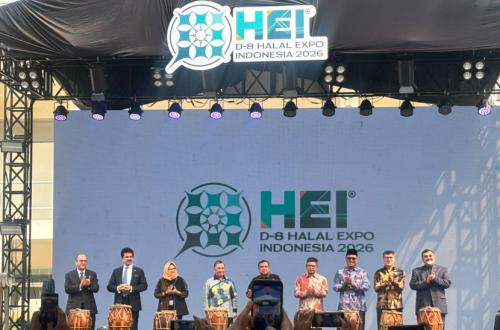
The D-8 member states are targeting an intra-regional trade value of 500 billion US dollars by 2030. This target leaves considerable work to be done, as the current trade value among member countries stands at only around 116 billion US dollars.
D-8 Secretary-General Sohail Mahmood stated that the target is part of the D-8 2030 Roadmap, which focuses on strengthening economic cooperation among member states. “Member states have committed to increasing intra-D-8 trade to reach 500 billion US dollars by 2030. So far, the progress achieved has been quite encouraging. The trade value among D-8 member states has reached 116 billion US dollars,” he said during the Opening Ceremony of the D-8 Halal Expo Indonesia in Jakarta on Wednesday (8/7/2026).
Indonesian Deputy Foreign Minister Anis Matta said that strengthening trade among D-8 member states is increasingly important amidst global geopolitical uncertainty. He noted that member states now possess a much stronger political will to enhance economic cooperation. “Firstly, cooperation among these countries is now much stronger, especially because there is a strong political will among the leaders to strengthen it,” he said.
Anis assessed that the global geopolitical situation is prompting many countries to diversify their economic relations. Consequently, the D-8 is accelerating the resolution of various trade barriers, ranging from tariffs and logistics to regulations, in order to achieve the 500 billion US dollar trade target.
To pursue this target, Sohail Mahmood said the D-8 is promoting the strengthening of trade and industry, the digital economy, artificial intelligence (AI), innovation, energy security, transport connectivity, food security, tourism, and the development of micro, small, and medium enterprises (MSMEs), as well as the green transition.
He assessed that the halal economy is a sector capable of connecting various industries, from trade, manufacturing, and agriculture to logistics, finance, digital technology, and innovation. The halal industry is also one of the fastest-growing sectors in the world. However, despite this vast potential, Muslim-majority countries are not yet the main players in global halal trade. “This condition shows that the challenge we face lies not in the size of the market, but in the ability to create added value,” he said.
Sohail added that the D-8 possesses significant capital to change this situation. Its member states have strong agricultural production, diverse manufacturing capacities, internationally recognised halal certification systems, strategic shipping lanes, growing digital economies, and expanding consumer markets. As a result, the D-8 is proposing the establishment of an integrated halal trade corridor through the harmonisation of halal standards and certification, the development of halal logistics, and the simplification of trade procedures. “These steps will significantly lower transaction costs while accelerating the flow of trade among member states,” he stated.