
Cyrus Survey: Public Supports MBG Programme but Calls for Improvements
Jakarta (ANTARA) - A national survey by Cyrus Network shows that the majority of the public still supports the Free Nutritious Meals (MBG) programme, but urges improvements in its implementation and governance for sustainability.
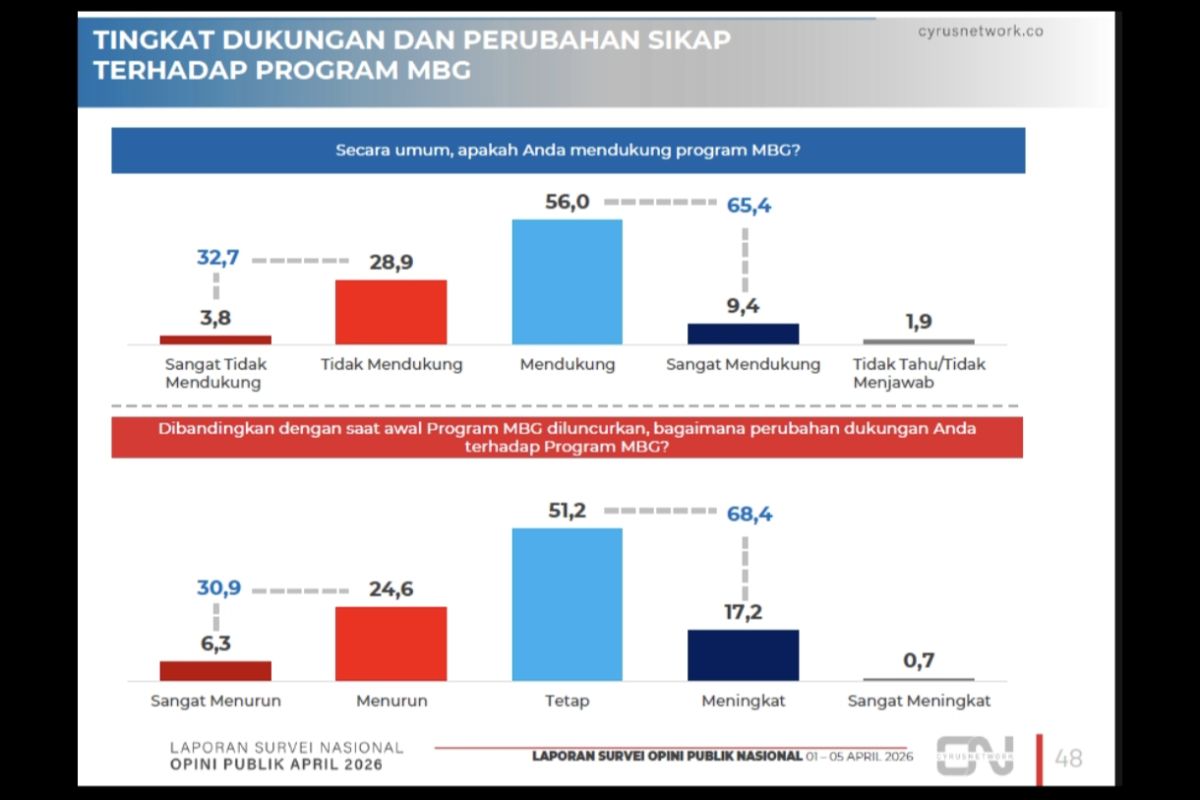
Lead researcher at Cyrus Network, Syahril Ilhami, stated that public support for the MBG programme reaches 65.4%, although nearly half of respondents want improvements in its execution.
“As many as 65.4% of the public support Free Nutritious Meals, meaning two out of three Indonesians still hold hope for this programme. However, 45.6% of the public want improvements in implementation. This number is quite significant, with nearly 70% of MBG supporters wanting improvements,” he said during an online presentation in Jakarta on Tuesday.
He explained that public support is driven by the tangible benefits felt by society, particularly in fulfilling nutritional needs and reducing family economic burdens.
“The three main reasons for this support are helping to meet public nutrition (31.5%), reducing family economic burdens (28.4%), and supporting the health of schoolchildren, toddlers, pregnant women, and breastfeeding mothers (23%),” he said.
Additionally, other benefits such as equitable welfare distribution, long-term impacts on the younger generation, and support for local SMEs and farmers are also recognised, albeit in smaller percentages.
On the other hand, public evaluation of the programme’s implementation is a key note, particularly regarding quality and targeting accuracy.
“Reasons for non-support include implementation deemed inadequate (30.1%), questionable food quality (22.3%), and inaccurate targeting (11.7%). These can serve as forward-looking suggestions for the National Nutrition Agency as the MBG organiser,” Ilhami said.
The survey also shows very high public knowledge of the MBG programme, reaching 98.6%. Of that number, 61.6% of respondents said their families are direct beneficiaries, while 11.3% others feel indirect benefits.
“Knowledge of MBG has reached 98.6%. This indicates the programme is massive and felt by the public, both as beneficiaries and as part of the supply chain such as kitchens and food suppliers,” he said.
Additionally, the dynamics of public support are recorded, where 51.2% of respondents have supported it since the programme’s launch and 17.2% state their support has increased. However, 30.9% of respondents admit their support level has decreased.
The survey was conducted from 1–5 April 2026, involving 1,260 respondents in 126 villages or sub-districts across 38 provinces using multistage random sampling, with a 95% confidence level and a margin of error of around 2.82%.