
Cycling Seen as a Solution for Decarbonising Jakarta's Transport
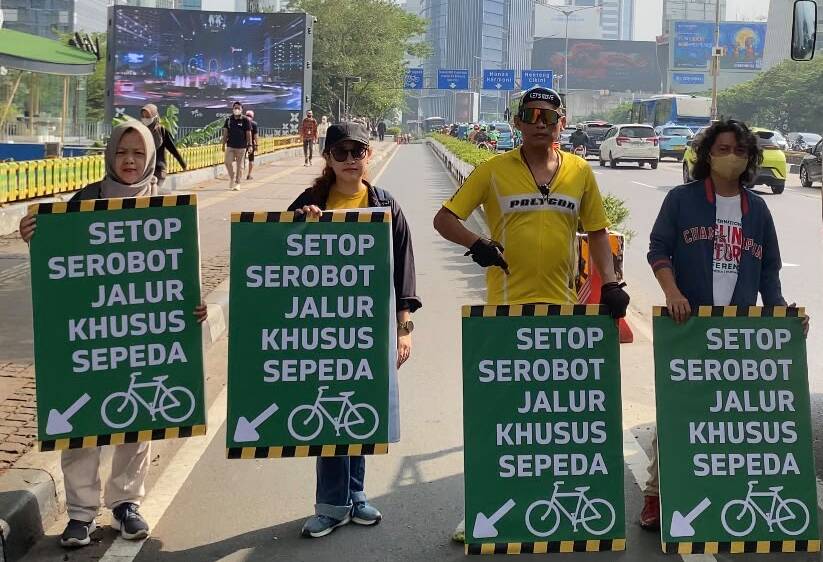
Air quality in Jakarta and its surrounding areas has again come under scrutiny as PM2.5 pollutant concentrations are reported to exceed the safe thresholds set by the World Health Organization (WHO) and national standards. Bike to Work (B2W) Indonesia, together with the Committee for the Phasing Out of Leaded Petrol (KPBB) and the Pedestrians Coalition (KoPEKA), is encouraging the use of bicycles as a transport option to reduce carbon emissions and help curb urban air pollution. The three groups consider fossil-fuel-based land transport to be one of the main sources of emissions and air pollution in Jakarta. The daily use of large numbers of motor vehicles produces emissions that affect air quality and public health.
B2W Indonesia, KPBB, and KoPEKA say that using bicycles for daily journeys, particularly on first-mile and last-mile routes, can form part of efforts to decarbonise the transport sector. Cycling is also seen as capable of reducing carbon dioxide (CO2) emissions as well as a range of air pollutants such as HC, CO, NOx, SOx, PM10, and PM2.5. Beyond the emissions issue, cycling is considered helpful in reducing traffic congestion. A reduction in the number of motor vehicles on the roads is expected to lower fuel consumption, including emissions produced when vehicles stop with their engines still running, or idling. Cycling is also being promoted for integration with public transport such as the MRT, LRT, and TransJakarta. Such integration is seen as capable of forming a lower-emission and more sustainable urban mobility system.
To support the net zero emission target of 2060 or sooner, B2W Indonesia, KPBB, and KoPEKA are urging the government and stakeholders to strengthen infrastructure and policies that support low-emission mobility. First, protected cycle lanes are considered necessary to be maintained, expanded, and integrated. These lanes are expected to connect residential areas, business centres, and public transport stations safely. Second, the provision of supporting facilities such as secure bicycle parking and shower rooms is encouraged in office buildings, stations, public transport stops, and shopping centres. Third, the groups are calling for law enforcement against motor vehicles that use or encroach on cycle lanes. Keeping cycle lanes clear is deemed important to guarantee the safety of cyclists.
“Air pollution in Jakarta is a real public health crisis. Cycling is not merely a lifestyle choice, but a form of climate-saving action and the most effective air pollution control that can be undertaken by every city resident today,” stressed Bike to Work Indonesia representative Sanny Tanuwijaya. “B2W Indonesia invites all levels of society to start prioritising bicycles in daily activities and together reclaim the right to clean air in Jakarta’s skies,” said B2W Indonesia Chairman Hendro Subroto.
B2W Indonesia, KPBB, and KoPEKA emphasise that cycling does not mean people must completely abandon private motor vehicles. They are encouraging a shift in transport mode choices by increasing the share of walking, cycling, and public transport in urban mobility. It is not about avoiding private motor vehicles, but about improving choices. A prosperous city is not one that demands everyone own a private vehicle so that roads and various open spaces are filled with motor vehicle congestion. “Cities are for people, not for motor vehicles,” exclaimed Koalisi Pejalan Kaki (KoPEKA) activist Amalia S Bendang, who is also Indonesia council for CMC SEA (Clean Mobility Coalition South East Asia). “For that reason, urban transport modes for residents’ journeys must be proportional, prioritising walking, cycling, and mass public transport, so that residents have humane and equitable mobility choices.”
Meanwhile, KPBB Advocacy Programme Manager Alfred Sitorus stressed the importance of providing public transport that can support public mobility while also being connected to facilities for cyclists and pedestrians. “The city must provide safe, comfortable, and scheduled mass public transport equipped with cycle lanes and safe pedestrian facilities,” Alfred Sitorus said.