
Customs Uncovers Smuggling of 8.9 Million Illegal Cigarettes
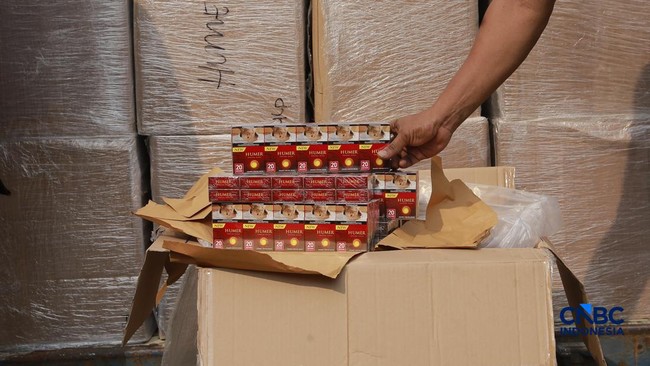
The Directorate General of Customs and Excise (DJBC) at the Ministry of Finance has successfully foiled the smuggling of 8.96 million illegal cigarettes. Director General of Customs and Excise Djaka Budhi Utama explained that the enforcement action began with a tip-off from the public, which was followed up by surveillance officers who identified two containers at the port suspected of transporting illegal cigarettes, declared as pipes and lightweight steel. The containers were then secured and scanned using X-ray equipment. ‘The analysis of the scan results indicated that the contents of the containers were suspected illegal cigarettes,’ Djaka stated at a press conference at Tanjung Priok Port on Tuesday. The two containers were subsequently secured for further inspection at a Temporary Storage Facility. To verify the contents, officers conducted a scan using a container scanner. The image analysis from the scan showed a pattern resembling neatly arranged cartons, indicating the presence of illegal cigarettes. Based on this indication, both containers were secured and followed up with the issuance of an intelligence result note by the Tanjung Priok Customs Office. A physical inspection was then carried out on 10 August, uncovering machine-rolled kretek cigarettes without excise stamps. The Director General explained that the inspection found illegal machine-rolled kretek cigarettes without excise stamps, totalling 8,960,000 sticks, comprising several brands, including New Humer special taste 20s, Humer Filter Black 20s, and Gus’E 20s. ‘The goods are estimated to be worth Rp13.30 billion, with potential state losses reaching Rp8.66 billion. This figure consists of potential excise revenue of Rp6.68 billion, cigarette tax of Rp668.45 million, and value-added tax on tobacco products of Rp1.3 billion.’ Further investigation revealed that the two containers were shipped from the Surabaya area, East Java, to Tanjung Priok Port using cargo train services, before being intended for onward shipment to Sumatra by sea. Djaka added that supervision of the circulation of illegal excisable goods is part of Customs and Excise’s efforts to maintain compliance with excise regulations while protecting the public and state revenue. ‘Customs and Excise continues to strengthen supervision of the circulation of illegal excisable goods, including on inter-regional and inter-island distribution routes. This enforcement demonstrates that supervision is carried out continuously based on risk analysis and information received from the public,’ he said.