
Customs to Tighten Vape Production Oversight from 2027
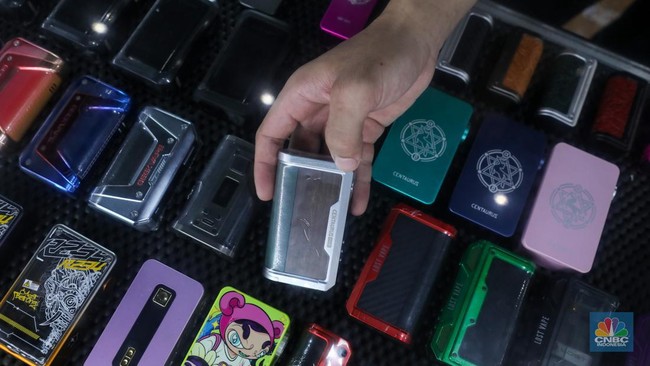
Jakarta – The Directorate General of Customs and Excise (DJBC) at the Ministry of Finance has assured the public that legally distributed electronic cigarettes, or vapes, which meet excise obligations do not contain narcotics or other prohibited substances.
Customs and Excise said vapes containing narcotics had been found circulating through illegal channels and did not carry official excise stamps. As a result, these products are outside the supply chain currently monitored by the government.
Djaka Kusmartata, DJBC’s Director of Excise Technical Affairs and Facilities, said the agency had so far found no narcotics-containing vapes bearing official excise stamps.
“Products monitored by the government definitely carry excise stamps. Based on the investigations and information we have gathered to date, we have not found any vape containing narcotics with an official excise stamp. This means vapes containing narcotics are circulating through a separate illegal channel,” Djaka said at a focus group discussion on issues concerning vapes and electronic cigarettes (REL) held by the Indonesian Ulema Council’s Fatwa Commission in Cikini. He was quoted on the MUI website on Friday (6 November 2026).
Djaka explained that the difference between legal vapes and products misused to consume narcotics lies not only in excise stamps and licensing, but also in the technical characteristics of the devices.
Customs and Excise has inspected the electronic-cigarette ecosystem and manufacturing facilities in several industrial areas, including Tangerang and Padalarang. The inspections were intended to understand production processes and the interaction between e-liquid and heating devices.
Based on its technical assessment, devices used to heat legal nicotine liquid generally use a cotton-core technology with a particular density.
By contrast, devices used to consume liquids containing prohibited substances require a closed system based on a ceramic core, as well as specialised processing in illegal laboratories.
These differences in specifications mean that legal vape devices produced by authorised manufacturers are not compatible with narcotics formulations that use different technology.
Nevertheless, Customs and Excise has urged industry players and electronic-cigarette business associations to strengthen internal oversight to prevent the vape industry from being infiltrated by narcotics distribution.
Businesses are also expected to ensure compliance with Indonesian National Standards (SNI) and ISO standards, as well as anti-narcotics commitments throughout the production and distribution chain.
Tighter vape oversight from 2027
Customs and Excise is preparing several strategies to tighten oversight of the electronic-cigarette ecosystem. One measure is the planned implementation of the Integrated Excise Goods Monitoring System (SPTBKC) from 2027.
The system will be equipped with automatic production-counting machines installed at manufacturers’ premises. This will enable the government to strengthen monitoring of excisable-goods production.
In addition, DJBC may propose tighter rules on imports of vape raw materials through the Prohibitions and Restrictions (Lartas) mechanism.
Under this mechanism, imports of vape materials could be restricted to parties holding an official Excise Goods Entrepreneur Identification Number (NPPBKC).
The measure is intended to prevent illegal raw materials from entering the country and potentially being misused to produce vapes containing prohibited substances.
Customs and Excise said stronger oversight forms part of efforts to balance public protection from dangerous goods, consumption control and the optimisation of state revenue from excisable goods.
Source: jawawa.id (https://jawawa.id/newsitem/customs-to-tighten-vape-production-oversight-from-2027-1793958630)
Originally published by CNBC Indonesia (https://www.cnbcindonesia.com/news/20261106152027-4-783018/mulai-2027-bea-cukai-siapkan-pengawasan-produksi-vape), translated from Indonesian