
Customs Seizes 43 Containers of Illegal Used Clothing in Tanjung Priok
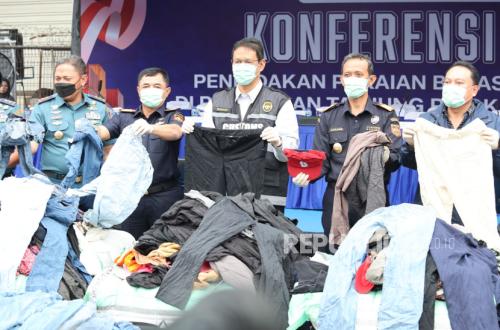
The Directorate General of Customs and Excise (DJBC) has successfully uncovered two cases of suspected illegal used clothing imports (ballpress) in Jakarta and West Kalimantan. Finance Minister Purbaya Yudhi Sadewa stated that these enforcement actions are part of the government’s efforts to maintain compliance with import regulations, protect domestic industry, and create healthy and fair business competition. “The government is committed to taking firm action against illegal import practices that harm compliant businesses, the public, and the state,” Purbaya said during a press conference held on Tuesday (23/06) at the Buffer Area of CDC Banda, Tanjung Priok.
Purbaya explained that the enforcement at Tanjung Priok Port originated from intelligence information regarding the suspected shipment of ballpress via the KM Eden Mas vessel on the Pontianak–Tanjung Priok route. Of the 268 containers transported by the ship, 46 loaded containers were scanned by the Customs and Excise Directorate of P2 and Tanjung Priok Customs. “The scanning results indicated that 43 containers contained ballpress, and they were immediately sealed and subjected to further inspection. As of 22 June 2026, inspection of 19 containers found 2,067 bales containing used clothing, clothing accessories, and bags. The total load in the 43 containers is estimated to reach 4,687 bales with an economic value of approximately Rp 37.5 billion,” he said.
Following the enforcement action in Tanjung Priok, the Directorate of P2 Customs and the West Kalimantan Regional Customs Office conducted further investigations. These operations, carried out from 19-21 June 2026 at two warehouse locations in Kubu Raya and Mempawah Regencies, West Kalimantan, resulted in the prevention and seizure of 2,060 bales of illegal used clothing valued at Rp 16.48 billion. The Finance Minister noted that the successful uncovering of these cases was the result of strong synergy between Customs, the Indonesian Armed Forces Strategic Intelligence Agency (BAIS TNI), the Attorney General’s Office, and the National Police’s Investigative Supervisory Corps.
“The enforcement against 43 containers in Tanjung Priok and the discovery of stockpile locations in West Kalimantan demonstrates the effectiveness of intelligence-based supervision and cross-agency collaboration. This collaboration is key to breaking the chain of illegal used clothing distribution from upstream to downstream,” Purbaya said. He added that legal proceedings will not stop at securing the goods. Customs is continuing to investigate to identify the parties responsible for the importation, storage, and distribution of these illegal goods. The government will trace the owners of the warehouses used as stockpile locations in West Kalimantan and the parties linked to the ownership of the 43 containers in Jakarta. The entire legal process will be conducted professionally, transparently, and without discrimination in accordance with applicable regulations.
The two cases in Tanjung Priok and West Kalimantan are suspected of violating Article 103 letter d in conjunction with Article 102 letter a of Law Number 17 of 2006 on Customs, in conjunction with Article 55 of the Criminal Code. The potential state loss cannot be calculated solely from customs duties and import taxes, as used clothing is a prohibited import commodity under the Minister of Trade Regulation Number 47 of 2025. However, the circulation of illegally imported used clothing can cause significant immaterial losses, including damaging the nation’s image by positioning Indonesia as a market for other countries’ discarded goods. “The circulation of ballpress also risks becoming a medium for the spread of diseases, originating from viruses or bacteria attached to the used clothing. Furthermore, this practice can disrupt the sustainability of the national textile industry and reduce the market share for domestically produced clothing,” Purbaya stated. He affirmed that the government will continue to guard the borders, monitor the flow of goods, and enforce the law to protect national interests, domestic industry, and the Indonesian people.
Director General of Customs and Excise, Lieutenant General TNI (Ret.) Djaka Budhi Utama, added that his team will continue to strengthen supervision over the entry and circulation of illegal goods, including used clothing. “This enforcement shows that Customs supervision is active and measured. We urge all business actors to conduct their activities legally and comply with all customs and trade regulations,” he said.