
Customs Seize 270.7 Million Illegal Cigarettes in Central Java and Yogyakarta
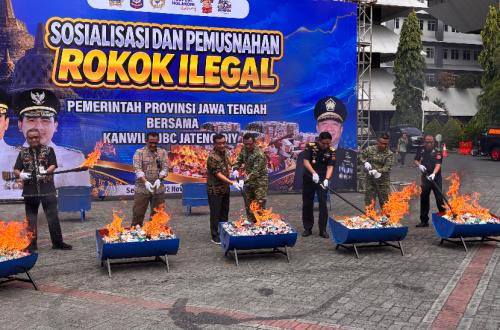
SEMARANG – The circulation of illegal cigarettes in Central Java and the Special Region of Yogyakarta (DIY) remains widespread. Between 2025 and 2026, the Central Java-DIY Regional Office of the Directorate General of Customs and Excise seized more than 270 million illegal cigarettes.
Agus Yulianto, head of the regional office, said it issued 4,278 enforcement notices in 2025. Officers seized 144,880,100 illegal cigarettes and 17,724 litres of beverages containing ethyl alcohol during those operations.
“These operations resulted in the seizure of 144,880,100 illegal cigarettes and 17,724 litres of beverages containing ethyl alcohol,” he said in a speech at a symbolic destruction of 32.78 million illegal cigarettes at the Central Java Provincial Government Office in the middle of the week.
In 2026, the regional customs office issued 3,764 enforcement notices. Officers seized 125,851,799 cigarettes and 19,630 litres of illegal beverages containing ethyl alcohol.
“Thus, over the past two years, enforcement action has been taken against 270,731,899 illegal cigarettes across Central Java and DIY. Of that total, 10,694,312 cigarettes were found during market operations conducted jointly with our colleagues in the Civil Service Police Unit (Satpol PP),” Agus said.
Agus stressed that Customs would not tolerate the production or circulation of illegal cigarettes. He said efforts to eradicate illegal cigarettes were also linked to protecting state revenue from tobacco excise.
“Excise goods are expected to generate substantial state revenue: almost Rp300 trillion nationally, and around Rp60 trillion in Central Java alone from tobacco products excise,” he said.
He said combating illegal cigarettes required cross-sector and multi-stakeholder involvement, including from the public. Agus urged people to learn how to identify illegal cigarettes, which fall into at least four categories.
The first is plain cigarettes with no excise stamp. The second is cigarettes bearing counterfeit stamps, identifiable by differences in colour and holograms compared with genuine stamps. The third is cigarettes using reused stamps. The fourth is cigarettes with incorrect personalisation, meaning the excise stamp does not match the company name or product type.
“We hope cooperation among the provincial government, the Regional Leadership Coordination Forum (Forkopimda), and the Civil Service Police Unit at provincial level and in all 35 regencies and municipalities will continue to be strengthened, both in market operations and in educating traders and the public,” Agus said.
Agus also urged the public not to buy illegal cigarettes and to report their presence to Customs or the Civil Service Police Unit.
“We are doing all this to maintain a healthy and fair economic ecosystem,” he said.