
Customs Reveals Contents of BYD-Wuling Containers Piling Up at Tanjung Priok
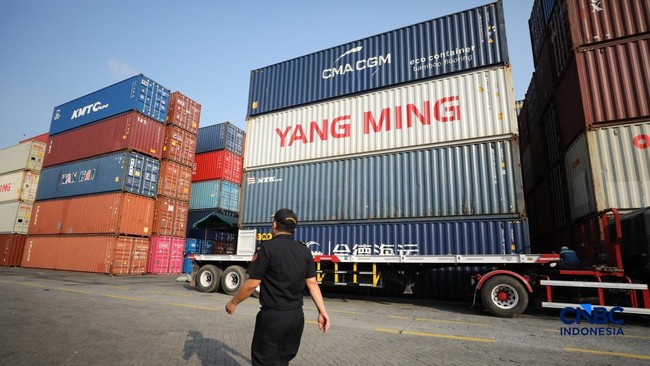
Tanjung Priok Customs has addressed the issue regarding the volume of containers from automotive manufacturers BYD, Wuling, and VinFast at Tanjung Priok Port, which previously caused significant congestion.
Niko Budhi Darma, Head of the Compliance Guidance and Information Services Division at Tanjung Priok Customs, stated that as of Thursday (18/06/2026), the number of accumulated containers—including those from BYD, Wuling, and VinFast—has decreased to approximately 1,500, down from a peak of 10,000 containers.
“As of 18 June 2026, the number of containers that have not been removed within 4 to 30 days after the SPPB (Release Order) is around 1,500. These containers are gradually being removed by their owners,” Niko told CNBC Indonesia.
Niko added that the accumulation resulted from a combination of three stages: pre-customs clearance, customs clearance, and post-customs clearance. The 10,000 containers in question were in the post-customs clearance stage, meaning they had already received SPPB under both red and green lanes.
He further clarified that the contents of the BYD, Wuling, and VinFast containers consist of automotive spare parts in the form of Incomplete Knocked Down (IKD) kits, which are vehicle components intended for domestic assembly.
Customs has implemented several measures to alleviate the congestion, including increasing inspection personnel, expanding inspection locations at the Jakarta International Container Terminal (JICT) and TPK Koja Terminal, extending inspection hours into the night, and adjusting service mechanisms.
“We are conducting comprehensive mitigation across all three processes. Steps taken include coordination with relevant stakeholders, increasing the number of inspectors, adding inspection shifts (day and night), establishing effective inspection mechanisms, and expanding inspection areas,” he explained.
Additionally, Customs has facilitated business-to-business (B2B) meetings between logistics entities, including importers, logistics associations, and trucking associations. Regarding the customs process at TPK Koja and JICT, while containers requiring physical inspection are normally moved to the Integrated Physical Inspection Site (TPFT) Graha Segara, temporary inspection areas have been added at TPK Koja and JICT to accelerate the process for low-risk imports without requiring container movement.
Previously, the Director General of Customs, Djaka Budhi Utama, stated that the congestion was not caused by customs administration processes, but rather by importing companies allowing their goods to remain at the port for extended periods.
“Even after containers are cleared, accumulation persists because players do not immediately remove their goods,” Djaka said during a working meeting with Commission XI of the House of Representatives (DPR) in Jakarta. He noted that companies such as BYD and Wuling had been utilising port facilities by leaving imported goods for more than two weeks after the SPPB was issued.
To resolve this, the Directorate General of Customs and Excise (DJBC) has implemented measures to ensure importers do not allow goods to pile up, thereby preventing disruptions to dwelling time.