
Customs and Excise Warns Health Ministry's Packaging Rules Must Not Create Loopholes for Illegal Cigarettes
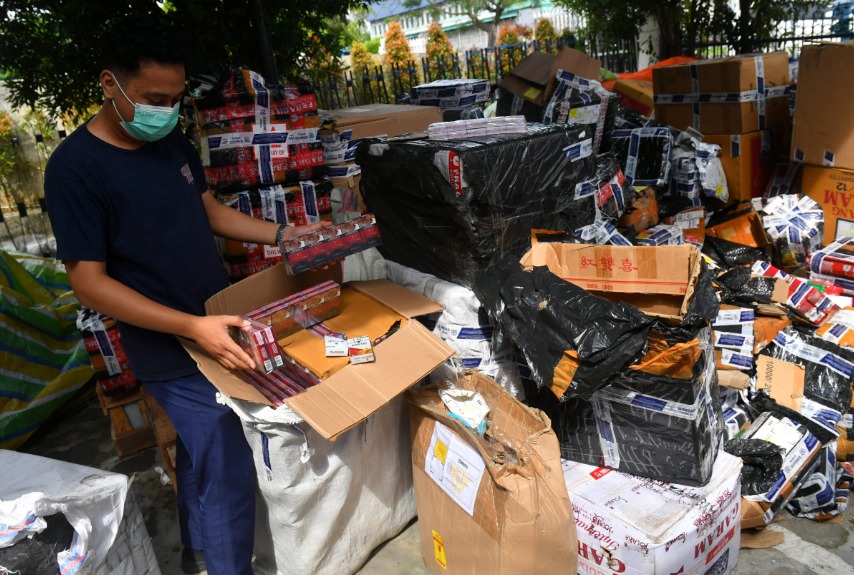
The Directorate General of Customs and Excise at the Ministry of Finance hopes that various non-fiscal policy drafts related to the Tobacco Products Industry being formulated by other ministries and agencies will not create new loopholes for the circulation of illegal cigarettes. One such non-fiscal policy being drawn up is a draft regulation on plain packaging without branding, which is being prepared by the Ministry of Health.
Budi Prasetiyo, Head of the Public Relations and Counselling Sub-Directorate at the Directorate General of Customs and Excise, stated that the technical substance regarding packaging regulations falls under the purview of the leading sector ministry or agency. “In this case, Customs and Excise will continue to coordinate and provide input in accordance with its authority, so that the resulting policies can be implemented effectively and proportionally, and do not create new loopholes for the circulation of illegal cigarettes,” Budi said.
According to Budi, Customs and Excise supports a comprehensive policy formulation process involving various stakeholders. The agency provides input according to its duties and functions, particularly concerning the implementation of excise policy, supervision of tobacco products circulation, safeguarding state revenue, and eradicating illegal cigarettes.
Tobacco product policy must be formulated in a balanced manner by considering four main pillars: controlling consumption to support public health, sustaining the industry and workforce, securing state revenue, and ensuring the effectiveness of supervision against illegal cigarette circulation.
In a recent presentation on the state budget, Minister of Finance Purbaya Yudhi Sadewa stated that up to April 2026, the Directorate General of Customs and Excise had carried out 5,451 enforcement actions against illegal cigarettes, a 23.3 per cent increase year-on-year. These actions resulted in the seizure of 684 million illegal cigarettes, up 125.8 per cent year-on-year, with potential state revenue recovery reaching IDR 53.4 billion. The existence of illegal cigarettes has been an obstacle to optimising state revenue.
The Chairman of the Permanent Committee for Inter-Institutional and Government Relations at the East Java Chamber of Commerce and Industry, Saifuddin Alamsyah, previously asserted that many of the non-fiscal draft regulations currently being prepared are contradictory. Besides the plain packaging plan, another conflicting draft rule being developed is the proposal to limit maximum nicotine content to 1 milligram and tar to 10 mg in cigarette products, put forward by the Coordinating Ministry for Human Development and Cultural Affairs’ study team.
This policy is seen as contradicting the target of optimising state revenue from Tobacco Products Excise by 2027. “It is like one hand building while the other demolishes. The government wants to increase revenue from tobacco excise, but at the same time is preparing regulations that could potentially kill its own production engine,” Saifuddin stressed. In the 2027 Macroeconomic Framework and Fiscal Policy Principles document, the government places tobacco excise as a strategic instrument to support the state budget. Saifuddin argued that increased revenue targets must be accompanied by policies supporting industrial sustainability.
“The logic is simple. If you want to obtain large excise revenue, the industry that is the source of that revenue must keep running. No country increases tax targets while simultaneously narrowing the living space of the tax object,” Saifuddin added. The plan to limit maximum nicotine content to 1 mg is considered a threat to the national tobacco farming sector, as Indonesia’s climate and soil characteristics naturally produce tobacco with high nicotine content. Excessively low nicotine limits are deemed likely to harm tobacco and clove farmers, the raw materials for kretek cigarettes, especially given local consumers’ strong taste preference for domestic tobacco. He expressed hope that the government would adhere to the Indonesian National Standard already set by the National Standardisation Agency.
The tobacco products industry is currently under pressure from several planned policies, ranging from plain packaging and a ban on additives in derivative regulations of Government Regulation 28/2024, to the tar and nicotine limits proposed by the Coordinating Ministry for Human Development and Cultural Affairs’ team. This condition potentially threatens the sustainability of a strategic sector and could lead to significant job losses, particularly in the labour-intensive hand-rolled kretek segment, which would be unable to meet the proposed maximum nicotine and tar limits.