
Curious About Maggots, MIND ID's MINERALive Booth Inspires Circular Economy at INVIROTECH 2026
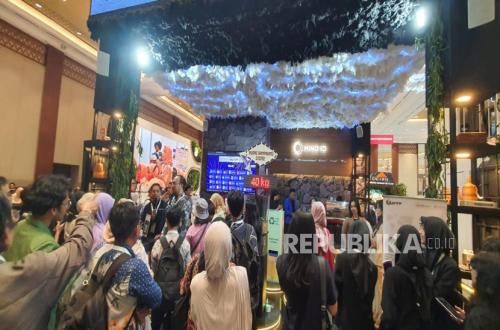
The MIND ID MINERALive booth was thronged by visitors during the INVIROTECH 2026 event at the Jakarta Convention Center on Saturday (13/6/2026). Beneath a cloud-shaped ceiling installation that sheltered the entire booth area, dozens of people gathered. Some captured the moment with their mobile phones, while others queued to take a closer look at each integrated waste management showcase presented by MIND ID.
The MINERALive booth featured maggot-based organic waste that could be viewed and studied directly, demonstrations of plastic waste management, and 3D printer technology that transforms non-organic waste into valuable creative products.
Amidst the crowd, Dwi Agus stood observing carefully. As a practitioner from a main waste bank in the Bekasi area, he came not merely to look around. “It is quite inspirational for me, so that our Waste Bank can achieve something like this,” said Dwi Agus. He admitted that some of what was displayed at the booth had actually begun to be implemented in his community, particularly the processing of organic waste using maggots. For plastic waste, he explained, management at his site is still limited to sorting before handing it over to an offtaker. Seeing how MIND ID integrates the entire process in one chain, he began to envision greater development potential for the Waste Bank he manages. “If there are 10,000 residents who regularly deposit waste, and the proceeds go into a cooperative, then a circular economy can operate. Waste is resolved at its source and becomes income for residents,” Dwi said.
Not far from there, another visitor appeared enthusiastic while watching a screen displaying a visualisation of the recycling process. Bulan, a student from a state university in Malang, admitted she learned many new things that day. “I learned a lot about waste processing at the MIND ID booth. It turns out mining companies also have many programmes that are responsible for environmental sustainability,” she said. For Bulan, the experience at the booth changed her perspective on how protecting the environment can start from the simplest things, even from one’s own home. “Preserving the environment can be done starting from home by sorting waste according to its type. With small steps, we can preserve nature,” she said.
The atmosphere at the booth was indeed designed to invite visitors not only to see, but also to experience the process firsthand. In the first area, organic waste collected from visitors over the three days of the event was processed in real time using maggots, and the results, from the volume of decomposed waste to the organic fertiliser produced, were openly displayed via a digital screen that continuously showed running figures. In another area, a plastic crusher became the centre of attention. Visitors who brought plastic waste could directly deposit it into the machine, a tangible representation of the waste bank programme that has been running in various operational areas of the MIND ID Group. Not far from there, a 3D printer technology worked slowly, transforming recycled material into craft products displayed on surrounding shelves—proof that inorganic waste can be transformed into something with economic value.
What made this booth feel different was the large installation at the top: a cluster of clouds with a gradient from dark to bright white, adorned with blue lights that flickered softly resembling flashes. This installation, themed ‘cloudy and bright clouds’, was not merely decoration. It served as a visual symbol of the decarbonisation journey that MIND ID aimed to showcase. Until late afternoon, the queue of visitors at the booth did not subside. For many who came, what they took home was not just photos or attractive souvenirs like fertiliser and mining-themed merchandise. They also took home a new perspective on how something considered leftover can become the beginning of something valuable and beneficial for the future.