
Crypto Movements Ahead of Fed Decision: Fire in the Red Zone
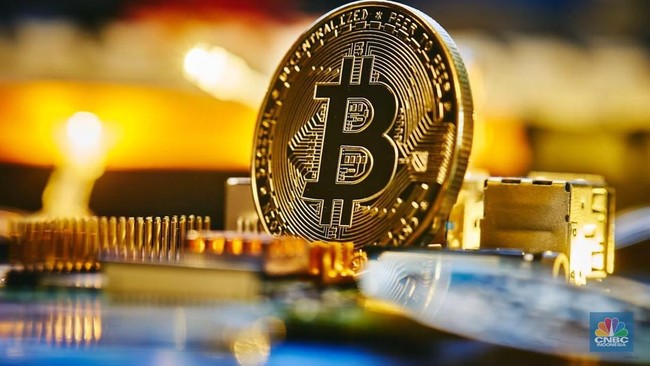
The crypto asset market moved into the red zone during Wednesday’s trading, ahead of the announcement of the United States central bank’s (Federal Reserve) interest rate policy on Thursday morning, Indonesian time.
According to the latest data, Bitcoin weakened by 2.66% over the last 24 hours to a position of US$75,718.75. Over the past week, the largest market-cap crypto asset has corrected by 3.70%.
Ethereum fell even deeper by 4.18% in a single day to US$2,399.53. The greatest pressure was experienced by XRP, which plummeted 8.69%, followed by Solana at 4.57% and Dogecoin at 3.95%.
Has the interest rate hike already been priced in?
Pressure on crypto is occurring as the market almost entirely expects the Fed to raise interest rates by 25 basis points. CME FedWatch shows the probability of such an increase has reached approximately 92.5%, jumping from 59.4% a week earlier.
If realised, the federal funds rate range will rise from 3.50%-3.75% to 3.75%-4.00%. This high probability suggests that a 25 basis point hike has already been largely accounted for or priced in by the market.
This means that a decision to raise interest rates in line with expectations does not necessarily mean Bitcoin will immediately fall again. Some selling pressure may have already occurred before the announcement as investors reduced exposure to risky assets.
The market may even experience a ‘sell the rumour, buy the fact’ pattern. Bitcoin may be sold off before the decision due to fears of a rate hike, but bought back if the announced policy turns out not to be worse than expected.
Therefore, investor focus will shift to the interest rate projections in the dot plot and the statement from Fed Chair Kevin Warcham.
If the Fed does not open the door to further aggressive tightening, Bitcoin could experience a relief rally. Conversely, signals of high interest rates for a longer period could once again pressure the market.
US Treasury Yields Highest Since 2007
Crypto sentiment is under further pressure after the 10-year US Treasury yield briefly reached approximately 5.04%, the highest since 2007, or in the last 19 years.
A 5% yield increases the opportunity cost of holding Bitcoin, which does not generate cash flow.
Investors can obtain a nominal yield of around 5% from US government bonds if held to maturity, although bond prices can still fluctuate during trading.
High yields also tighten financial conditions, support the US dollar, and make investors more selective regarding risky assets.
The impact is usually greater on altcoins due to their smaller market capitalisation and liquidity, as well as their higher volatility compared to Bitcoin. This is evident from the deeper declines in XRP, Solana, Hyperliquid, and Dogecoin.
However, the crypto weakness is not triggered by monetary factors alone. The US Senate also failed to proceed with discussions on the CLARITY Act, a regulation expected to provide certainty for the digital asset industry. This regulatory disappointment helps explain why XRP fell much deeper than Bitcoin.
Where is Bitcoin Heading?
Bitcoin is currently testing an important support zone in the US$75,000-US$76,000 range. In the very short term, its movement remains defensive as long as it is unable to break back through US$78,000-US$80,000.
In the primary scenario, the Fed raises rates by 25 basis points; however, if the Fed adopts a somewhat hawkish tone and indicates several additional hikes, Bitcoin risks breaking below the US$70,000 level. If a decline triggers large liquidations in the derivatives market, the US$65,000-US$67,000 area could become the next support.
This opens a greater possibility for investors who have not yet accumulated Bitcoin at the US$50,000-US$60,000 level, which is slightly above the market consensus for the Bitcoin price bottom in this cycle.
Thus, the interest rate hike is no longer the sole determinant. Bitcoin’s next direction will depend more on the tone of the Fed’s statement, projections for future hikes, and whether Treasury yields remain around 5%.
Since Bitcoin has been one of the worst-performing assets on an annual basis, it could serve as an alternative investment that has historically been capable of providing big returns in this cycle, provided that geopolitical tensions do not become prolonged and absorb market liquidity.