
Crypto Market Plunges Sharply: What Should Investors Do?
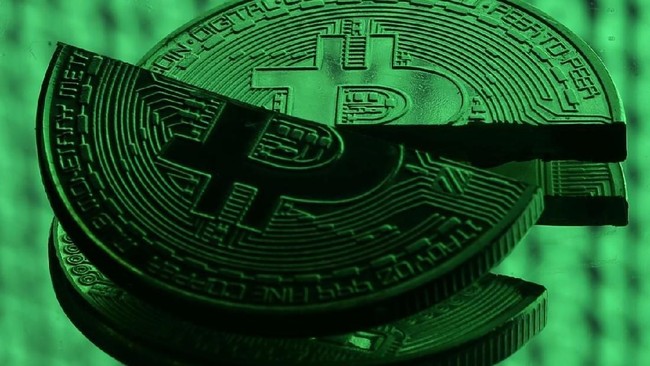
Jakarta, CNBC Indonesia — The crypto market came under heavy pressure again on Sunday (15 November 2026). The decline was fuelled by a combination of concerns about US interest rates, institutional fund withdrawals and the liquidation of leveraged positions.
Bitcoin fell 5.67% in 24 hours to US$64,384.39. Over the week, the crypto asset with the largest market capitalisation had declined by 14.95%.
Ethereum shed 8.26% to US$1,771.51, taking its weekly decline to 20.74%. Zcash recorded the steepest weekly loss among the group, at 30.95%, while Solana and Monero each fell by more than 21%.
Persistent inflation brings high interest rates back into focus
Macro-economic pressure stems from US inflation, which has yet to provide a clear opening for monetary easing. Consumer prices rose 0.4% month on month in October, while core inflation increased by 0.3%. Producer prices were also up 6.5% year on year.
These conditions have sustained expectations of a Federal Reserve rate rise in December. The yield on 10-year US Treasuries returned to about 5.15% on Friday, while a stronger dollar added to pressure on risk assets.
For Bitcoin, high interest rates raise the opportunity cost of holding an asset that generates no cash flow. Investors become more selective when interest-bearing instruments offer attractive returns, while financing speculative positions remains expensive.
This means the market has yet to receive support from looser liquidity conditions. A price recovery is more difficult while investors continue to anticipate a high cost of capital.
Institutional funds flow out as corporate Bitcoin sentiment weakens
The pressure is not just coming from expectations. US spot Bitcoin ETFs recorded net outflows of about US$1.07 billion from 9 to 13 November.
Withdrawals continued for seven consecutive trading sessions from 5 November, amounting to around US$1.91 billion in total. This indicates that demand through institutional investment channels has been weakening persistently.
When large buyers reduce their exposure, the market’s capacity to absorb selling also diminishes. Prices then come under pressure more easily, particularly when other investors choose to exit after key psychological levels are breached.
Sentiment has also been weighed down by Strategy’s inclusion on a list of companies to be removed from the MSCI USA Index, effective after the close on 30 November. The change creates a risk that index-tracking funds will sell the company’s shares.
However, the removal of its shares does not automatically force Strategy to sell Bitcoin. The direct impact is on demand for its shares, while any effect on future Bitcoin purchases will depend on the company’s ability to obtain financing.
Liquidations accelerate the fall
The initial decline was amplified by the forced closure of derivatives positions. One record for 14 November showed about US$1.23 billion in liquidations over 24 hours, around US$1.02 billion of which came from long positions.
The process is cyclical: prices fall, positions no longer have sufficient collateral, and they are forcibly closed. The resulting additional sales put further pressure on prices and can trigger more liquidations.
As a result, crypto declines can be far deeper than the underlying changes in the news would suggest. Investors who anticipate a recovery too soon can themselves become a source of forced selling.
The latest weakness cannot be explained simply as a spillover from Wall Street. The S&P 500 rose 2.5% over the week, despite falling 0.4% on Friday. The Nasdaq also posted a weekly gain.
This divergence suggests that pressures within the crypto market are playing a major role. The impact of the Binance hack remains a source of concern, but ETF outflows and liquidations offer a more direct explanation for the latest wave of selling.
Outlook: Begin accumulating gradually and avoid leverage
Bitcoin’s fall to around US$64,000 indicates that the previous bullish pattern has been broken. The US$70,000–US$78,000 range, which had initially been seen as a correction target, has also been breached, meaning assumptions of a swift recovery need to be reconsidered.
Even so, the correction could present an opportunity for long-term investors to begin accumulating Bitcoin. This would be a process of building a position, not confirmation that the price has reached its bottom.
One approach is dollar-cost averaging (DCA): investing a fixed amount on a consistent schedule, such as weekly or monthly. Dividing the funds into several instalments avoids concentrating purchases at a single price.
Accumulation should focus on spot Bitcoin, using funds that will not be needed in the near future. Leverage is best avoided because high volatility can trigger liquidation before a recovery materialises.
Further gains remain possible if liquidation pressure eases, ETF outflows stop and monetary policy expectations improve. However, those developments would need to be confirmed.
The current sharp decline could be a moment to start buying in a measured way. DCA helps reduce dependence on getting the timing exactly right, while disciplined allocation remains essential because further losses are still possible.
Source: jawawa.id (https://jawawa.id/newsitem/crypto-market-plunges-sharply-what-should-investors-do-1794725449)
Originally published by CNBC Indonesia (https://www.cnbcindonesia.com/research/20261115072607-128-785310/pasar-kripto-anjlok-parah-investor-harus-bagaimana), translated from Indonesian