
Crypto Market Capitalisation Jumps 45%, OJK Strengthens Oversight
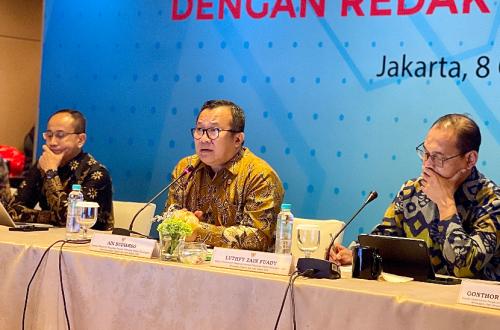
JAKARTA — Crypto asset trading in Indonesia totalled Rp194.28 trillion from January to August 2026, as the number of consumer accounts rose to 23.21 million. The industry’s growth has prompted the Financial Services Authority (OJK) to plan changes to crypto trading mechanisms, strengthen investor identity records and increase oversight of transaction risks and cyber security.
Adi Budiarso, OJK’s Chief Executive for the Supervision of Financial Sector Technology Innovation, Digital Financial Assets and Crypto Assets, said the crypto asset industry continued to expand in both trading activity and consumer numbers. However, this growth also required adjustments to infrastructure and supervisory systems.
Speaking at a media discussion in Jakarta on Thursday (8 October 2026), Adi said spot crypto transactions reached Rp23.16 trillion in August 2026. “Cumulatively, transactions in the first eight months of this year reached Rp194.28 trillion,” he said.
Digital financial asset derivatives trading recorded transactions worth Rp37.09 trillion from the start of the year to August 2026. In August alone, derivatives transactions totalled Rp4.56 trillion.
Indonesia’s crypto market capitalisation also climbed from Rp22.21 trillion in July to Rp32.23 trillion in August 2026, an increase of about 45 per cent in a month.
The number of consumer accounts rose from 22.93 million in July to 23.21 million in August 2026, an increase of around 280,000 accounts in one month.
Indonesia’s crypto trading ecosystem currently comprises two exchanges, two clearing institutions, two custodians, 28 digital financial asset traders (PAKDs) and seven payment service providers. Assets across the digital financial asset and crypto ecosystem totalled Rp54.62 trillion.
Including Rp770.63 billion in assets held by financial sector technology innovation (ITSK) providers, total assets in the IAKD industry reached Rp55.39 trillion. The figure reflects the scale of assets managed within the digital finance ecosystem supervised by the OJK.
Greater role for the exchange
In response to this growth, the OJK is preparing to shift crypto trading towards a centralised trading venue system. Under this model, the exchange would play a larger role in matching buy and sell orders for crypto assets.
Adi said Indonesia’s crypto trading structure differed from that in a number of other countries. Alongside traders or exchanges, Indonesia has a dedicated exchange, clearing institution and custodian, each with distinct functions.
“In the regulatory framework we have built, crypto trading globally is referred to as exchanges. But in Indonesia, in addition to exchanges or PAKDs, we also have an exchange,” Adi said.
He said having a dedicated exchange enabled trading records and oversight to be handled through infrastructure separate from the traders. The clearing institution processes settlements, while the custodian is responsible for storing consumer assets.
“Because we have an exchange, there will be off-chain transactions recorded on the exchange. Outside Indonesia, everything is on-chain at the exchange,” he said.
The OJK also regulates the separation of crypto asset storage between traders and custodians. Under the arrangement outlined by Adi, about 70 per cent of consumers’ crypto assets must be placed with a custodian, while traders may manage the remaining 30 per cent in accordance with the rules.
The arrangement is intended to reduce risks in the event of operational disruption or the failure of a crypto asset trader. Separating storage means consumer assets are not entirely reliant on a single provider.
Adi said the planned changes would give the exchange a greater role in matching transactions. Implementation would require preparation, however, as it would affect traders’ business models and the readiness of trading infrastructure.
“In the future, we will have centralised trading on the exchange. That means all transactions will be, so to speak, like what we currently have in the capital market,” Adi said.
The changes could alter the role of crypto asset traders. Their role in matching transactions may diminish, but they could still provide other services within the scope of their licences and applicable regulations.
Adi cited brokerage as one possible function that traders could develop. The changes are still being discussed with industry participants before implementation.
The OJK is conducting studies, discussions and consultations with exchanges, traders and industry associations. Preparations also include strengthening the exchange’s capacity and trading systems to ensure the changes do not disrupt the industry’s continued operations.
Single investor identification
Alongside the changes to trading, the OJK is developing a single investor identification (SID) system for consumers. The system will integrate data on crypto asset ownership, transactions, balances and consumer exposure.
Adi said an SID was needed because the consumer figures currently reported by the industry are based on accounts. One person may hold accounts with more than one trader, so the number of accounts does not necessarily correspond to the number of individual investors. “So far, what we have reported is consumer accounts, not SIDs. We need to introduce this gradually,” he said.
A single identifier would give the OJK a more accurate picture of investor numbers and activity across different providers. It could also support transaction monitoring and risk management.
Similar identification systems are already used in other parts of the financial sector, including the capital market. The OJK wants to adopt a comparable approach for crypto trading without having to build the entire record-keeping mechanism from scratch.
Adi said data integration would make it easier to monitor consumer holdings and transactions. More comprehensive information could also support the implementation of anti-money laundering and counter-terrorism financing requirements.
The single identification system is being developed in stages. The OJK still needs to align infrastructure readiness, industry participants and the rules governing the exchange and management of consumer data.
Source: jawawa.id (https://jawawa.id/newsitem/crypto-market-capitalisation-jumps-45-ojk-strengthens-oversight-1791517927)
Originally published by Republika (https://ekonomi.republika.co.id/berita/tmmepy416/kapitalisasi-kripto-melonjak-45-persen-ojk-perkuat-pengawasan), translated from Indonesian