
Crypto Increasingly Connected with Banks, Regulation Becomes Foundation
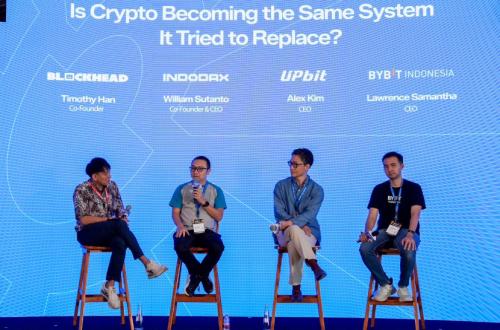
The crypto industry is entering a new phase as more traditional financial institutions become connected with digital assets and blockchain technology. This development opens opportunities for market expansion, but also demands a balance between room for innovation, consumer protection, and regulatory certainty.
One development considered to bring the two ecosystems together is tokenisation. Traditional financial assets are increasingly able to be represented on-chain, opening opportunities for digital asset investors and financial institutions to interact within the same ecosystem.
Indodax CEO William Sutanto said the development is making the boundary between traditional finance and crypto increasingly thin. However, integrating the two requires trust, regulation, and infrastructure capable of supporting activity in both ecosystems.
William made the remarks at Coinfest Asia 2026 in Bali on Friday (21/8/2026). “When traditional assets start entering the blockchain, the boundary between traditional finance and crypto becomes increasingly thin. This opens great opportunities, but also requires trust, regulation, and infrastructure capable of connecting the two ecosystems,” William said.
Changes are also visible in the investor profile. Crypto, which was previously often associated with speculation and short-term movements, is beginning to attract attention from investors with more diverse understanding, including institutions that view digital assets as one investment option.
Amid increasing institutional involvement, regulation is still considered an important factor in maintaining consumer protection and market confidence. On the other hand, crypto technology is developing relatively quickly, so the regulatory framework needs to continue providing room for innovation.
“Crypto and blockchain are essentially a large playground for innovation in the financial sector. This space is one of the reasons the industry has been able to develop so quickly. Therefore, it is important to maintain a balance so that regulation still provides protection while also giving room for the development of new products and services in a directed manner,” he explained.
This balance also relates to the competitiveness of domestic industry players. Domestic platforms need to have room to develop relevant products, especially when facing offshore platforms that have greater flexibility in delivering innovation.
Besides regulation, liquidity is an important factor in developing the digital asset market. One of the industry’s challenges is facilitating the movement between fiat currency and crypto assets, while building infrastructure that can be used by the public more broadly.
Stablecoins are considered to have the potential to play a role as a bridge between the conventional financial system and the on-chain economy. These instruments can become a more familiar path for users to interact with the digital asset ecosystem.
“The most important thing going forward is how we build better liquidity, user experience (UX), and infrastructure. With technology continuing to develop, the challenge now is to make the crypto ecosystem increasingly accessible and relevant for more people,” he added.
William also assessed that education remains necessary as the use of digital assets expands. According to him, the public needs to understand not only investment potential, but also how blockchain technology works and the responsibility of managing digital assets.
In its product development, Indodax has introduced the DAX Rewards gamification feature and the Trade API v2 update. DAX Rewards is intended to add user interaction features, while Trade API v2 was developed to support the needs of developers and users who utilise automated trading systems.
“For us, innovation must be directly felt by users and developers. Through DAX Rewards and the Trade API v2 update, we want to continue delivering relevant products while supporting the development of the Indonesian crypto ecosystem,” William concluded.
The development of tokenisation, the entry of institutional investors, and the use of stablecoins show the increasingly close relationship between digital assets and the broader financial system.
The next challenge is to ensure this development proceeds with infrastructure, liquidity, education, and regulation capable of keeping pace with change without hindering innovation.